 Guide On Map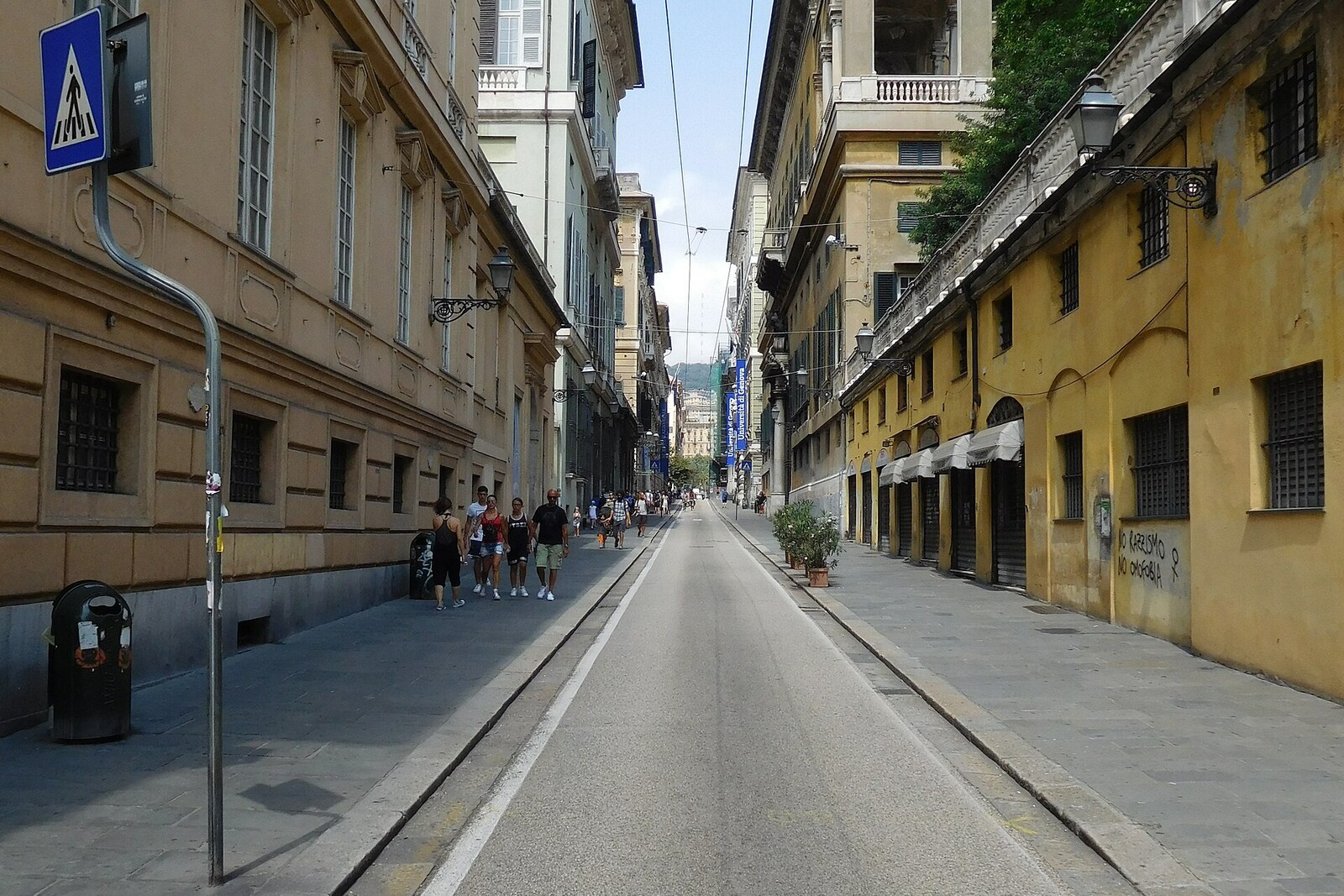
Look around first
What to notice
- The facade of house number four
- The shared gateway
- The inner courtyard
- Two principal floors
The story of the place
At house number four on Via Balbi, there are two names. Balbi is the family of merchants and bankers that paid for this street. Senarega is the maiden name of the woman for whom the palace itself was built.
At the beginning of the seventeenth century, Stefano Balbi proposed building a straight road from the old center to Genoa's western exit. The family took on the costs and gained the opportunity to build five residences along the new route. The street was then called Strada dei Signori Balbi—the Street of the Balbi Lords. Their money came from trade in silk, velvet, wool, and mercury, as well as loans to European rulers. Here, profit was turned into stone and a family name on the city map.
In sixteen eighteen, the brothers Giacomo and Pantaleo Balbi commissioned the architect Bartolomeo Bianco to build a palace. Each brother needed a separate home, but the plot was narrow. Bianco arranged two equal principal floors, one above the other: the two families shared the gateway, courtyard, and staircase, but not their living quarters. Giacomo settled here with his wife, Battina Senarega. Her surname remained in the building's second name.
In sixteen forty-four, their son Francesco Maria Balbi inherited his father's share and received part of his uncle Pantaleo's. The two family floors came under one owner. Francesco Maria was a financier and collector; paintings served him at once as decoration, a family archive, and valuable property. He expanded the palace, created a gallery, and commissioned Valerio Castello to paint its vaults.
Among the works that passed to Francesco Maria was a huge equestrian portrait of his cousin Gio Paolo Balbi by Anthony van Dyck. The artist portrayed the Genoese patrician as rulers and commanders had previously been portrayed: the rider holds back a rearing horse and turns toward the viewer. For a family of bankers, such a portrait declared the status it had attained.
In sixteen forty-eight, with France's support, Gio Paolo attempted to overthrow the government of the Republic of Genoa and change its allies. The conspiracy was uncovered before the uprising. Gio Paolo was sentenced in absentia and banished; his name was placed on the board of infamy in the Doge's Palace. He wandered through European cities and died in Venice. The portrait of a man declared an enemy of the Republic became a dangerous part of the family inheritance.
Francesco Maria did not want to lose van Dyck's canvas. He commissioned the artist Simon du Bois to paint his own face over that of his condemned relative. The horse, the rider's figure, and the painting by the famous Flemish artist remained unchanged. Visitors to the palace saw Francesco Maria Balbi where van Dyck had portrayed Gio Paolo. The owner preserved a valuable painting and removed a disgraced member of the family from his own gallery.
The Balbis owned the palace for more than three centuries. In nineteen seventy-four, the portrait was sold, and during its restoration the later-painted face was removed. Gio Paolo reappeared beneath it. The canvas is now in the collection of the Magnani-Rocca Foundation near Parma.
The palace itself belongs to the University of Genoa: behind its old facade is the School of Humanities. The brothers' two principal floors, the courtyard, and the frescoes commissioned by Francesco Maria have been preserved here. The equestrian portrait has disappeared from here. In Genoa, the family name remains, while on the painting near Parma is the face of the relative whom the owner of this house ordered concealed.
Useful on site
The street is accessible at all times; the palace is used by the University of Genoa and is not a regular museum.
Checked: date not specified. Check the official source before visiting.These are working university buildings. View accessible courtyards quietly, do not enter classrooms, and be prepared to limit your visit to the facades.