 Guide On Map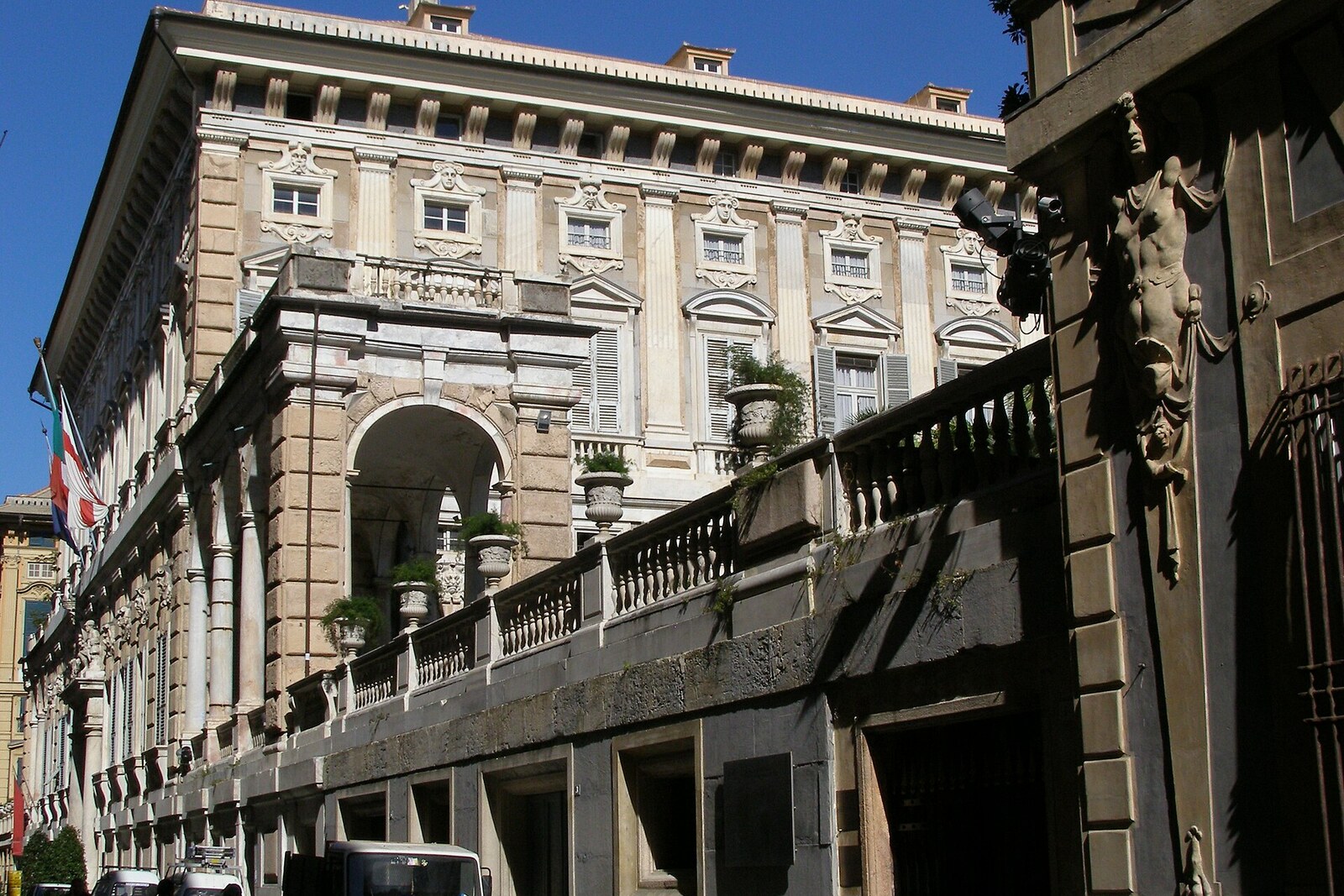
Look around first
What to notice
- The pink stone of the facade
- Gray-black slate
- White marble
- The shield with the cross of Genoa
The story of the place
Along Via Garibaldi stretches the street's longest palace; its facade is made of pink stone, dark slate, and white marble. Later, two open loggias were added to the sides of the main block, stretching the house even farther along the street. In the Rolli, it was assigned the highest category, intended for receiving the Republic of Genoa's most important guests. Now, beneath the portal with its shield and Genoese cross, city services work, the council meets, and a municipal museum is open.
Niccolò Grimaldi commissioned this palace in fifteen sixty-five, when one of his principal debtors was the Spanish king, Philip II of Spain. Grimaldi was a Genoese banker: he advanced cash for the pay of Spanish armies and fleets while silver from the king's possessions was still in transit. He earned from interest and from transferring money between European cities. He risked his own capital: if the royal treasury delayed payment, there was nothing with which to replenish the sums he had advanced.
For a time, this risk brought him lands and titles. Grimaldi bought possessions in southern Italy, became Prince of Salerno, and contemporaries nicknamed him the Monarch because of his wealth. On what was then Strada Nuova—today's Via Garibaldi—he acquired a plot that made it possible to build the street's longest palace. Pink stone from Finale, gray-black slate, and white Carrara marble on the facade showed where part of the banking profit had gone. In the Rolli, the residence was immediately assigned the highest category: it was meant to receive the Republic of Genoa's most distinguished guests.
In fifteen seventy-five, Philip II of Spain declared the treasury bankrupt. Of the thirty-seven million ducats of debt, ten million were owed to Genoese financiers, and the Crown owed half that sum to Grimaldi alone. The banker tried to negotiate directly with the king, but could not recover the money at once. Two years later, the Spanish side recognized only part of the claims. In return, the Genoese undertook to provide the king with five million ducats again, and Grimaldi and his partners were to find more than half of this new sum.
He did not go bankrupt completely, but he could no longer sustain his former expenses. Grimaldi began selling southern Italian towns and lands, then gave up Salerno and his princely title. At the end of fifteen ninety-three, it was the Genoese palace's turn: the Monarch sold his principal residence for fifty thousand scudi. He probably died as early as the following year.
A few years later, the palace was acquired by Giovanni Andrea Doria, Prince of Melfi and an admiral in Spanish service. He intended the residence for his younger son, Carlo Doria, and ordered two open side loggias to be added; they still stretch the facade along the street. Carlo held the title Duke of Tursi, named after a town in southern Italy. The palace acquired the second part of its present name from him: Doria is the surname of the new owners, and Tursi is the son's ducal title.
Since the middle of the nineteenth century, this has been the principal seat of the City of Genoa. City services work in the offices, council members meet in the council chamber, and part of the piano nobile is occupied by a municipal museum. A shield with the cross of Genoa now stands above the marble portal. The former Doria eagle is no longer there; the family's surname remains in the palace's name.
Useful on site
April 20–September 30, 2026: Tuesday–Sunday 10:00–19:00; closed Monday. Last entry one hour before closing.
Checked: date not specified. Check the official source before visiting.First take in the building as a whole from outside, as far as the narrow street allows. The municipal and museum spaces inside follow their own access rules.