 Guide On Map
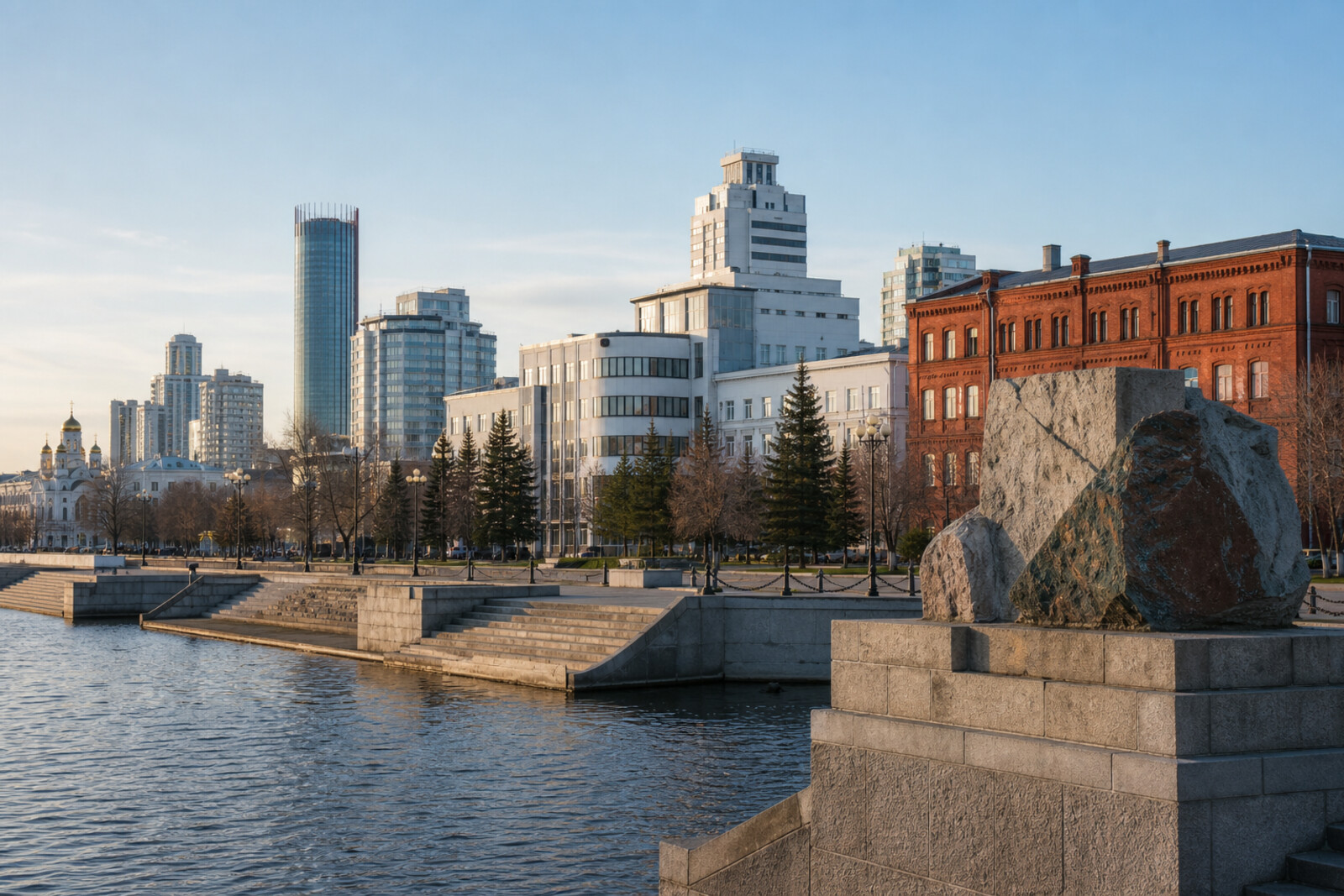
Yekaterinburg: from industrial Plotinka to Yeltsin Center
Via Lenin Avenue, Iset, and the shores of City Pond
Guide On Map on your phone
Open the walk like a regular app
It takes about 10 seconds to install. No app store needed.
The whole path
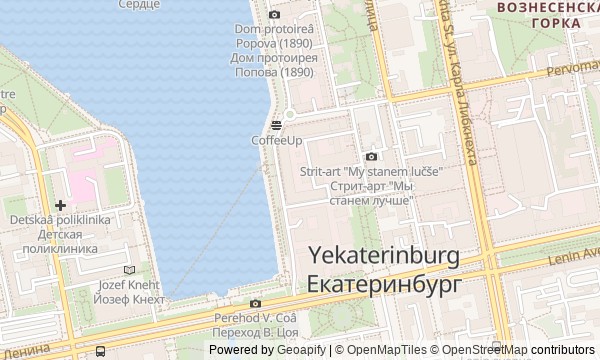
Route map
About the walk
You will begin at Plotinka, where water turned a factory into a city. Then you will step onto Lenin Avenue: an ornate mansion stands beside the House of Communications, the House of Printing, and a district where architects tried to reorganize everyday life. From the Iset residential complex, you will turn toward Ascension Hill, then circle City Pond by way of the Dynamo Sports Complex and on to Yeltsin Center.
Along the way, you will come across a letter that never reached its addressee, a slab in an entryway, and an empty chair in a relocated office. Why they ended up here becomes clear through the actions of builders, postal workers, residents, a coach, and museum staff—quietly, without grand conclusions.
By the end, you will be able to explain why central Yekaterinburg is put together from a dam, former workshops, a residential complex, and a round museum floor—and what work each of them once did.
Why this order
Plotinka sets out the city’s original mechanism, while the neighboring Museum of Architecture and Design immediately shows what remains of the factory buildings and who chose to preserve them. From the former workshops, the route moves to Sevastyanov House: after the state factory comes the private city, whose building a court adapted for government service. Farther on, one avenue links the House of Communications and the House of Printing—a letter and a newspaper issue revealing two sides of mass communication in wartime Sverdlovsk. Continuing east to the Iset residential complex shifts the conversation from institutions to the life arranged around them. The route then turns toward Ascension Hill, where one site was successively home to a parish, a dwelling, and a church. Circling the pond brings you to the Dynamo Sports Complex: after apartments and kitchens, you will see a stadium, swimming pool, and shooting range—the same idea of collective routine transferred to sport. The final stretch follows the water to Yeltsin Center, where a finished round floor had to become a sequential museum route.
Those who want to understand Yekaterinburg through what its buildings were for, rather than a catalog of styles Fans of constructivism, industrial history, and human details Those ready to walk the whole center instead of collecting a few photo stops
Those looking for a short walk around Plotinka alone Those expecting a light story without wartime and political subjects Those with little interest in how buildings work and how city life is arranged
Before you go
Most of the story is designed for viewing from the street, so dress for the weather and leave time to stand with the facades rather than simply tick points off on a map. Plan a visit to the Museum of Architecture and Design and the Yeltsin Center exhibition as separate parts of the day: check current opening hours and entry conditions beforehand. At Church on the Blood, keep quiet and remember that it is an active church, not only a historical stop. The district around the Iset hotel remains a residential environment, so look at the buildings without disturbing residents.
When to go
Allow several hours for the outdoor walk without museum exhibitions. If you want to enter both museums, do not try to squeeze them into a quick pass: the Museum of Architecture and Design is easier to visit at the start of the route, while Yeltsin Center can be left as an independent continuation after the final stop.
Backup plan
If a museum or a particular interior is unavailable, the route still works from outside. At the former Yekaterinburg Mechanical Factory, read the brick industrial volumes; at the House of Communications, the organization of the facade and its setback from the street; at the House of Printing, the horizontal windows and rounded corner. At Church on the Blood, focus on the contrast between today’s monument and the vanished private house. The finish at Yeltsin Center also works without the exhibition: its outer volume and public spaces already show how the museum seeks to take part in city life. Do not try to make up for closed access by entering staff-only, residential, or fenced-off areas.
Route conditions
Surface. Paved — 5.9 km; unpaved — 127 m (data covers 92% of the route)
Stairs. Flights: 1, 15 m in total
Access. Wheelchair — no; stroller — limited (stairs)
Facilities. Toilets — 3; drinking water — 1
Elevation. Ascent — 57 m; descent — 48 m
OpenStreetMap extract of July 7, 2026: database data, not a check on the ground. Data © OpenStreetMap contributors, ODbL licence
Walk plan
Open in maps ↗- 1
Historical Square and Plotinka
Here you will see why the city center began not with a square, but with water for factory machinery. - 2
Museum of Architecture and Design
This stop explains who preserved the remains of the factory and why real machines were placed among them. - 3
Sevastyanov House
Using one mansion as an example, you will find out which proved more enduring: the owner's wish or forty years of judicial service. - 4
House of Communications
Military mail will become the personal story of one triangle that never reached its addressee. - 5
House of Printing
Here, a newspaper issue will become the beginning of a campaign that spread far beyond the editorial office. - 6
Iset Residential Complex and Hotel
The complex is needed to see what happened to daily life when architects tried to move the kitchen out of the apartment. - 7
Church on the Blood and the site of Ipatiev House
One site links two churches, a residential mansion, and the present-day church. - 8
Dynamo Sports Complex
Postwar sport will be visible not in a list of records, but in a coach's everyday rules and the quality of the ice. - 9
Yeltsin Center
The finale will explain how an unfinished circular floor was turned into a museum route through seven decisions.
Route features
Everything you need stays in the browser
Progress, saves and your trip plan are stored on this device.
Add Guide On Map to your home screen so the walk opens outside the browser.
How we handle sources, maps and corrections: our editorial standards