 Guide On Map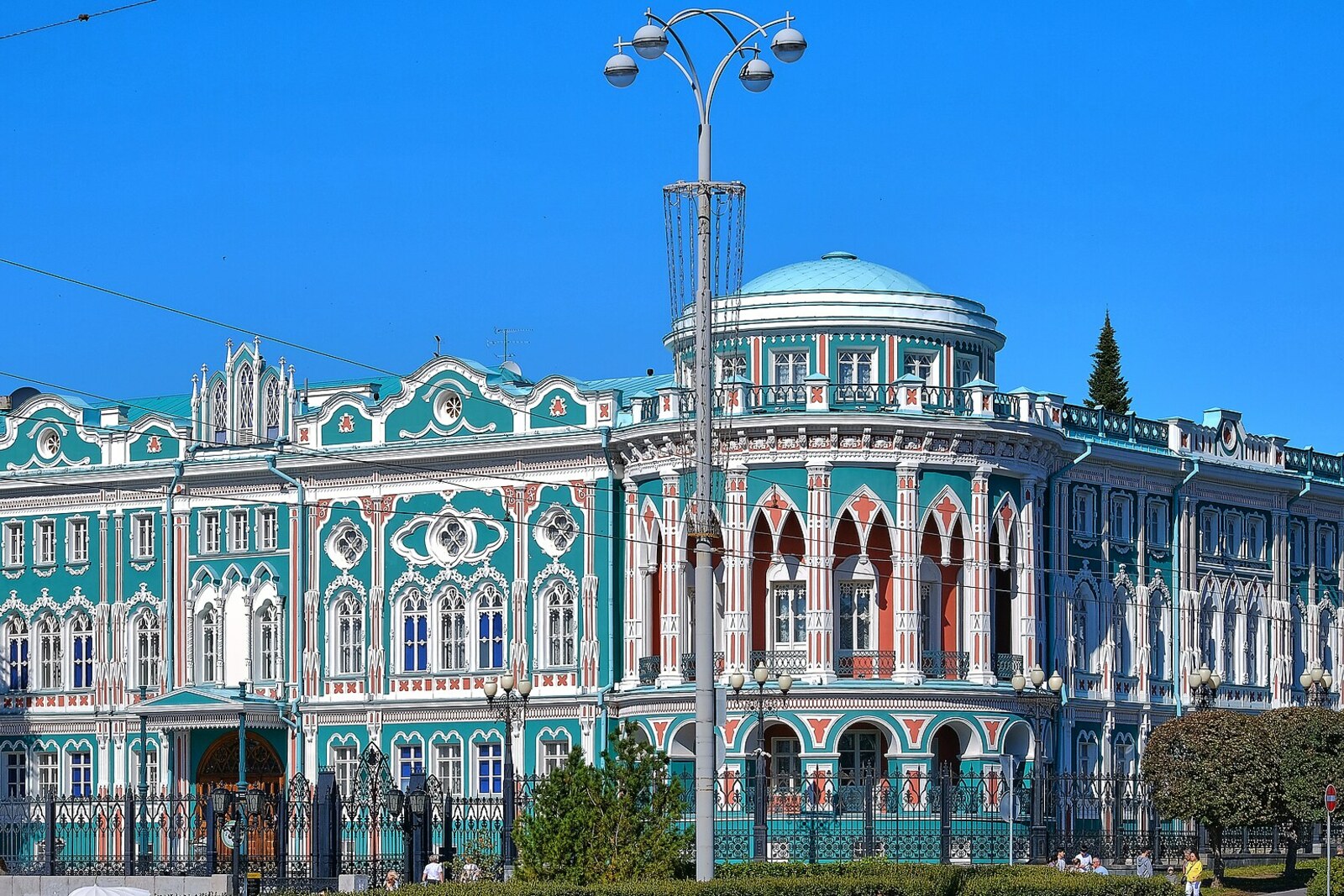
Look around first
What to notice
- Round corner tower
- Pointed windows
- Stucco ornaments
- Heraldic shields
The story of the place
Pointed windows, turrets, stucco scrolls, and heraldic shields are gathered on the façade so densely that the building immediately stands apart from its neighbors. The ceremonial rooms were occupied by the district court for more than forty years: criminal and civil cases arrived here from five districts, and for hearings the halls were divided by partitions and linked by corridors. Official receptions are now held here, so there is no free museum admission inside.
Nikolai Sevastyanov did not build this house from scratch. In eighteen sixty, he bought an already completed three-story mansion with a round corner tower. The surname became attached to the building later, after the new owner ordered the façades altered so extensively that the former house became difficult to recognize.
Sevastyanov began as a teenage junior clerk at the Ural Mining Administration. Later he was entrusted with state caravans carrying metal: he was responsible for delivering and selling the products of factories in the Urals. By the time he bought the house, he had left the service and was investing his own money in steamships, gold mines, a manufactory, and a distillery. His wealth now depended on those businesses rather than on a guaranteed civil-service salary.
In eighteen sixty-six, Sevastyanov commissioned the architect Alexander Paduchev to turn the calm classical façade into its present profusion of pointed windows, turrets, stucco ornaments, and heraldic shields. Paduchev prepared an even more lavish design—with a balcony, a belvedere, and additional decorations—but it was carried out only in part.
The townspeople created a legend that the owner wanted to gild the dome of the rotunda and asked the emperor for permission. For such audacity, he was supposedly made to attend church in cast-iron galoshes. There is no documentary evidence of either the petition or the punishment. The story arose around a real act by Sevastyanov: one man commissioned an exterior for a house that, in the Yekaterinburg of that day, could not be mistaken for a neighboring one.
In June eighteen seventy-four, Sevastyanov sold the mansion to the treasury for forty thousand rubles and left for Saint Petersburg. He lived there for another nine years and never returned to Yekaterinburg. A few months after the sale, a district court opened in his former house. Judicial reform reached the city with a ten-year delay: previously, different estates had different institutions, and serious cases were sent to Perm for final judgment.
The first chairman of the new court, Andrei Butakov, occupied two halls on the second floor and remained in his position for twenty years. Criminal and civil cases arrived here from five districts, home to about one and a half million people. Hearings were made open, investigators, prosecutors, and lawyers worked nearby, and the local newspaper printed court reports. For this purpose, the ceremonial rooms were divided by partitions, new doorways were cut, and corridors were created. The inscription “District Court” appeared on the rotunda, and figures of lions were removed from the side facing Main Avenue.
Sevastyanov owned the house for fourteen years; the district court occupied it for more than forty. Official receptions are now held inside, and there is no free museum admission. The court inscription has disappeared from the rotunda, the lions have not returned to the pediment, but the pointed surrounds commissioned by Sevastyanov remain, along with his surname.
Useful on site
Available for exterior viewing from the public sidewalk; there is no regular tourist admission.
Checked: June 24, 2026. Check the official source before visiting.The main features are visible from outside. Step back far enough to take in the corner composition as a whole, then examine the decoration more closely without blocking the way.