 Guide On Map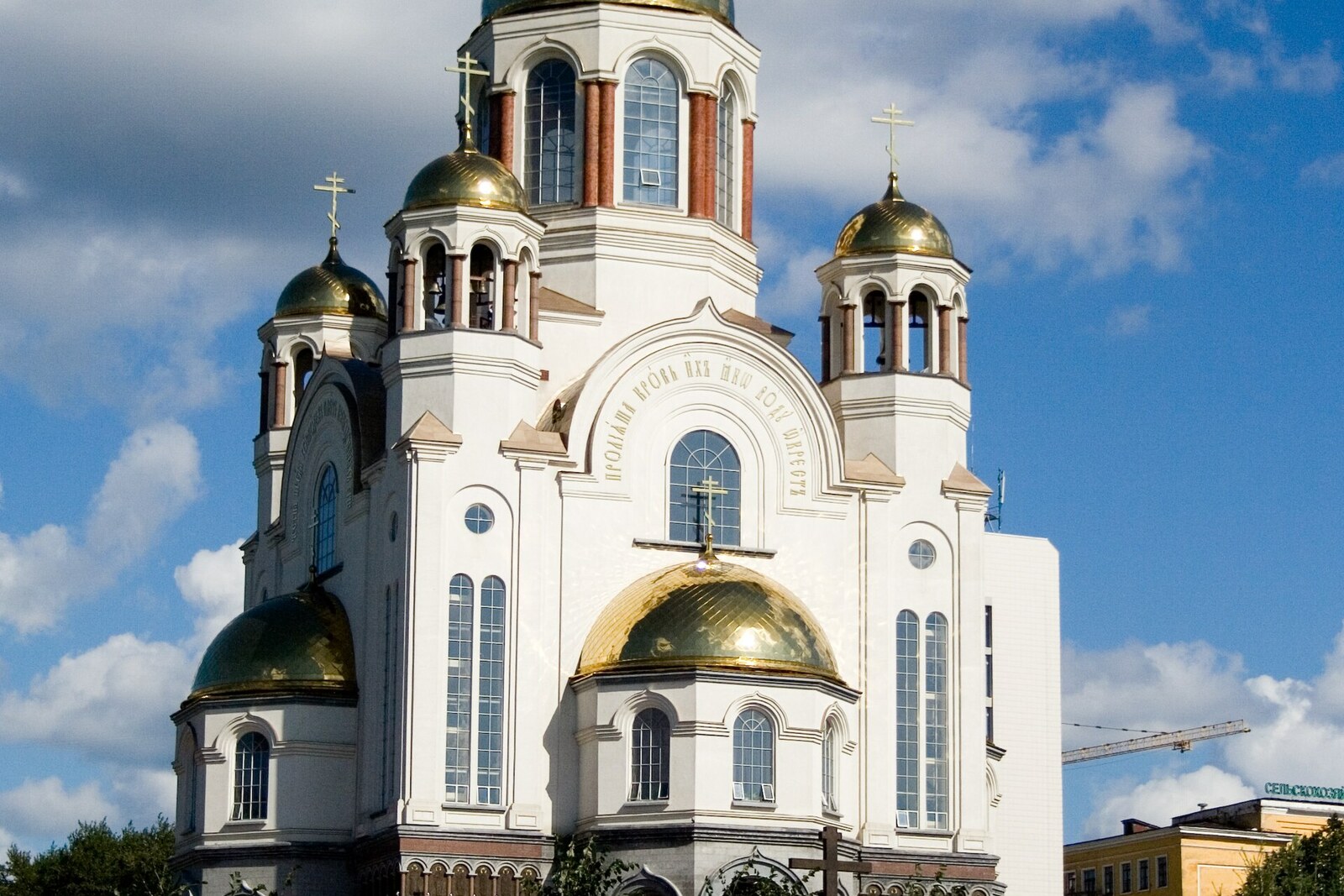
Look around first
What to notice
- The white-stone Church on the Blood
- The blue Ascension Church
- The slope of Ascension Hill
The story of the place
The stone building of Church on the Blood rises on the slope of Ascension Hill, below the blue Ascension Church. It opened in two thousand three on the site where a residential mansion once stood: an office operated downstairs, while the owner's family lived upstairs. Earlier still, the plot was a church site; the wooden church was dismantled and moved to Nizhne-Isetsky Plant when the stone church was built on the hill. A small chapel remained for a while at the site of the former altar.
In May seventeen sixty-six, residents of this part of Yekaterinburg decided to build a church here with their own money. At that time, the factory center and Trade Square had their own churches, while Ascension Hill had no parish of its own. Permission from Metropolitan Pavel of Tobolsk was required, and he granted it.
Archpriest Kochnev was assigned to lay the foundation stone for the church. But the work was stopped by General Andrei Irman, a member of the Main Factory Administration—the body that administered the factory town. The police made the petitioners give a written undertaking to stop construction. The people had already agreed to pay for the church and had received a blessing, yet they still could not build it.
In January seventeen sixty-eight, Metropolitan Pavel came to Yekaterinburg. The residents submitted their petition again, now with a ready-made solution: to dismantle the wooden side chapel of the old Epiphany Church on Trade Square and move it here. The metropolitan gave permission. Kochnev laid the foundation stone for the transported church in May seventeen seventy, and in September it was consecrated in the name of the Ascension of the Lord. A parish of one hundred eighty-six households formed around the new church.
Twenty years later, the wooden church had become dilapidated and too cramped. The parishioners decided to build a stone one, but chose another site for it—about three hundred meters to the east, higher up the slope. This is the present-day blue Ascension Church at the top of the hill. While it was being built, the old church continued to receive people. Then the log structure was dismantled again, moved to Nizhne-Isetsky Plant, and reassembled there. A small St. Elijah Chapel was left at the site of the former altar.
The vacant plot became residential. In the late eighteen seventies, mining engineer Ivan Redikortsev built a stone mansion here. The house bears another man's surname because engineer Nikolai Ipatiev bought it in nineteen eight. He earned money from railway-construction contracts: he set up an office on the lower floor, while his family occupied the upper one. Redikortsev created the house, but the city remembered its last private owner.
The mansion has not survived. The white-stone church opened here in two thousand three. And higher up the hill stands the stone Ascension Church—the very church for which the parishioners once cleared this plot and sent their first wooden church on its third journey.
Useful on site
The exterior can be viewed freely. Access inside depends on services; ask on site about tours and access to the lower church.
Checked: June 24, 2026. Check the official source before visiting.Distinguish the present-day church from the vanished house: they are different buildings and different ways of speaking about the past. Inside, follow the rules of an active religious space; during a service, do not disturb the parishioners.