 Guide On Map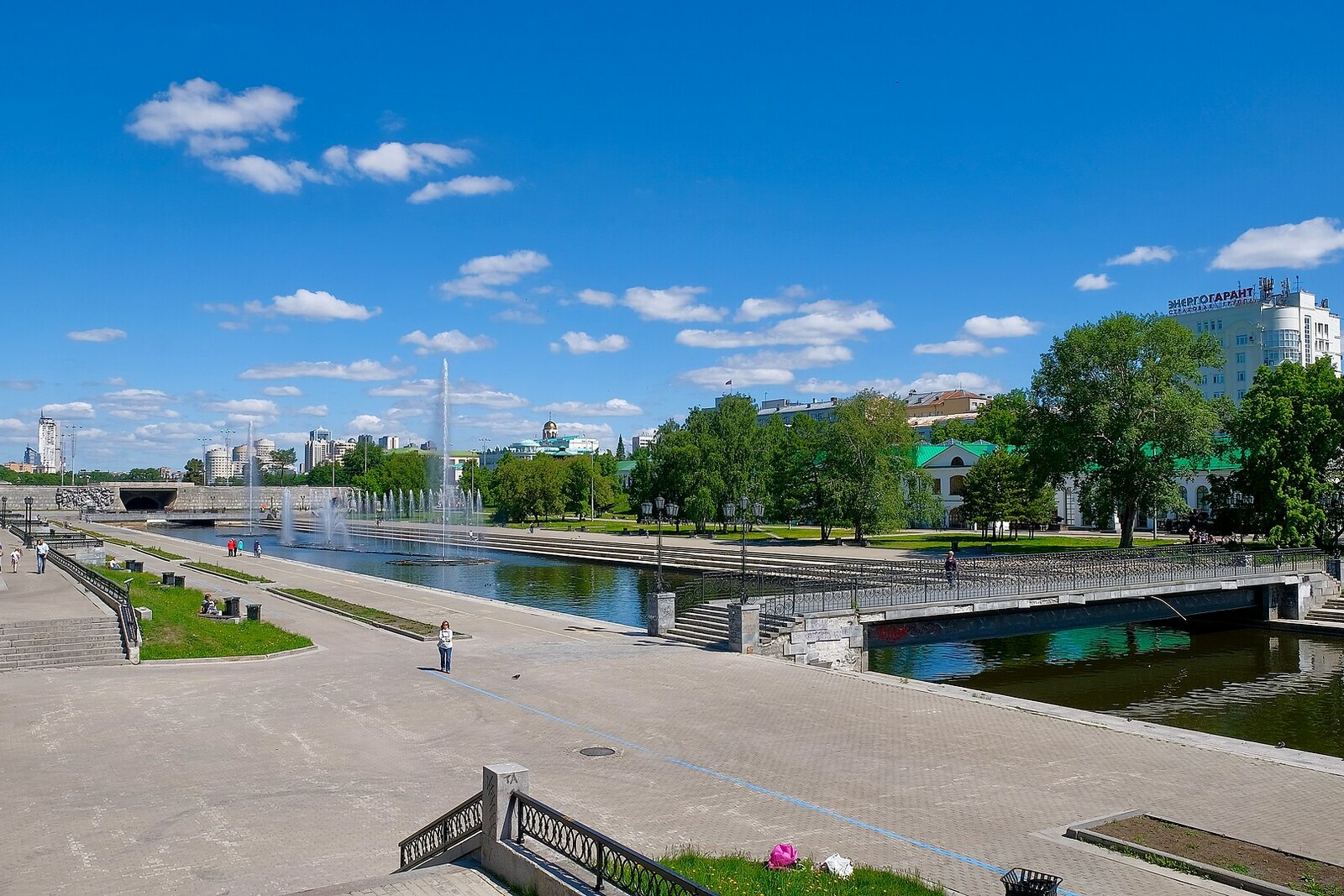
Look around first
What to notice
- The dam's granite facing
- Sluice openings
- Bas-reliefs
- Tram tracks
The story of the place
Beneath Plotinka's granite facing, the old wooden body of the dam has survived: larch log cribs filled with stone and clay hold back the City Pond. Three sluice passages were left inside it to discharge excess water and direct it to the factory wheels. The workshops along the Iset River have long disappeared, replaced by Historical Square with its stairways, bas-reliefs, and platforms; tram tracks run across the top of the dam.
In the spring of seventeen twenty-three, Leonty Zlobin, a dam master who was to provide a new plant with water power, inspected the Iset River and rejected the chosen site. During low water, he warned, there would not be enough water for the factory hammers. Georg Wilhelm de Gennin, the head of construction and a military engineer charged with launching a state-owned metallurgical plant here, refused to change the site: work had already begun.
The plant needed a pond. Water from it was sent along wooden troughs to wheels, which powered forging hammers, bellows, saws, and other machinery. Without a dam, the workshops could not produce metal. Zlobin was responsible for the structure at a site he himself considered unsuitable: a summer shortage of water halted production, while spring flooding could damage the embankment.
De Gennin had to beg Nikita Demidov, the owner of private plants in the Urals who valued his specialists, to let him have the master himself. Their relationship was difficult: de Gennin had previously testified against Demidov in the Senate, and now he needed Demidov's help. Demidov agreed to send Zlobin, three apprentices, and several dozen skilled workers.
Zlobin was not a free contractor. He was registered with Demidov's plants, received a house in Nevyansk, thirty silver rubles a year, and a bread allowance; his owner assigned his labor to other construction projects. On the Iset River, the master proposed moving the plant or at least building a reserve pond upstream. De Gennin ordered construction here. The Upper Pond was created later on Zlobin's advice, but for the time being all responsibility rested on one dam.
Larch log cribs were laid in its foundation and filled with stone and clay. Three openings with sluices were made in the body of the dam: excess water was discharged through the middle one, and water was sent to the factory wheels through the two side ones. On September eleventh, the dam was closed and the pond began to fill. It held. For his work, de Gennin ordered a gold ring to be made for Zlobin, and the master himself went on to build the next factory dams.
On November eighteenth, seventeen twenty-three, water set the first large hammers in motion. This trial run is considered Yekaterinburg's founding day: the city emerged as a settlement beside a plant powered by the dam.
Most of the workshops that once stood on both sides of the Iset River are now gone. In nineteen seventy-three, when Yekaterinburg was called Sverdlovsk, their remains were dismantled, and Historical Square was laid out for the city's two hundred fiftieth anniversary. The dam was widened, faced with granite, and given stairways, bas-reliefs, and platforms. Trams, cars, and pedestrians now cross its top, while city celebrations are held on the site of the factory yards.
Residents extended the colloquial name “Plotinka” from the dam itself to the entire square. Beneath the later stone facing, the structure's foundation still consists of larch log cribs filled with stone and clay—the dam that Zlobin undertook at the very site he had rejected.
Useful on site
Viewing the exterior does not require a ticket; access to certain areas may temporarily change because of city events.
Checked: June 24, 2026. Check the official source before visiting.Look at the water as more than just a landscape: stand where you can see both the pond and the stretch below the dam at the same time. Take care at the water's edge and on stone surfaces.