 Guide On Map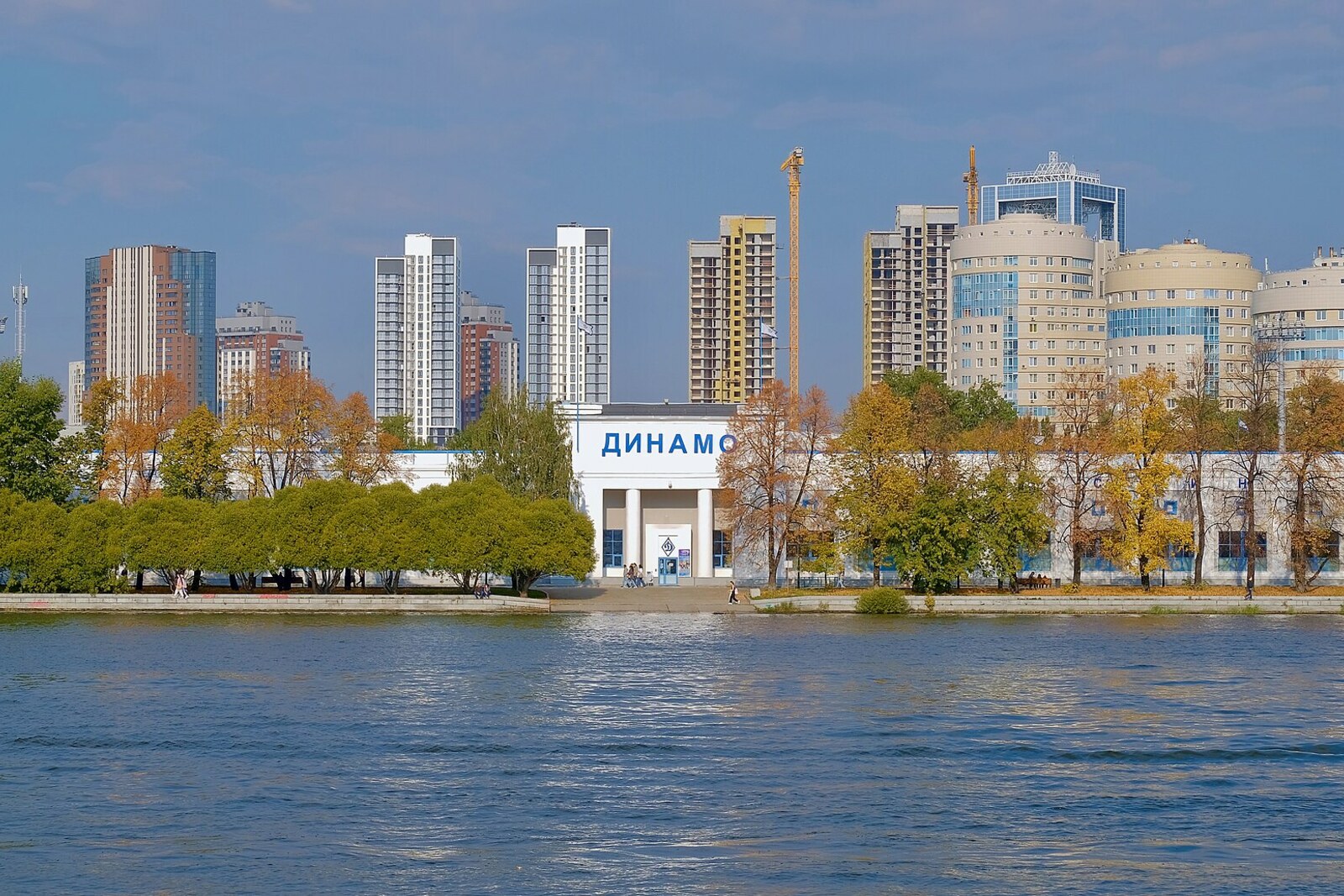
Look around first
What to notice
- White building
- Round windows
- Long balconies
- Small tower
The story of the place
The white building, with round windows, long balconies, and a small tower, faces City Pond like a ship's bow. Architect Veniamin Sokolov designed it as a House of Physical Culture: inside were a sports hall, a swimming pool, locker rooms, and a shooting range. A water station operated by the shore, with open-air pools, diving platforms, and a boat pier. It has not survived. The stadium behind the building is still in use: track-and-field athletes train here now, and field hockey is played here.
The name appeared before the building. In nineteen twenty-five, when Yekaterinburg was called Sverdlovsk, employees of the Ural State Security Administration created a local branch of the Dynamo Sports Society. They intended to strengthen the physical and combat training of their colleagues. That is why a stadium, shooting range, halls, pools, and water station were combined in one complex.
After the war, the stadium was turned into a speed-skating oval in winter. The quality of the ice depended on the work of ice makers Alexander Andronikov, Arkady Tilkiev, and Mehak Torosyan. They flooded and leveled the track so well that the national team preferred to train here, and records for lowland rinks were set on Sverdlovsk ice.
In nineteen forty-six, twenty-year-old student Rimma Zhukova came to this track. She had begun skating only a year earlier and was competing for a place among athletes who had trained since childhood. Yevgeny Sopov, a Dynamo speed skater, had just returned from the war and was moving into coaching. He considered women insufficiently disciplined, but admitted Zhukova to his group.
For Sopov, two late arrivals in a week meant expulsion. He gave grades for training sessions, reserving the highest grade for competitions: there, the stopwatch made the decision. Zhukova met the Master of Sports standard in her very first season. Three years later, she became Soviet Union champion in the one-thousand-meter event and won bronze at the world championships. In nineteen fifty-five, she won the world all-around championship; over the preceding several seasons, she had set eight world records.
Zhukova changed Sopov's mind about women in speed skating. He continued to coach women athletes, also trained world champions Lidiya Selikhova and Sofya Kondakova, and in nineteen fifty-six received the title of Honored Coach of the Soviet Union.
Zhukova's natural ice has not survived: it was remade every winter. The stadium where it lay has survived. The field is now surrounded by modern running tracks, and the name of the section to which Sopov once invited the aspiring speed skater remains on the white building: Dynamo.
Useful on site
The exterior can be viewed from Olympic Embankment; access to the stadium and indoor spaces depends on training sessions and events.
Checked: June 24, 2026. Check the official source before visiting.The image of a ship is best seen from some distance, when both the silhouette and the water are visible. Do not try to look for the removed antennas: today, the maritime metaphor is carried by the shape of the building and its details.