 Guide On Map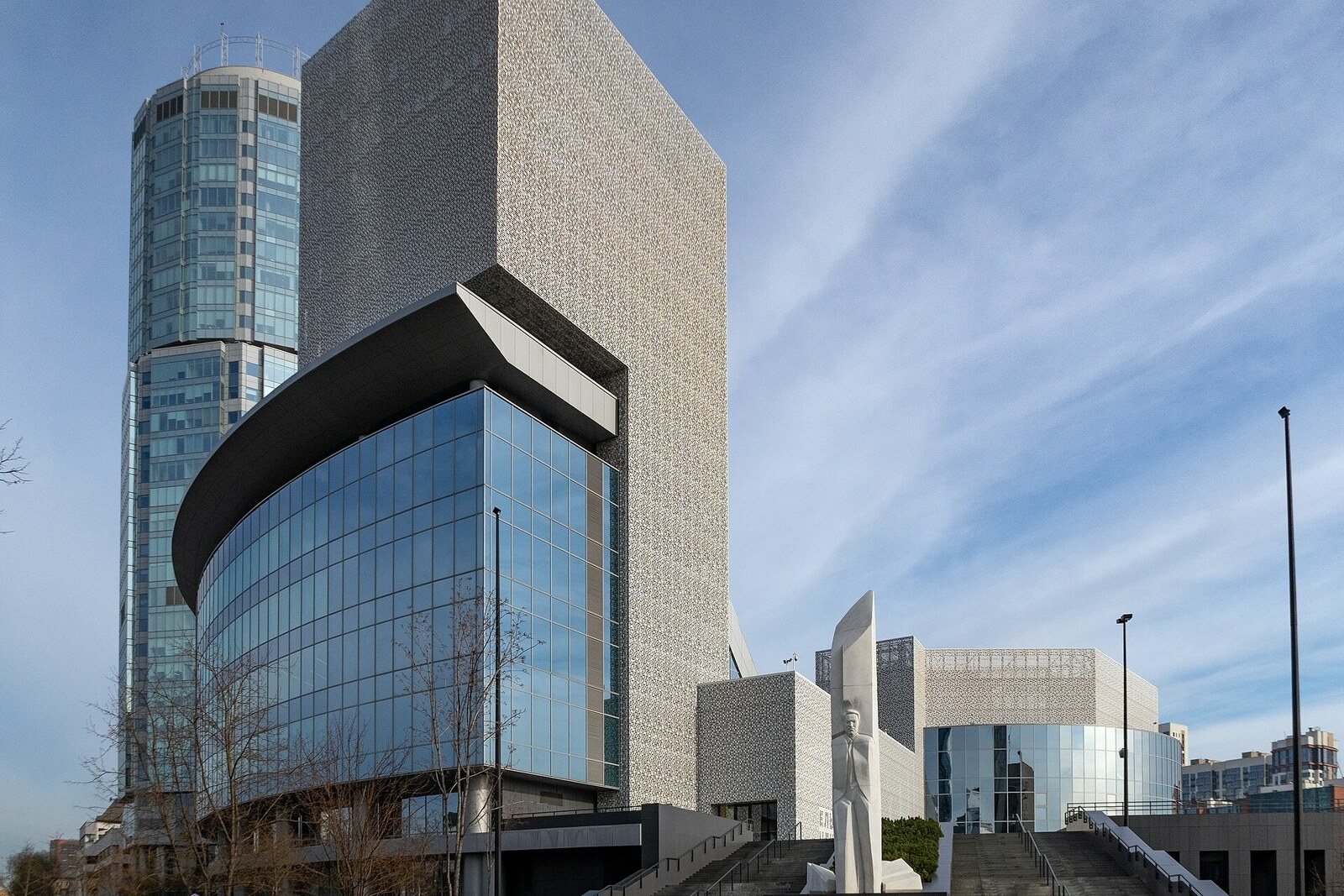
Look around first
What to notice
- Circular second floor
- Seven museum halls
- Furnishings of the presidential office
- Empty chair
The story of the place
The Yeltsin Center might have ended up in Moscow: they even discussed a site for it at VDNKh. More visitors and opportunities were expected there. But Tatyana Yumasheva, Boris Yeltsin’s younger daughter and one of the creators of the future center, insisted on Yekaterinburg.
Boris Yeltsin was the first president of Russia, holding that office from nineteen ninety-one to nineteen ninety-nine. Most of his adult life was connected with this city. In nineteen forty-nine, he came to Sverdlovsk, as Yekaterinburg was then called, enrolled at the Polytechnic Institute, became a civil engineer, headed a house-building combine, and then the oblast. He left for Moscow only in nineteen eighty-five. According to Yumasheva’s recollections, Yeltsin himself believed that a museum of his time should be located here.
After his resignation, the family began discussing what such a museum would be like. In nineteen o eight, legislators provided for the creation of centers for former presidents, with a museum, archive, and library. For the first of them, they chose the unfinished congress hall of the Demidov Complex on the shore of City Pond.
Tatyana Yumasheva invited film director Pavel Lungin to devise the exhibition. He agreed for a personal reason: Lungin connected his ability to make his own films freely with the changes of the late eighties and nineties, and saw this work as repaying a debt to his time.
In early winter, the director came here and saw bare walls, an unfinished roof, and a circular second floor. It could not accommodate an ordinary sequential exhibition. Lungin decided to use the circle and divide it, like a pie, into seven parts. Instead of a biography from birth to death, he proposed seven days on which Yeltsin made decisions with consequences for the entire country. Each hall became a separate chapter, and the whole route a story of the nineties.
After that concept, the museum staff had to fill the seven parts with real objects and testimony. When the archive began its work, the team had neither a finished building nor an assembled collection. Four archivists spent three years searching for and describing documents and exhibits. Naina Yeltsina, the first president’s widow, handed over her husband’s preserved papers, photographs, and personal belongings every week. For the multimedia programs, staff recorded more than a hundred interviews and tracked down materials in numerous state and private archives. To conclude the exhibition, they transferred the furnishings of the presidential office from Kremlin Building 14.
On November twenty-fifth, nineteen fifteen, Russia’s first presidential center opened here. Today, staff preserve the archive, welcome researchers to the library, and organize exhibitions, lectures, film screenings, concerts, and activities for children. The seven museum halls still occupy the circular floor that Lungin first saw as part of an abandoned construction site, and the route ends at an empty chair in Yeltsin’s office.
Useful on site
Boris Yeltsin Museum: Tuesday–Sunday 10:00–21:00, Monday closed. Admission to the center’s common spaces is free; the museum requires a ticket.
Checked: June 24, 2026. Check the official source before visiting.The outdoor stop does not replace the permanent exhibition. If you want to see the transferred presidential office and follow the museum’s story in full, set aside separate time for it in advance and check the visiting conditions.