 Guide On Map
Power and Faith in Old Vilnius
From Cathedral Square along Pilies Street to the Gate of Dawn
Guide On Map on your phone
Open the walk like a regular app
It takes about 10 seconds to install. No app store needed.
The whole path
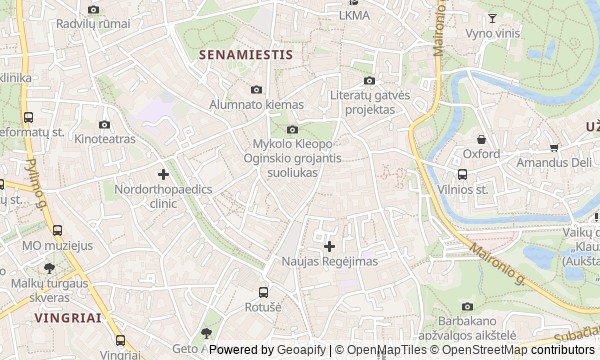
Route map
About the walk
You will walk from Cathedral Square through the princely Vilnius Lower Castle, along Pilies Street, through university courtyards and Town Hall Square, to the monasteries near the Gate of Dawn. At first, the road will belong to the grand dukes. Then power will move into a rented room above a confectioner's shop, a university courtyard, an imperial study, and the square before the town hall. Each place will have its own way of turning a private decision into the city's business.
The stories hinge on vulnerable details: an ambiguous Latin formula, a secret passage between houses, a table you have to climb onto with a sheet of paper, gates built for carts, and a chapel above a busy street. You will get the answers only when you are there. The account will compare documents with later legends and calmly mark the places where certainty runs out.
By the end, you will be able to draw a line from the princely residence to Our Lady of the Gate of Dawn and explain who, in a tower, a rented room, a town hall, and a monastery courtyard, gained the right to speak in the name of Vilnius.
Why this order
Cathedral Square sets the opening scene: a prince will negotiate with the outside world beside his own residence. The neighboring palace takes you inside the same Vilnius Lower Castle, where state calculation collides with private choice. From the castle, Pilies Street follows the old road used by arrivals to the House of the Signatories: power leaves the princely chambers for a rented city room. The university courtyard, one block away, shows how the right to teach and award degrees was created alongside political decisions. The Presidential Palace continues this line literally through the university complex: a place of learning gives way to a residence where two emperors occupied the same rooms in turn. The descent to the town hall brings the decision out of the palace and onto the square before the townspeople. Farther south, the religious part of the route begins: beyond the Basilian Gate, a community was gathered anew, while by the Church of St Teresa land and passage were fought for on its behalf. The Gate of Dawn is the necessary finale, because Discalced Carmelites from the neighboring monastery turned a city gate into a street shrine, and here prayer, military passage, and urban defense later collided.
Those who want to understand Vilnius through people's decisions rather than a list of styles Those interested in the Grand Duchy of Lithuania, the Polish–Lithuanian Commonwealth, and the emergence of modern Lithuania Those who enjoy documents, disputed versions, and the human consequences of major events
Those expecting an easy walk focused only on architecture Those who do not want to enter courtyards or untangle changing eras Those who care more about views, cafes, and city entertainment
Before you go
The main story can be followed from outside, but some details are inside the university courtyard, museums, and church interiors. Check access in advance if you want to enter the Palace of the Grand Dukes of Lithuania, the House of the Signatories, university spaces, or a separate tour of the Presidential Palace: do not treat these visits as an automatic part of the walk. In churches and the chapel, keep quiet, mute your audio during services, and do not block worshippers' way. Take an unhurried pace for the frescoes and icon: the final three stops are close together, but ask for more attention to what is happening inside.
When to go
Walking between all stops takes about 30 minutes. With the audio stories and time to look around, allow roughly 2 hours 15 minutes. Museum rooms, a tour of the official residence, and a climb up the university bell tower require additional time.
Backup plan
A closed interior does not break the route: at the palace, the House of the Signatories, Vilnius University, and the presidential residence, you can hear the main stories before the facade or entrance arch. If the Grand Courtyard is inaccessible, look at the complex from the street and move on to the next stop. During a service, do not try to visit a church or chapel as if it were a museum: stay outside, notice the gate, facades, and the links between the buildings, and leave the interior visit for later. At the Gate of Dawn, you can hear the finale entirely from the street without disturbing pilgrims.
Route conditions
Surface. Paved — 2 km (data covers 98% of the route)
Facilities. Toilets — 5; drinking water — 3
Elevation. Ascent — 43 m; descent — 6 m
OpenStreetMap extract of July 7, 2026: database data, not a check on the ground. Data © OpenStreetMap contributors, ODbL licence
Walk plan
Open in maps ↗- 1
Cathedral Square and the Monument to Gediminas
Here begins the dispute over how the duke could promise rapprochement with Rome without agreeing to baptism. - 2
Palace of the Grand Dukes of Lithuania and Vilnius Lower Castle
This stop will show how a secret marriage from neighboring chambers turned into a dispute over the crown and succession. - 3
House of the Signatories
Beyond the third-floor windows, the political split will end in a formula that all twenty participants agreed to sign. - 4
Grand Courtyard of Vilnius University
Here, a school play and a public disputation will mark the beginning of an institution granted the right to award recognized degrees. - 5
Presidential Palace
The rooms of one palace will link a summer refusal to negotiate with a winter award for the victor. - 6
Town Hall Square
Here, the military capture of the city will be turned into a public commitment signed by the townspeople. - 7
Basilian Gate and the Church of the Holy Trinity
An almost empty monastery would become the center of a new monastic congregation thanks to two people and several dozen students. - 8
Church of St Teresa
The history of its construction begins with a dispute over a residential house and continues with a separate passage for carts. - 9
Gate of Dawn
The finale brings together the city gate, open-air prayer in the street, and an Easter assault whose accounts diverge.
Route features
Everything you need stays in the browser
Progress, saves and your trip plan are stored on this device.
Add Guide On Map to your home screen so the walk opens outside the browser.
How we handle sources, maps and corrections: our editorial standards