 Guide On Map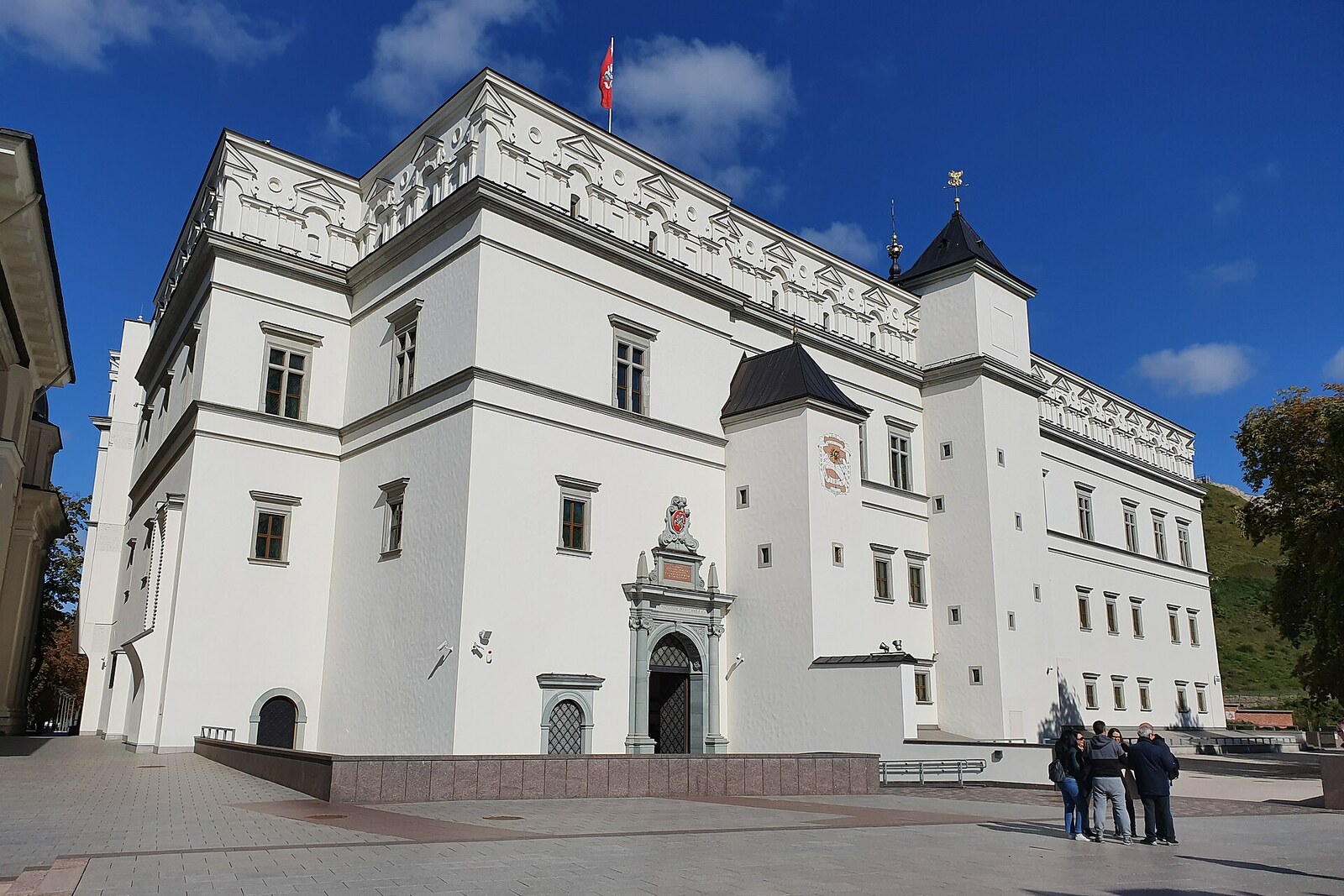
Look around first
What to notice
- The white palace buildings
- The windows of the palace facades
- Vilnius Cathedral
The story of the place
In the middle of the sixteenth century, Sigismund Augustus, Grand Duke of Lithuania, left his residence by a covered passage that led through Vilnius Lower Castle toward the House of the Radziwiłłs. Barbara Radziwiłł lived there—a young widow of Stanislovas Goštautas, the voivode of Navahrudak. Her husband left her no children; but after his death Barbara had a substantial inheritance and a status that allowed her to live independently. Sigismund sought meetings with her, although he was married to Elizabeth of Austria.
The palace was well suited to such a story precisely because it served as the residential and administrative center of Vilnius Lower Castle. Behind its walls were the family apartments, the treasury, the archive, council halls, and rooms for courtiers. Vilnius Cathedral, arsenals, and service buildings stood nearby. The grand duke could receive ambassadors, deal with state affairs, and go to Barbara without leaving the enclosed castle grounds.
In fifteen forty-five, Elizabeth died in this palace. After her death, Barbara moved into the House of the Radziwiłłs near the grand ducal residence, and the meetings could no longer be concealed. Her brother, Nicholas Radziwiłł the Red, and her cousin, Nicholas Radziwiłł the Black, pressed for a marriage: if a woman from their family became the wife of the heir to the Polish and Lithuanian thrones, the Radziwiłłs would gain a position unavailable to other Lithuanian magnates.
In the summer of fifteen forty-seven, Sigismund and Barbara were secretly married in a private chapel of the neighboring Vilnius Cathedral. Sigismund did not ask the consent of either his parents or Polish dignitaries. For the only son of the king, marriage was considered a family contract: he was expected to form an alliance with a foreign dynasty and produce a legitimate heir. Barbara came from a very wealthy family, but she was not a king's daughter.
Sigismund's father died the following year. The new king announced to the Council of Lords of Lithuania that Barbara was his lawful wife and grand duchess. In Poland, he was demanded to dissolve the marriage. The queen mother, Bona Sforza, also resisted: she had hoped to arrange another dynastic alliance for her son and did not want the Radziwiłłs to become stronger. Sigismund refused to back down. After two years of disputes, Barbara was recognized as his wife, and in December fifteen fifty she was crowned in Krakow.
She remained queen for five months. Barbara fell seriously ill and died in May fifteen fifty-one. The exact cause of death is unknown; stories that Bona Sforza poisoned her belong to later suspicions, not to proven circumstances. Sigismund fulfilled his wife's wish: her body was brought from Krakow to Vilnius and buried in Vilnius Cathedral.
After the funeral, he ordered the construction in Vilnius Lower Castle of the Church of St Anne and St Barbara—a family tomb for her and for himself. Expensive stone was ordered for the craftsmen, but Sigismund died before completing the construction. The church was dismantled, and neither spouse was buried in it.
The old palace is gone as well. In sixteen fifty-five, troops occupying Vilnius looted and set it on fire; the residence was never rebuilt. From seventeen ninety-nine to eighteen oh one, the remaining walls were dismantled and the bricks were sold. The white building before us was erected above foundations found by archaeologists; beneath it, the authentic masonry of the former buildings has been preserved. Within Vilnius Lower Castle, fragments of the passage to the House of the Radziwiłłs and the foundations of the unfinished church also remain. Barbara still lies in the neighboring Vilnius Cathedral, where Sigismund brought her after five months of royal marriage.
Useful on site
June–August: Monday–Wednesday 10:00–18:00, Thursday–Saturday 10:00–20:00, Sunday 10:00–18:00. September–May: Monday closed; Tuesday–Wednesday and Friday–Saturday 10:00–18:00, Thursday 10:00–20:00, Sunday 10:00–16:00.
Checked: June 24, 2026. Check the official source before visiting.From outside, the restored volume is easy to make out. The authentic foundations and archaeological finds are in the museum section, for which you should allow a separate visit.