 Guide On Map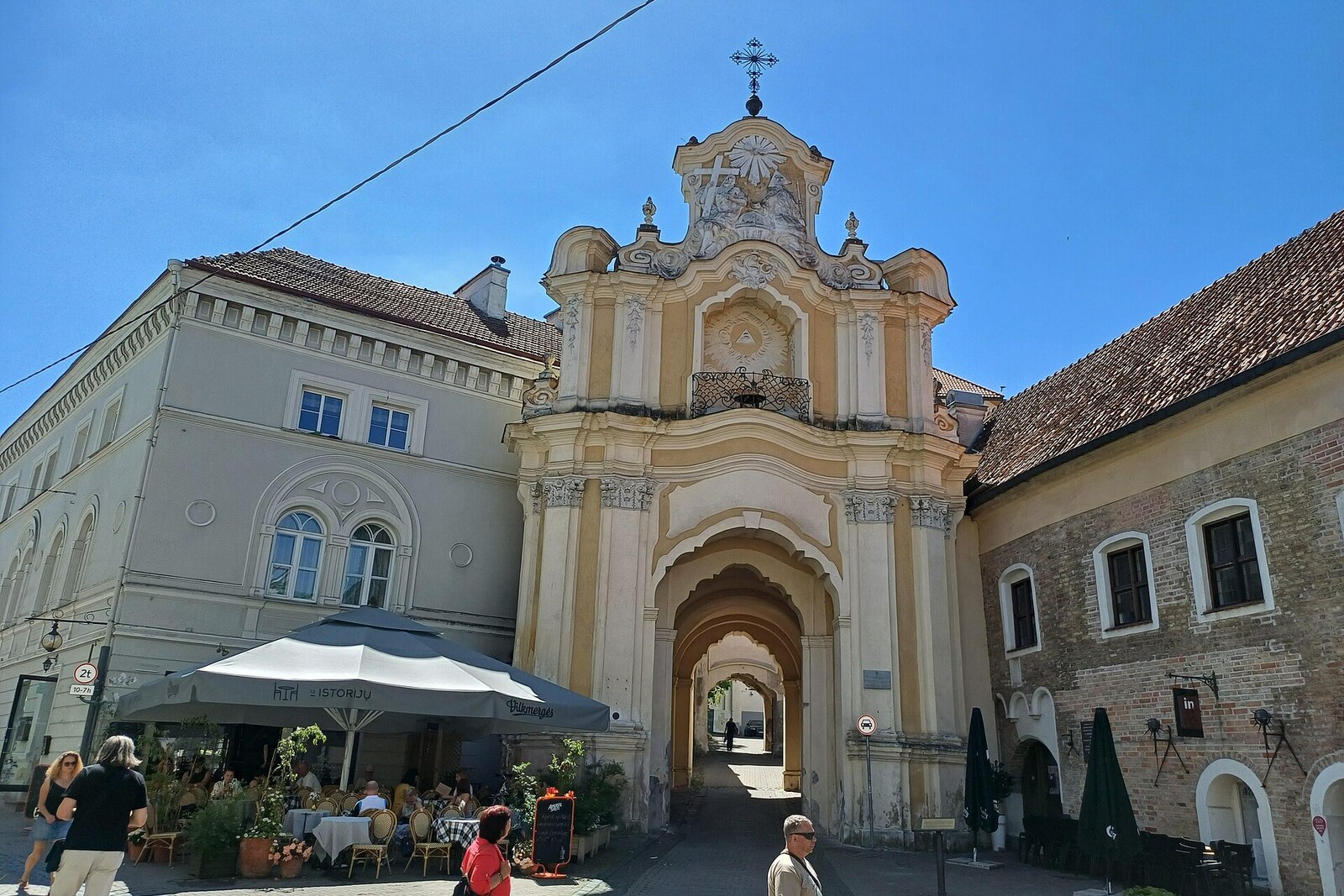
Look around first
What to notice
- Rococo gate
- Church of the Holy Trinity
- Monastery buildings
The story of the place
The courtyard of the monastery complex begins in the passage beneath the Rococo gate: the Church of the Holy Trinity and the monastery buildings stand beside it. The gate was built for the monastery of the Basilian Order; its monks followed the rules of Basil the Great and served according to the Eastern rite. Orthodox tradition links the earlier wooden church to the site where three courtiers who were Christians were executed, but there are no documents identifying that site. Later, the wooden church was replaced with a stone one, which became the basis of the present church.
When twenty-four-year-old Ivan Kuntsevych entered this courtyard in sixteen oh four, the present gate was not yet here. Ivan had come to Vilnius to learn the merchant trade: the profession of a merchant was supposed to support him. Instead, he chose the nearly deserted monastery, took the name Josaphat, and became a monk.
The monastery had emptied because of the Union of Brest. In fifteen ninety-six, some Orthodox bishops of the Polish-Lithuanian Commonwealth recognized the pope’s supremacy while retaining the Eastern liturgy. Supporters of this agreement were called Uniates; today they are called Greek Catholics. The Orthodox brotherhood of Vilnius rejected the union and moved to the Monastery of the Holy Spirit. One monk with the title of abbot remained at the Church of the Holy Trinity, and around twenty parishioners gathered there on feast days. The monastery owned almost nothing.
Josaphat Kuntsevych sought to unite the Eastern Church with Rome and set about rebuilding the community. He sang at services, taught church singing to new monks, and after his ordination became a mentor to novices. In sixteen oh seven, Josyf Veliamyn Rutsky joined him—an educated Uniate priest who was to create common rules and permanent clergy training for the scattered monasteries.
By sixteen fourteen, sources counted around sixty young monks here. Rutsky, having become Metropolitan of Kyiv, handed the monastery’s administration over to Kuntsevych. The new abbot sought donors for the monastery buildings, managed its affairs, and continued to teach the novices. Three years later, Rutsky and Kuntsevych gathered representatives of five monasteries and united them into the Congregation of the Holy Trinity, centered in Vilnius.
This is how the Basilian Order came into being. Its name derives from Basil the Great, a fourth-century Christian bishop whose monastic rules guided the community. The name of the gate has nothing to do with the architectural word “basilica.”
Kuntsevych was soon sent to Polotsk as archbishop to spread the union. There, his preaching provoked fierce resistance. In sixteen twenty-three, opponents of the union broke into his residence in Vitebsk and killed the archbishop. In eighteen sixty-seven, the Catholic Church canonized Josaphat Kuntsevych. The monastic community he had created with Rutsky had already existed for two and a half centuries by then.
The church they filled with monks was older than their order. According to Orthodox tradition, the first wooden church was built here in the fourteenth century, at the site where three courtiers who were Christians were executed; the site of the execution has not been documented. After the victory at Orsha, Konstanty Ostrogski, Grand Hetman of the Grand Duchy of Lithuania, received permission to replace the wooden Church of the Holy Trinity with a stone one. That structure became the basis of the present church.
The Rococo gate was built only in seventeen sixty-one to a design by Johann Christoph Glaubitz—for the already large monastery of the Basilian Order. Josaphat Kuntsevych never saw it. Today, a Greek Catholic Church of the Holy Trinity is once again active beyond the gate, and part of the monastery premises is once again occupied by the Basilian Order.
Useful on site
The church is open daily 9:00–19:00.
Checked: June 24, 2026. Check the official source before visiting.This is a religious space, so enter quietly and do not interrupt services. Do not look for Konrad’s indisputably established “real” cell: its exact location remains disputed.