 Guide On Map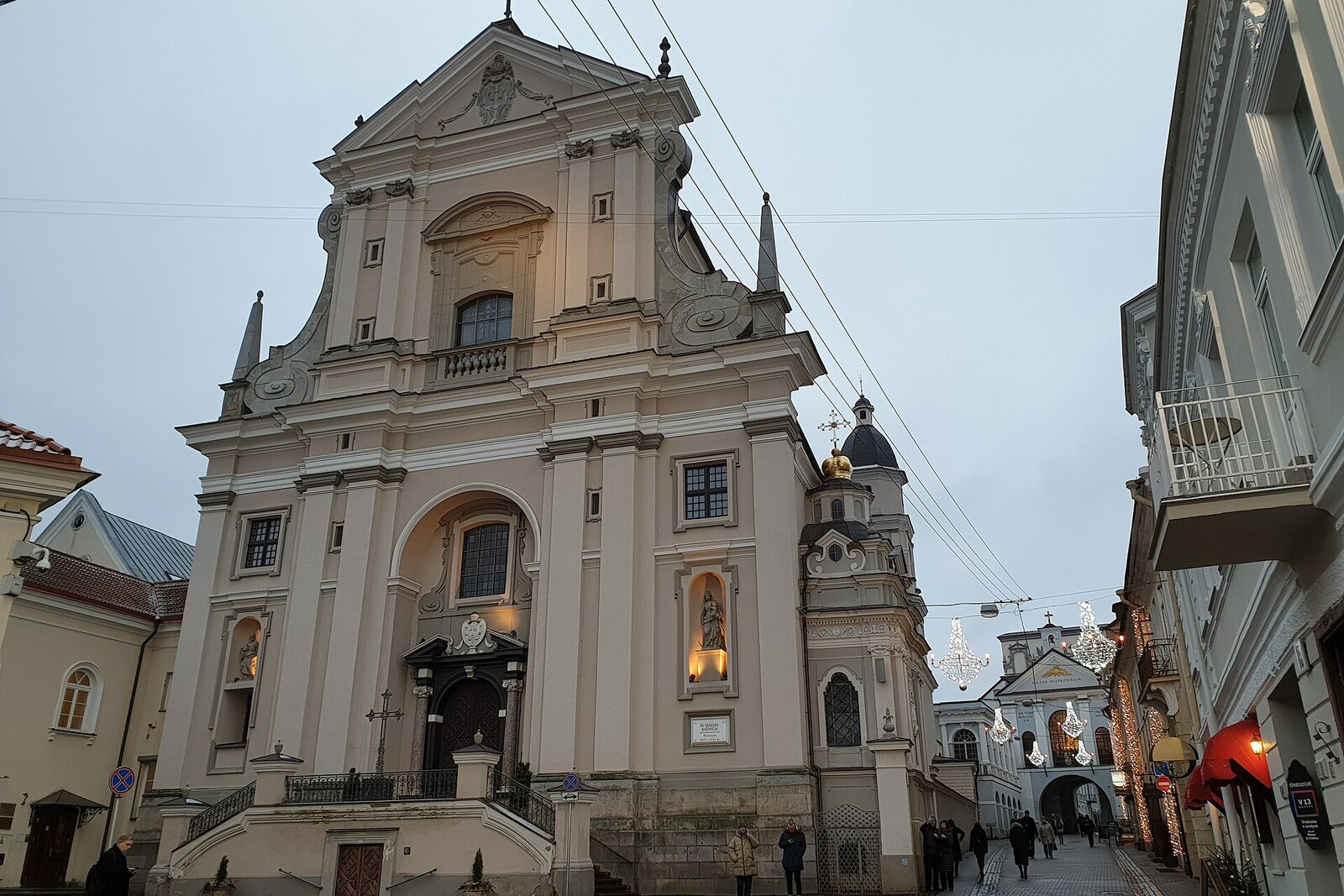
Look around first
What to notice
- The black and white marble of the facade
- The double lily on the gable
- The paintings on the vault
- The main altar
The story of the place
The Church of St Teresa was built for the Discalced Carmelites, the reformed branch of an old order. In their small communities, a strict rule combined contemplative prayer with spiritual guidance; the original wooden church soon became too small. The large stone church was built over twenty-one years: a double lily, the coat of arms of the Pac family, was placed above the gable, and the interior paintings were dedicated to the life of Saint Teresa. When the monastery was dissolved, the church remained a parish church and retained its connection with the Chapel of the Gate of Dawn.
The stone facade with black and white marble appeared here after a dispute over a residential house. Documents called it the Pashkevich House. Half the house belonged to Catholics, and half to Orthodox Christians who had not accepted the ecclesiastical union. It was this property that the monks needed to acquire for the church.
Ignacy Dubowicz, a Vilnius city councilor, took charge of their settlement by the Gate of Dawn. He sought permits, gave five thousand florins for the founding of the monastery, and bought up neighboring plots. In September sixteen twenty-six, the Discalced Carmelites arrived here. The Discalced were the reformed branch of the order, founded by the Spanish nun Teresa of Ávila. She wanted small communities of Carmelites to live by a strict rule, combining contemplative prayer with spiritual guidance. The Vilnius monks belonged to the order she created, so they dedicated their church to Teresa.
At first, the Carmelites built a wooden church. It soon became too small, and Dubowicz began assembling land for a large stone building. They managed to buy the Catholic half of the Pashkevich House. The Orthodox co-owners refused to sell their share. The Carmelites then invoked an old right of redemption, which allowed them to demand the sale of the disputed part of the property, and filed a lawsuit. They argued that the house prevented the construction of a church needed by the city.
Stefan Pac, a wealthy patron of construction and future Deputy Chancellor of Lithuania, became involved in the dispute. In December sixteen thirty-two, he appeared before the burgomaster and city council, seeking a decision in favor of the Carmelites. The court supported the monks. The co-owners filed a protest, and the case reached King Władysław IV. In the summer of sixteen thirty-three, two royal commissioners held three sessions and again decided the case in favor of the Carmelites. The king approved the purchase agreement. The former owners received two thousand florins for the plot, and the Pashkevich House gave way to the church.
In September of that same year, the bishop consecrated the foundation stone. Pac and his wife provided the money for construction. But the plot won in court proved almost inaccessible to carts carrying stone and timber. The Gate of Dawn was narrow and constantly occupied by traffic, while the city wall blocked the other side. The Carmelites again appealed to the king. In sixteen thirty-five, Władysław IV allowed them to break through a separate gate from the side of what is now Subačiaus Street and temporarily gave the builders a strip of city street three fathoms wide. After that, carts could bring materials directly to the plot.
Construction lasted twenty-one years. Stefan Pac did not live to see the consecration, but his wife supplied the sacristy with expensive vessels and left money for memorial services in her will. In sixteen fifty-four, Bishop Jerzy Tyszkiewicz consecrated the completed Church of St Teresa. The double lily on the gable is the coat of arms of the Pac family. Inside, the vault and walls are covered with scenes from Teresa's life, while the main altar depicts her mystical vision.
When the monastery was dissolved in eighteen forty-four, the church was not closed: it became a parish church and remained connected with the Chapel of the Gate of Dawn. Catholic Masses in Lithuanian and Polish are still held here.
The Pashkevich House is gone. The service gate broken through for construction has disappeared as well. The Gate of Dawn remains nearby—the passage through which construction carts once could not squeeze.
Useful on site
The church is open daily 10:00–19:00.
Checked: June 24, 2026. Check the official source before visiting.During services, limit yourself to the facade. The interior passage to the chapel should not be regarded as a route open to the public; use only clearly open passages.