 Guide On Map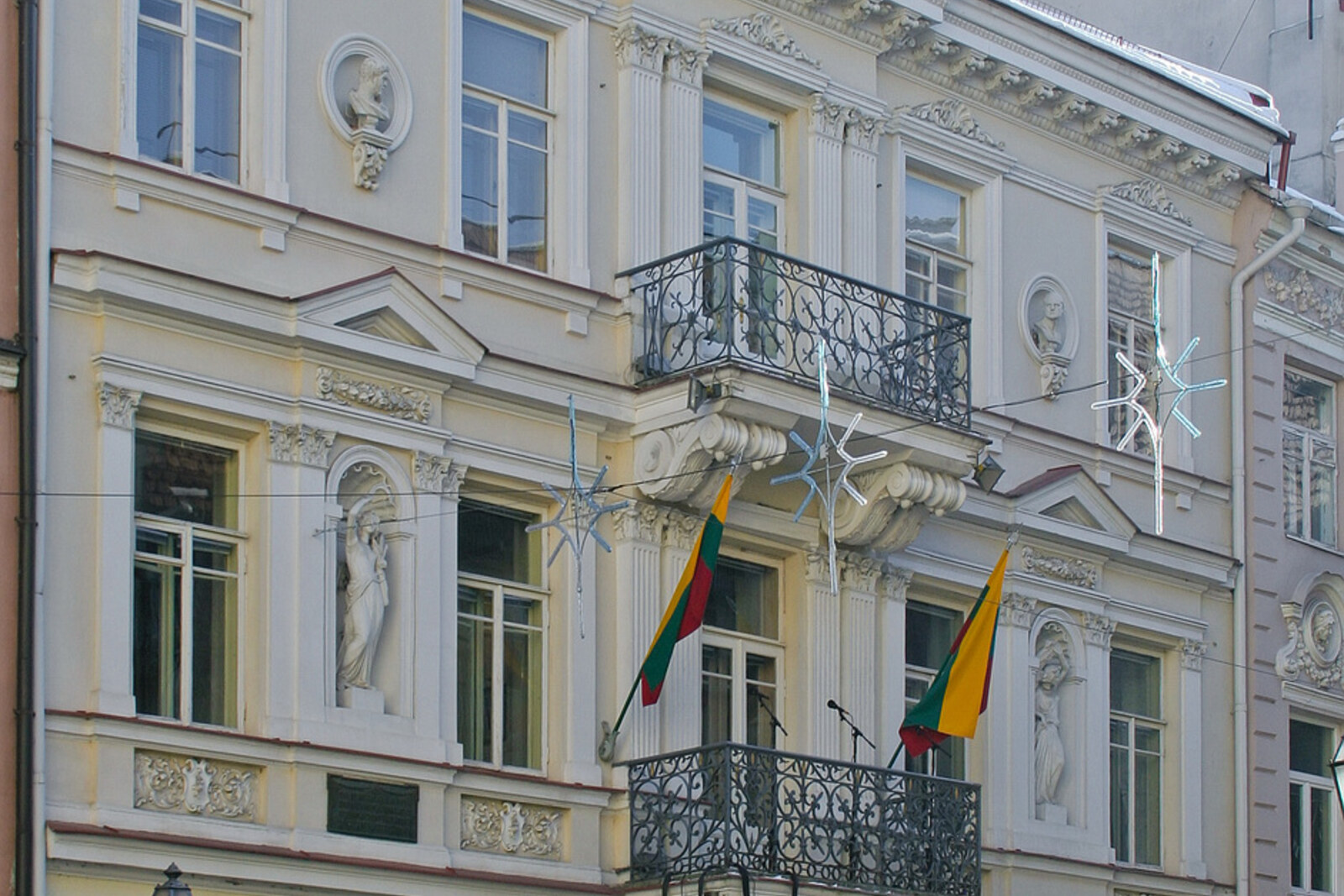
Look around first
What to notice
- Façade of house No. 26
- Balconies above the street
- Third-floor windows
The story of the place
The balconies and third-floor windows remain from the renovation carried out by the owners of the house in the late nineteenth century. The White Sztral pastry shop operated below them, while the upper floors were rented out as living quarters. One apartment was occupied by the society for the relief of war sufferers: it distributed food and ran shelters and schools. The house received its present name later, when the room above the pastry shop became connected with the fate of the Lithuanian state.
Pilies means “Castle” in Lithuanian. The street grew up along the road that led north from the south to Vilnius Castle; envoys and princely guests arrived by way of it. House number twenty-six entered history much later, and the main events unfolded not in the grand hall but in a rented apartment above a pastry shop.
In eighteen ninety-five, Karol Sztral and Józefa Sztral rebuilt the house. The White Sztral pastry shop opened downstairs, while the owners rented out apartments upstairs. In nineteen fifteen, the Lithuanian Society for the Relief of War Sufferers leased one of them on the third floor. Its staff distributed food, ran shelters and schools, and also provided rooms to people who were trying to agree on Lithuania’s future. That is why the Council of Lithuania met here.
The Council consisted of twenty people elected by the Vilnius Conference in the autumn of nineteen seventeen. Lithuania was then under German military occupation. Antanas Smetona, the chairman of the Council, sought recognition for the Lithuanian state and regarded an agreement with Germany as an acceptable price. In December, the majority approved a declaration that, following the proclamation of independence, promised a “firm and permanent union” with Germany.
Steponas Kairys opposed it. He was a Social Democrat and a city engineer who, before the war, had overseen the installation of Vilna’s sewerage and water-supply systems. He demanded that the promise of a union be removed: the Council was a temporary body and, in his view, could not bind the future country in advance through military, customs, and monetary agreements. The form of government and relations with neighboring countries were to be determined by those elected by the inhabitants.
Kairys was joined by Mykolas Biržiška, director of the Lithuanian gymnasium, and the lawyers Stanislovas Narutavičius and Jonas Vileišis. When, on January twenty-sixth, nineteen eighteen, the majority again adopted a formula pleasing to the German administration, the four left the Council. Kairys risked his place in the only Lithuanian representative body to which he had been elected. The remaining sixteen also stood to lose: without the Social Democrats and Democrats, it became harder for them to speak in the name of the whole country.
On February fifteenth, the sides agreed on a new text. The next day, twenty people gathered in a room on the third floor. They proclaimed the restoration of an independent state founded on democratic principles, with Vilnius as its capital; they severed former state ties and wrote in the central demand of the four who had left: the foundations of the state would be definitively established by the Constituent Assembly of Lithuania, elected by all inhabitants. The decision was adopted unanimously. Their signatures made the Council members signatories—people who personally certified this act.
The document did not bring immediate freedom. The German administration confiscated the print run of Lietuvos aidas containing its text and continued to invoke the December promise of a union. Only after Germany’s defeat could the Council begin forming a government. Universal elections were held in the spring of nineteen twenty, and on May fifteenth the Constituent Assembly of Lithuania declared Lithuania a democratic republic. The Council of Lithuania transferred its powers to it—exactly as Kairys and his three allies had insisted in the rented room above the pastry shop.
The balconies on the façade had appeared under the Sztrals, but on February sixteenth, nineteen eighteen, the act was not proclaimed from them: public proclamation was forbidden. Speeches from the balcony began only in nineteen ninety-eight. The signatures were made upstairs, behind the third-floor windows; because of those twenty signatures, the former Sztral house is now called the House of the Signatories.
Useful on site
The façade is accessible at all times. From May through October 2026, the museum admits only pre-registered groups because it is preparing a new exhibition.
Checked: June 24, 2026. Check the official source before visiting.You can listen to the story of the signing by the house. If the museum objects and interiors matter to you, check access in advance: free entry inside is not guaranteed.