 Guide On Map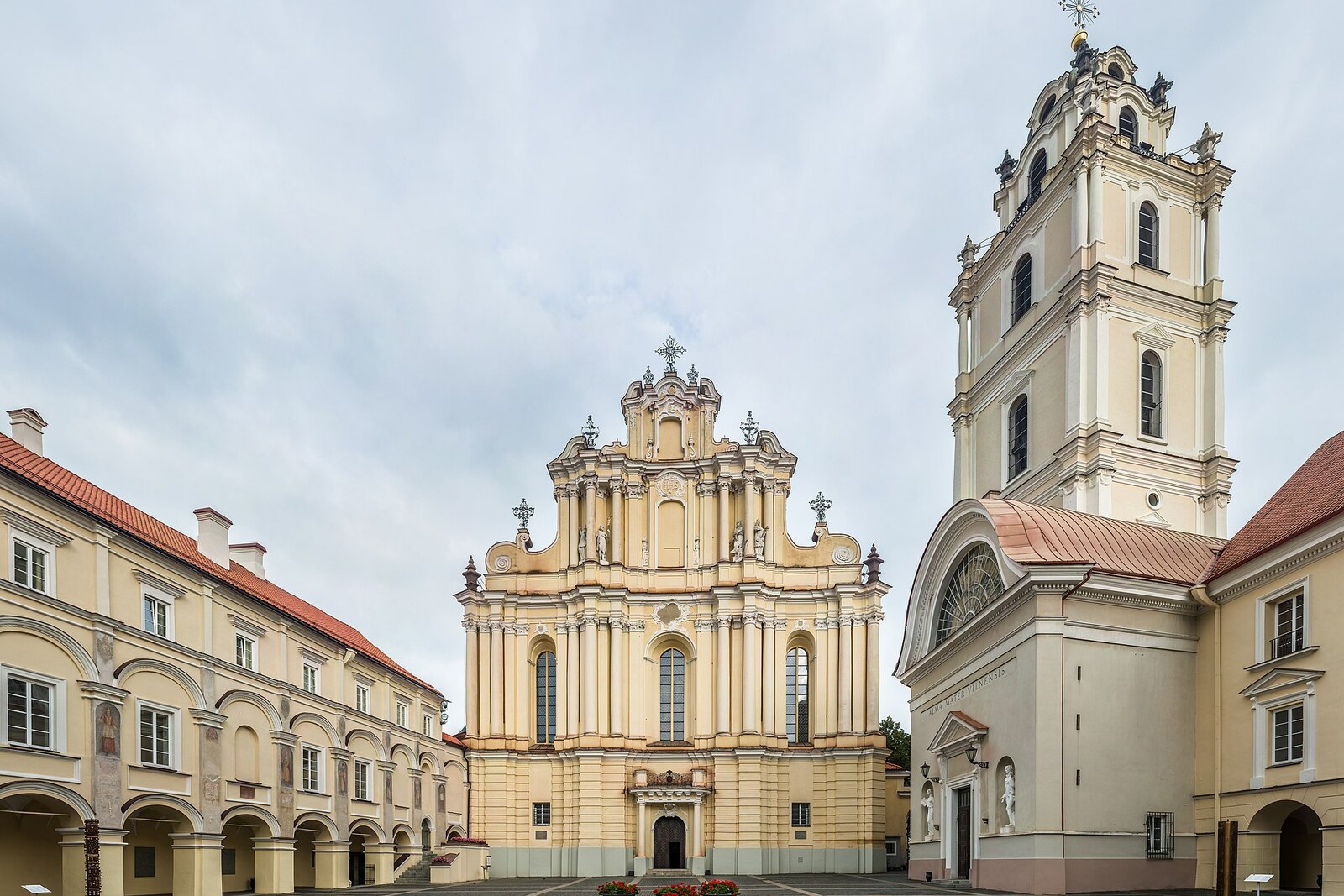
Look around first
What to notice
- Arcades of the Grand Courtyard
- Façade of the Church of St Johns
- Bell tower
- Portrait of Valerian Protasewicz
The story of the place
The arcades of the Grand Courtyard link the Church of St Johns with the old aula and the university classrooms. At first, there was a courtyard of the Vilnius Jesuit College beside the church; a large neighboring two-story house was bought for it. Galleries, the bell tower, and the church's Baroque façade were added to the appearance of the courtyard later; they did not yet exist in its early years. At the start of the academic year, students and teachers again pass here in procession between the church and the university buildings.
On October eighteenth, fifteen seventy, “Hercules” was performed here. There was not yet a professional theater in the city: the roles were played by students of the newly opened Vilnius Jesuit College, a school that prepared students for the study of philosophy and theology. The comedy was performed in Latin. This was how the teachers immediately showed what they intended to teach: command of the language, the ability to construct an argument, and composure before an audience. It was the first known theatrical performance in the territory of Lithuania.
The present Baroque façades did not exist then. On the site of the Grand Courtyard stood the courtyard of the Vilnius Jesuit College beside the Church of St Johns. The school was established by Valerian Protasewicz, Bishop of Vilnius, who sought to ensure that Catholics answered the spread of the Reformation with education rather than bans alone. He invited the Jesuits, bought them a large two-story house beside the church, gave them part of his library, and provided the school with income from landed estates. Later, he founded a dormitory for poor students. For the bishop, this was an expenditure of the property that supported both himself and his institutions, not honorary patronage from afar.
The opening was conceived as a public contest. The Jesuits posted theological theses on the church door and waited seven days for opponents, ready to defend them in a debate. No one came. The students then performed “Hercules” in the courtyard, and on October twenty-third, one hundred sixty young men began their studies. Grammar, poetics, and rhetoric were taught here; philosophy and theology were added soon afterward. Performances and disputations continued: the courtyard served as an open-air hall, the church as a venue for public debates, and works were defended and degrees awarded in the neighboring aula.
Yet the college could not yet award university diplomas. Wealthy young men left for places where a degree was recognized beyond a single school. For several years, Protasewicz sought new rights. In fifteen seventy-nine, Stephen Báthory, King of Poland and Grand Duke of Lithuania, issued a privilege establishing the Vilnius Academy, and Pope Gregory the Thirteenth confirmed it with a bull. The college received the right to award degrees in philosophy and theology. The Jesuit Piotr Skarga was appointed its first rector; this is why the Grand Courtyard was later called Skarga's courtyard.
Protasewicz died two months after the papal decision. The Jesuits governed the university he had created for almost two centuries, and students could defend their theses in Vilnius instead of traveling for a recognized diploma.
The arcades, bell tower, and the church's present façade appeared later. No scenery from the first “Hercules” remains. A portrait of Protasewicz has survived in the gallery, and at the beginning of the academic year, a procession of students and teachers still enters here: doors from the courtyard lead to the church, the university aula, and the classrooms.
Useful on site
Central complex: Monday–Saturday 9:00–18:00. Church of St Johns: Monday–Saturday 9:00–19:00, Sunday 9:00–15:00. Bell tower: daily 10:00–19:00, tickets until 18:30.
Checked: June 24, 2026. Check the official source before visiting.The university remains a working space, so access to the courtyard may be restricted. In that case, listen from the entrance arch; plan a climb up the bell tower separately.