 Guide On Map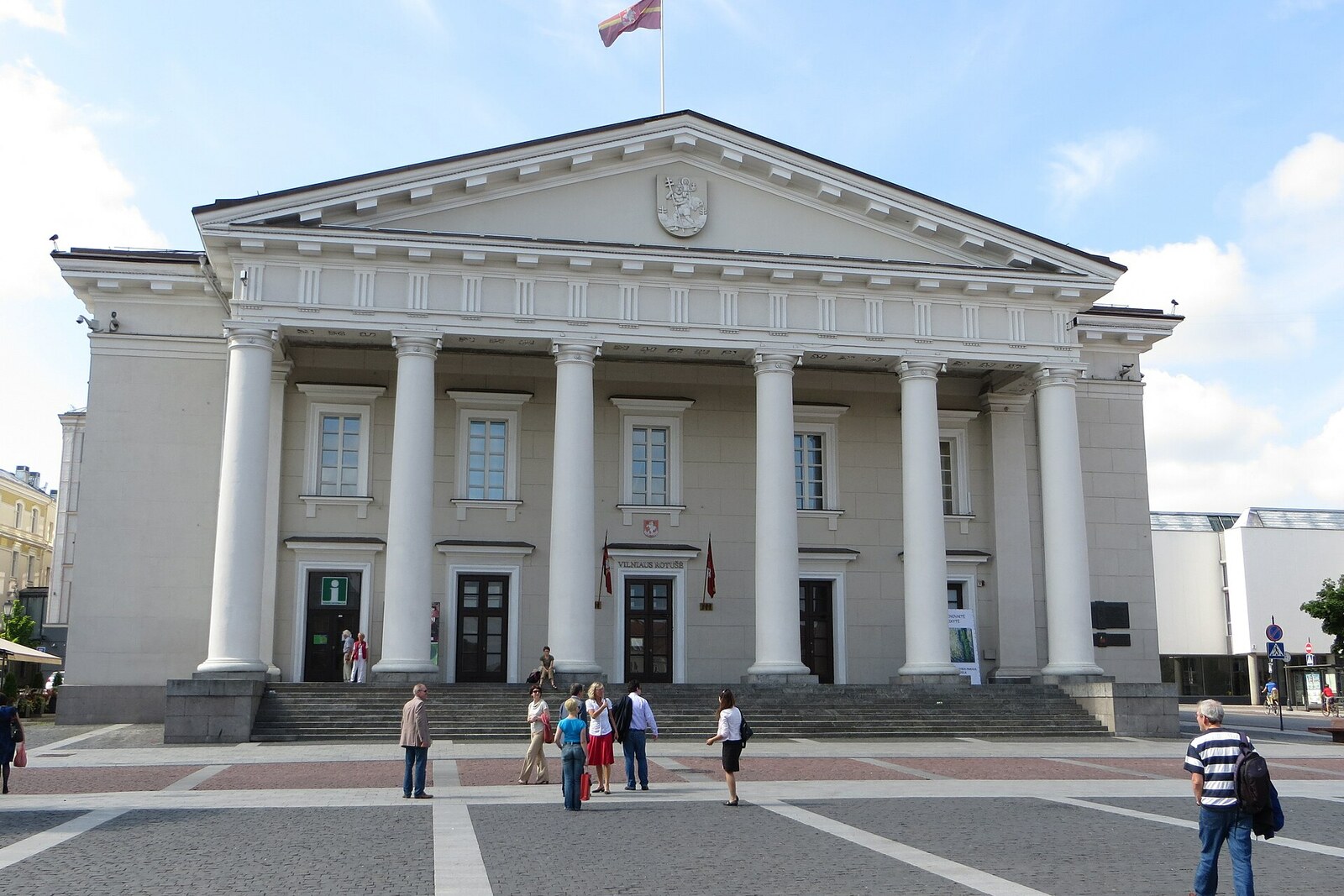
Look around first
What to notice
- The town hall's white portico
- The town hall façade
- The square's open space
The story of the place
The market around the town hall served the city as a place for trade, hiring, and meetings with rulers, which is why the square was once called Market Square. The magistrate, the city council and court, met in the town hall; the treasury and weapons were also kept here, while the underground chambers served as a prison. The white portico on the façade belongs to the building's reconstruction design. Today, the open space is occupied by fairs and city celebrations, while ceremonies, concerts, and exhibitions are held behind the portico.
On April twenty-fourth, seventeen ninety-four, one of the leaders of the uprising climbed onto a table here with a sheet of paper in his hands. Otherwise, those assembled would not have been able to see who was reading. Before him stood townspeople of different estates and Lithuanian military units, while banners and cannons captured from the Russian garrison had been displayed beside him. From the sheet came the Act of the Uprising of the Lithuanian People.
The uprising had been prepared by Jakub Jasiński, a colonel who commanded the Engineering Corps of the Grand Duchy of Lithuania and taught fortification to officers. After the Second Partition of the Polish–Lithuanian Commonwealth, the joint state of Poland and the Grand Duchy, a Russian garrison was stationed in Vilnius. The Polish-Lithuanian army began to be reduced by half; dismissed soldiers were compelled to enter Russian or Prussian service. For Jasiński, this meant the destruction of the army in which he served and from whose pay he lived. He began secretly gathering officers to raise the city and restore the state. When the conspiracy was uncovered, the colonel had to hide in Antakalnis.
During the night before the gathering in the square, Jasiński's detachments occupied Vilnius. Most of the garrison's soldiers and their commanders were taken prisoner, but some left the city with the artillery. Fighting could resume, so Jasiński needed to announce immediately on whose behalf the armed men were now acting.
The square was then called Market Square—today's Town Hall Square. The magistrate, that is, the city council and court, met in the town hall; the treasury and weapons were kept there, and prisoners were held in the cellars. People traded, hired themselves out for work, welcomed rulers, and carried out sentences around it. The capture of the garrison remained a military matter. Reading the act before the building of city self-government turned the uprising into a public commitment by the townspeople.
Jasiński, already appointed commandant of Vilnius, came out into the square with the members of the new council, which was to lead the uprising in the Grand Duchy of Lithuania. After the reading, they took an oath. Then more than two thousand residents signed the act. Jasiński was soon appointed commander in chief of the Lithuanian forces, but he was accused of excessive republican radicalism and of seeking to act too independently from Tadeusz Kościuszko, the overall leader of the uprising. In June, Kościuszko removed him from office. Jasiński went to fight near Warsaw and was killed in November on the barricades of Praga, a Warsaw suburb. The uprising was crushed; the following year, the Third Partition ended the existence of the Polish–Lithuanian Commonwealth.
Among the members of the council created here was Laurynas Gucevičius, a professor and architect who was rebuilding the town hall. After the act was proclaimed, he was entrusted with gathering armed townspeople into a city guard. He led it into battle, was wounded, and after the defeat temporarily lost his university chair. He was able to return to teaching only three years later.
Today, the town hall hosts city ceremonies, exhibitions, concerts, and weddings, while fairs and major events are held in the square. The table, the captured banners, and the old market rows have disappeared. The white portico belongs to Gucevičius's rebuilding design, but on the day the act was read, the town hall was still being rebuilt. The architect died in seventeen ninety-eight; the building was completed one year after his death.
Useful on site
Town Hall: Monday–Friday 11:00–19:00, Saturday 10:00–17:00, closed Sunday. Admission to exhibitions is free.
Checked: June 24, 2026. Check the official source before visiting.The main sights are visible from the square; there is no need to go inside for this account. During city events, choose a spot where you do not obstruct passage or the work taking place at the venue.