 Guide On Map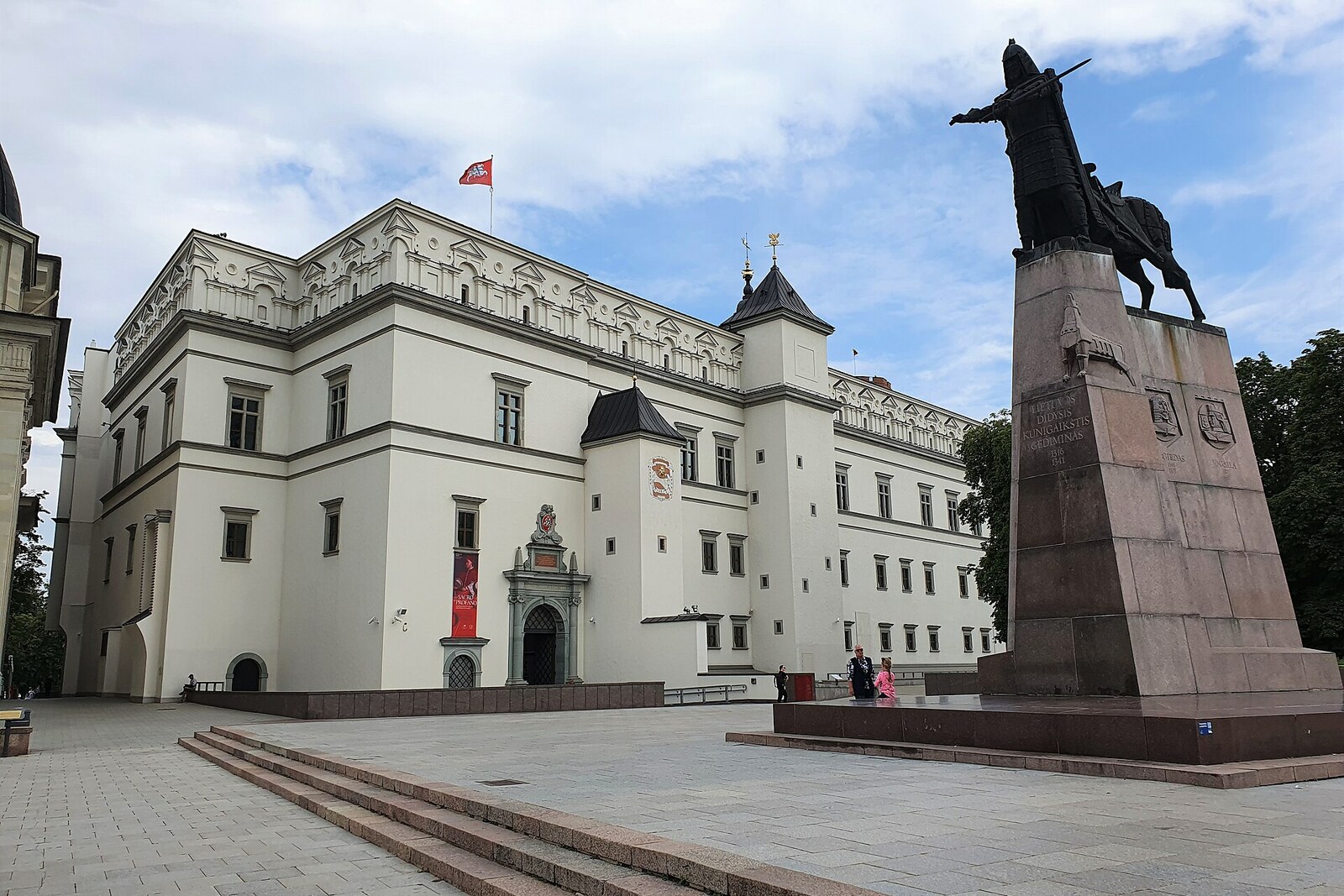
Look around first
What to notice
- Monument to Gediminas
- Iron Wolf on the pedestal
- Colored strip in the paving
- White facade of Vilnius Cathedral
The story of the place
Cathedral Square occupies the center of the vanished Vilnius Lower Castle, Vilnius's main ducal residence. Beneath the bronze statue, archaeologists found several pavements, a fragment of wall with an entrance, and a road to the castle; a colored line among the stones shows part of its boundary. The white Vilnius Cathedral appeared here much later with the country's conversion to Catholicism and changed its appearance many times, but the square still connects the former castle with the city's principal church.
Before the Catholic cathedral stands a man who remained a pagan until his death. This is Gediminas, the grand duke—the supreme ruler of Lithuania at the time. The sculptor placed him beside a horse, put a sword in his left hand, and raised his right in a gesture of blessing.
Gediminas is called the founder of Vilnius, although a settlement existed here long before him. Archaeologists found fortifications and residential buildings that appeared before the duke's rule. Gediminas made Vilnius his main residence, expanded Vilnius Lower Castle, and first named the city in a document that can be dated precisely.
At the beginning of the fourteenth century, the duke needed two things: a respite in the war with the Teutonic Order and people for his growing capital. The Order was a state of warrior monks who attacked pagan Lithuania, declaring its baptism to be their aim. Gediminas tried to deprive them of this argument with the help of the pope, but his own baptism could have cost him his throne and his life. His state united pagan Lithuanians and Orthodox Ruthenian lands; envoys later reported that close associates on both sides threatened the duke with reprisals if he became a Catholic.
Gediminas dictated Latin letters to his court monks. They were most likely drafted in the castle's residential tower nearby, where the Palace of the Grand Dukes of Lithuania now stands. On January twenty-fifth, thirteen twenty-three, the duke addressed the inhabitants of Lübeck, Bremen, Magdeburg, Cologne, and other cities. He invited knights, merchants, physicians, blacksmiths, shoemakers, millers, and farmers to Lithuania. He promised peasants ten years without taxes, merchants free entry and exit without duties, and Christians the opportunity to practice their faith. This is the first letter in which the name Vilnius survives in writing.
At the same time, Gediminas complained to Pope John the Twenty-Second about the Teutonic Order and used formulas that Rome understood as a promise to accept Catholicism. The pope, who sought the baptism of the Lithuanian ruler, sent him legates—his plenipotentiary representatives. In the autumn of thirteen twenty-four, their envoys arrived at the court in Vilnius to obtain final consent.
At the audience, Gediminas asked whether they knew the contents of the letter. The envoys replied that the duke intended to be baptized. He then declared that he had given no such instruction and accused the Franciscan Berthold—a monk who recorded the duke's words in Latin. Berthold defended himself: he had written that Gediminas wished to become a “son of obedience” and place himself under the protection of Holy Mother Church. To the Catholic clergy, these words meant baptism. Gediminas interpreted them differently. He said that he could call the pope father only because the pope was older; he called people of his own age brothers, and younger people sons.
The surviving account makes clear how the meeting ended, but it cannot establish whether the duke sincerely intended to be baptized at first or had left a loophole in the letter from the beginning. The envoys returned without consent. Gediminas remained a pagan, but the papal legates confirmed the four-year truce he had concluded, and Catholic monks continued to minister in his possessions.
The official baptism of Lithuania took place only six decades later. It was carried out by Gediminas's grandson Jogaila, who accepted Catholicism, received the Polish crown, and founded Vilnius Cathedral here in thirteen eighty-seven. The present white church was rebuilt many times, but the square's name still points to Jogaila's decision, and the monument before it to his grandfather's unfinished negotiations.
When a foundation was prepared for the bronze Gediminas in nineteen ninety-six, archaeologists discovered several old pavements beneath the future pedestal, a wall with a gate opening, and a road to the ducal residence. The statue was placed almost at the center of the former Vilnius Lower Castle. A colored strip in the square's paving marks part of its boundary.
The Iron Wolf on the pedestal relates to the legend of Gediminas's prophetic dream; it is a legend about the founding of the city. The documentary evidence is more modest: the originals of the duke's letters disappeared, and a copy made in Riga survives. It bears the date from which Vilnius now counts its age.
Useful on site
The square and the monument are accessible around the clock.
Checked: June 24, 2026. Check the official source before visiting.The hidden crypts and fortifications of Vilnius Cathedral are not visible from the square; for this stop, the open space and the four named landmarks are enough.