 Guide On Map
Medina of Tunis: Markets, Palaces, and Power
From Bab el Bhar through Zitouna Mosque and the Kasbah to Tourbet el Bey
Guide On Map on your phone
Open the walk like a regular app
It takes about 10 seconds to install. No app store needed.
The whole path
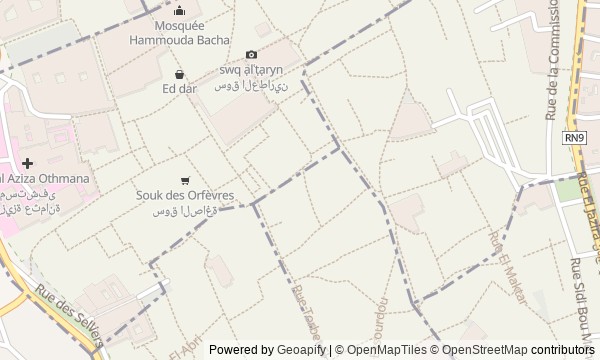
Route map
About the walk
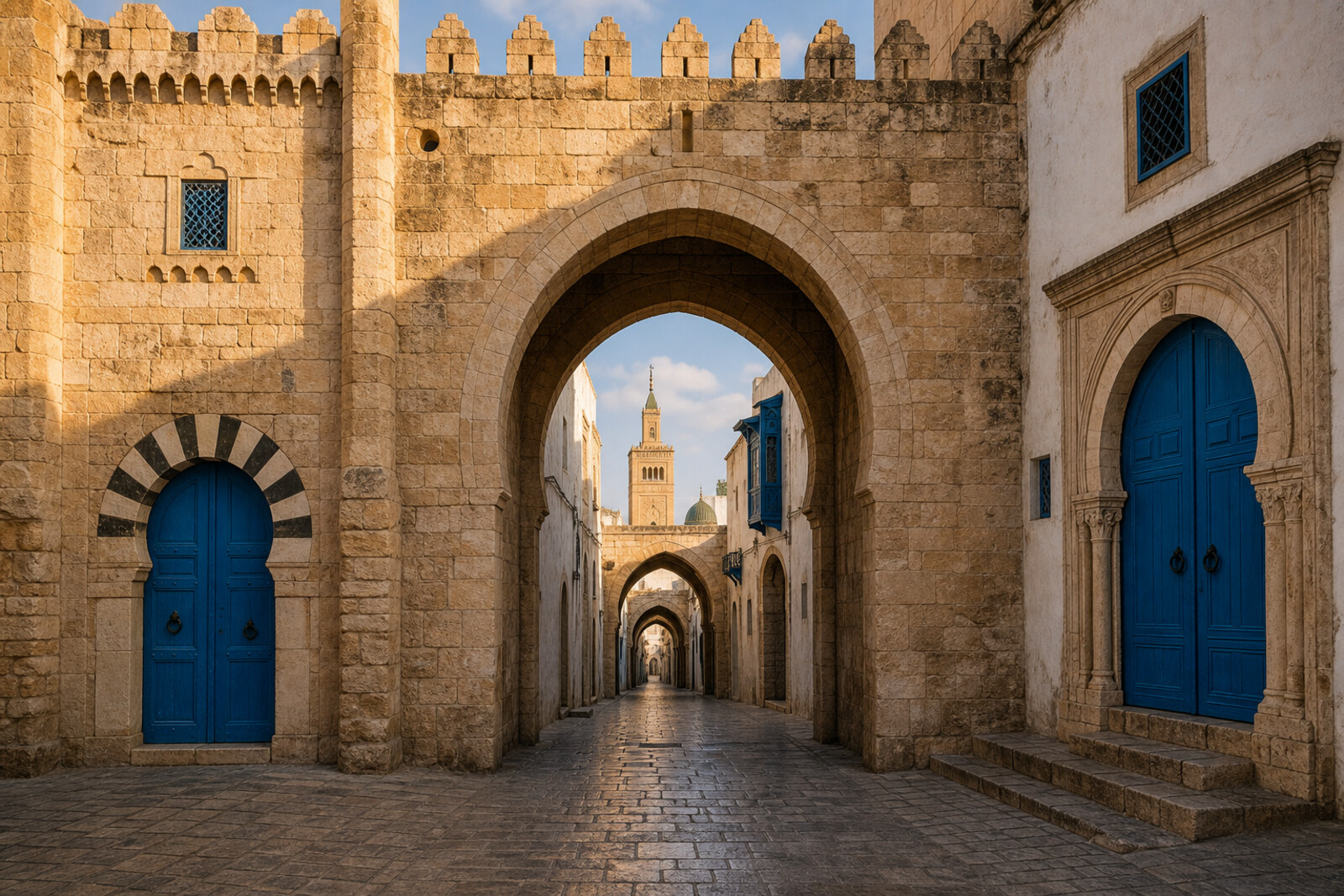
You will enter the medina through a freestanding arch and follow its main commercial street toward Zitouna Mosque. Then the way will narrow into covered rows of perfume sellers and jewelers, open out at Kasbah Square, and slip back into lanes leading to palaces and a family mausoleum.
This is not a walk through an “Eastern bazaar,” but through a capital where the place of a shop, a circle of learning, a palace hall, and a gunpowder store determined who could trade, study, and rule. You will encounter tiny raised shops, a vanished Friday platform, a palace without an owner, and a square beneath which traces of old workshops were found. The answers remain within the stories: why students had to return to the same columns, and why the head of the Tunis Municipal Council needed a certificate of good conduct.
The story will be precise, calm, and free of postcard gloss. By the end, you will be able to read the workings of old Tunis in the distances between the mosque, the market, the palace, and Kasbah Square.
Why this order
Bab el Bhar establishes the boundary between the new city and the medina; the straight commercial street leads to Zitouna Mosque, where the dispute at the gate was directed. From the center of learning, the route moves to Souk el Attarine, which adjoins its north wall: here, a merchant’s standing was determined by the distance from the mosque. The covered rows continue to Souk el Berka and Souk Ech-Chaouachine, where the hierarchy of trade becomes stories of ownership over people and the organization of craft. Dar el Bey stands nearby, so after the market, power appears in the form of halls, commissions, and officials. From the palace, the route reaches Kasbah Square, where the military framework of that power becomes clear. It then descends to Dar Hussein, where state reform narrows to the accounts of a single Tunis Municipal Council. The move to Tourbet el Bey completes the chain where inheritance determined the order of burials and places beneath the dome.
Those who want to understand how the medina worked, not simply pass through its markets Lovers of political and urban history without ceremonial rhetoric Those interested in specific human failures, deals, and decisions
Those looking above all for shopping and food stops Those who want an easy overview walk through the main postcard sights Those who do not want to hear about the history of slavery, executions, and struggles for power
Before you go
Plan first and foremost for a walk through a living city, not a chain of museums. Zitouna Mosque remains an active mosque: choose modest clothing, do not disrupt prayer, and accept local access restrictions without argument. Dar Hussein and Dar el Bey matter to the route even from outside; the latter is connected to state institutions, so remain in public areas and follow security instructions. Check locally whether it is possible to enter Tourbet el Bey, without making the interior a required part of the walk. In the souks, passages are narrow and shops keep their own rhythm: do not block the way, and ask permission before taking close-up photographs of people or goods. Save the map in advance and wear shoes suited to uneven streets.
When to go
Start during daylight, when you can make out the details clearly and find the souks alive. Morning is usually better for an attentive walk; allow enough daylight for Kasbah Square and Tourbet el Bey rather than counting on late entry.
Backup plan
A closed door does not break this route. If you cannot enter the courtyard of Zitouna Mosque, view the mosque from accessible streets and focus on its place within the commercial center. Read Dar Hussein and Dar el Bey from their outward restraint and from the way the character of the medina changes around them. If Tourbet el Bey is closed, end the story at the facade: the lack of access echoes the mausoleum’s own history, full of significant absences. If the souks slow you down, shorten the time spent shopping, but keep the sequence from Souk el Berka to the palaces and Kasbah Square—it is this transition that links trade to power.
Route conditions
Surface. Paved — 848 m (data covers 46% of the route)
Elevation. Ascent — 22 m; descent — 14 m
OpenStreetMap extract of June 18, 2026: database data, not a check on the ground. Data © OpenStreetMap contributors, ODbL licence
Walk plan
Open in maps ↗- 1
Bab el Bhar
Here you will see why a single open passage could become a carefully chosen political symbol. - 2
Zitouna Mosque
This stop will take you to a student strike, after which the students returned to the same columns and an almost unchanged curriculum. - 3
Souk el Attarine
Here, the distance to the main mosque explains the craft's place in the old urban hierarchy. - 4
Souk el Berka and the Trace of the Chaouachine
This stop links the gradual abolition of slavery to the neighboring production chain of chechia makers. - 5
Dar el Bey
Here, a palace without a permanent court became the place where people tried to turn promised guarantees into rules of state. - 6
Kasbah Square
The open esplanade will help reconstruct the vanished citadel and understand why its defenders lacked the most essential thing. - 7
Dar Hussein
The history of the first municipal council will show how city work came to a halt with revenues that existed only on paper. - 8
Tourbet el Bey
The finale will show how the dispute over succession continued in burial arrangements and the placement of family graves.
Route features
Everything you need stays in the browser
Progress, saves and your trip plan are stored on this device.
Add Guide On Map to your home screen so the walk opens outside the browser.
How we handle sources, maps and corrections: our editorial standards