 Guide On Map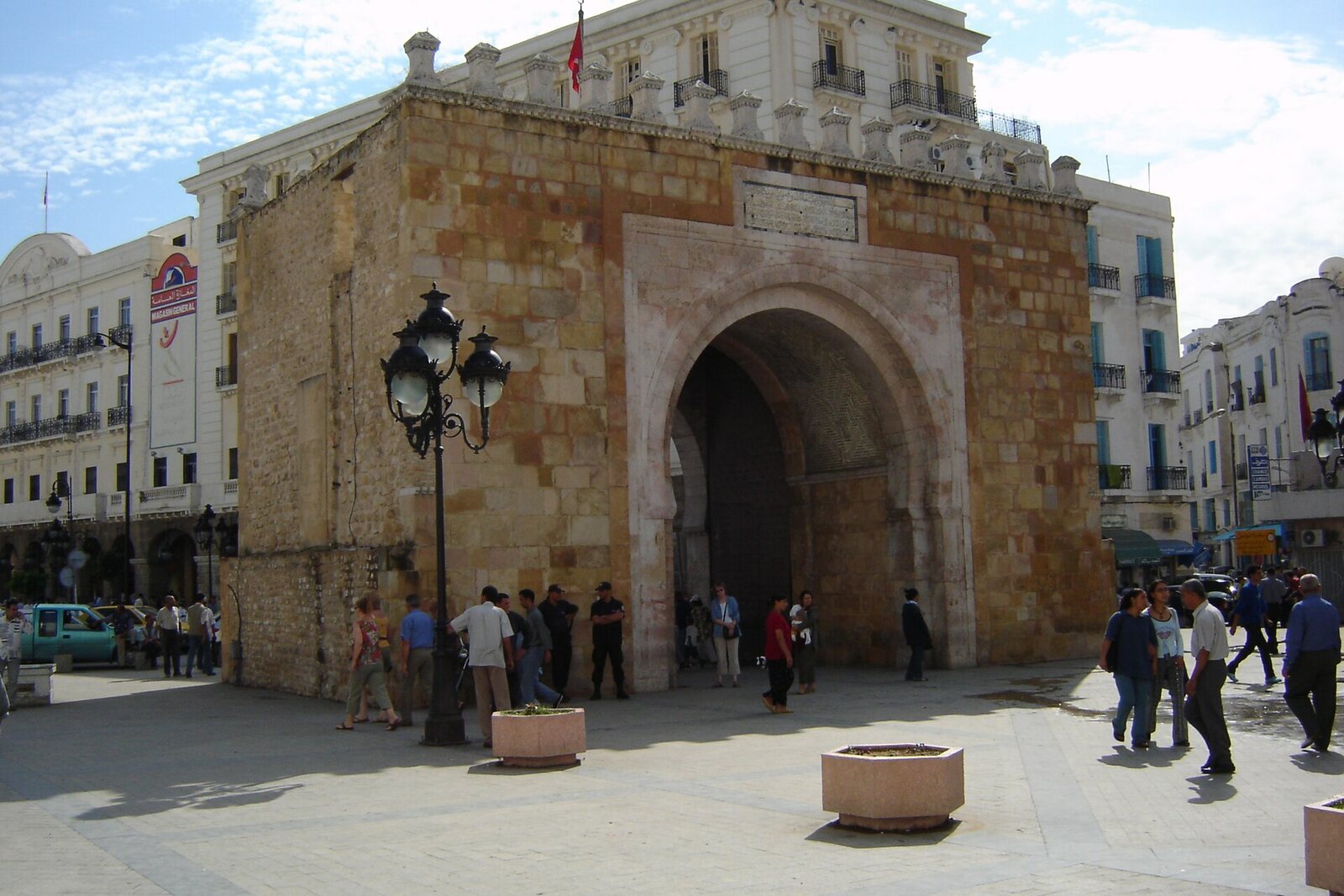
Look around first
What to notice
- A freestanding stone arch
- The gate opening
- Avenue de France
- Jamaa Ez-Zitouna Street
The story of the place
Bab el Bhar means “Sea Gate,” although the water never reached this arch. Beyond the city wall, the road began toward the pier on the Lake of Tunis: boats from La Goulette were unloaded there, and a naval arsenal stood nearby. People and goods entered the medina through the gate. The wall was later dismantled, and in late nineteen thirty-nine the shops pressed tightly around the passage were removed as well. That is why the gate now stands alone in the middle of the square.
After the French protectorate was established, a new city with straight streets grew up on the opposite side. The French called the arch Bab el Bhar. The old name is still used, but it did not arise from the shape of the building. The gate stood at the end of Avenue de France, before the street that leads through the medina to Zitouna Mosque. It was precisely this location that the French administration chose in nineteen twenty-five for a monument to Cardinal Charles Lavigerie.
Lavigerie was a former Archbishop of Carthage and the founder of the White Fathers missionary order. For the centenary of his birth, the French general resident Lucien Saint sought a major public tribute. The Tunis Municipal Council discussed several sites: by the cathedral, in Carthage, and at the White Fathers seminary. Tunisian council members warned that placing a monument at the entrance to the Muslim medina was dangerous. But the council chose the then Bourse Square in front of Bab el Bhar.
The site made it possible to compose a precise scene. Behind the bronze cardinal stretched the European Avenue, with the residence of the French administration, the cathedral, and the theater. Before him opened the passage to Zitouna Mosque. The sculptor Élie-Jean Vézien gave Lavigerie a Gospel and a raised cross. The square was renamed Cardinal Lavigerie Square.
A few days later, hundreds of Zitouna students went to city hall to demand that the statue be removed. They studied theology and law, expecting after graduation to take one of the few livelihoods available to them: teaching or work as a notary or judge. The mayor refused to receive them, ordered the delegation pushed out, and sent several participants to prison. The students then went to the residence of the general resident. Lucien Saint did not come out to meet them either and called the police; further arrests followed. Two students who later tried to damage the monument were sentenced to forced labor.
The protesters did not achieve their immediate goal. The bronze Lavigerie remained before the gate for another three decades. In photographs, his figure appeared in the opening of the arch: the raised cross stood exactly between the European Avenue and the street leading into the medina.
After independence was proclaimed, Prime Minister Habib Bourguiba demanded that the monument be removed. Maurice Perrin, Archbishop of Carthage, agreed to transfer it to the White Fathers. On May eighth, nineteen fifty-six, workers spent five hours removing the statue from its pedestal before a gathered crowd. It was taken to Carthage, and later the White Fathers themselves cut the bronze figure into pieces.
It is now Victory Square. Avenue de France begins on one side of the arch, and Jamaa Ez-Zitouna Street on the other. The fortress wall and the figure with the cross are gone; the open passage of Bab el Bhar remains.
Useful on site
The exterior can be viewed all day; this is a city passage, not a ticketed site.
Checked: June 17, 2026. Check the official source before visiting.Step away from the main flow before listening to the story or taking photographs: people are constantly passing through the arch.