 Guide On Map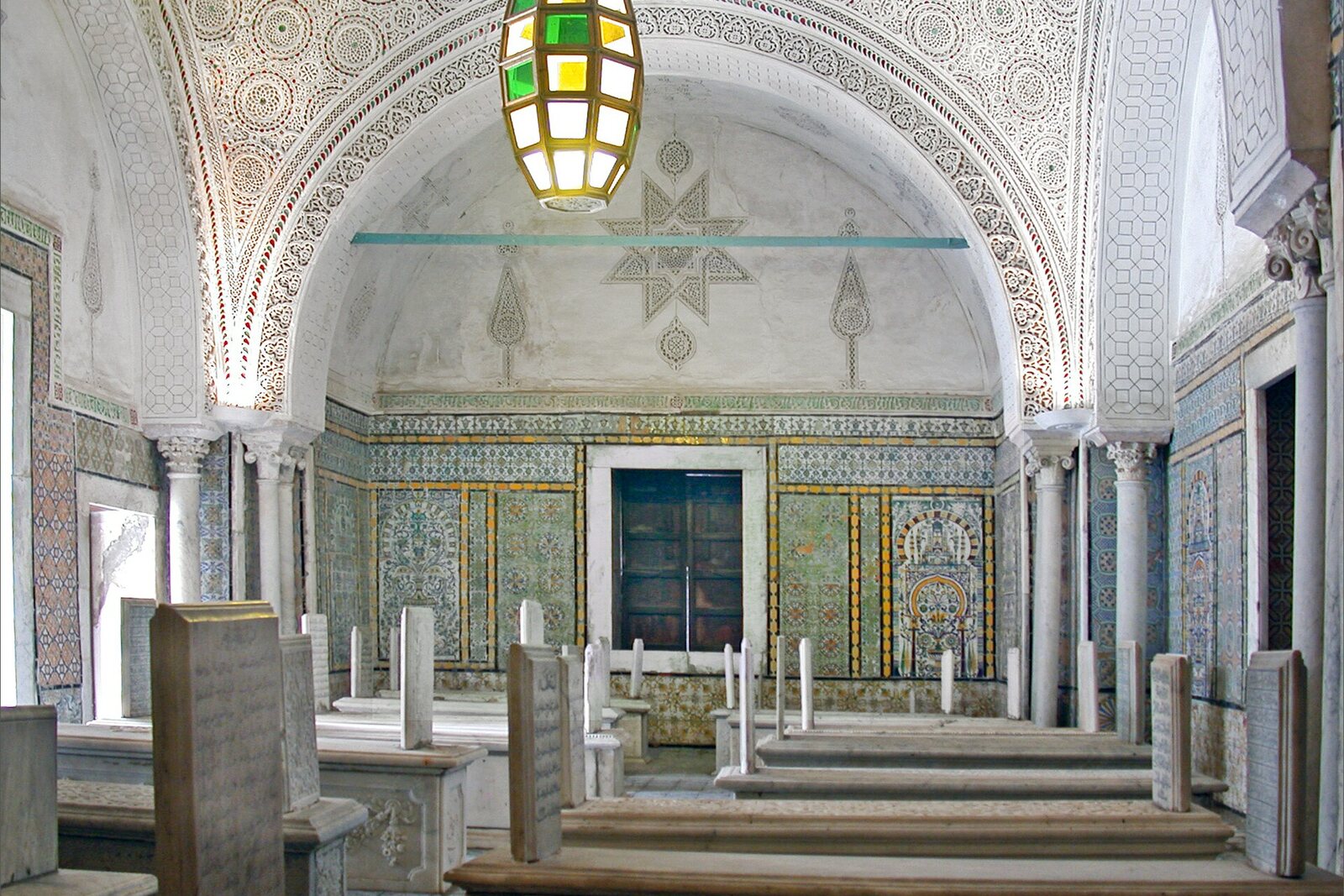
Look around first
What to notice
- Green-tiled dome
- Two inner courtyards
- Marble tombstones
- Ornamented wooden box
The story of the place
In the main hall of Tourbet el Bey, before any Bey's grave appeared, there was an ornamented wooden box belonging to Hassan al-Sharif—a righteous man revered by the early Husainids. Whether he was actually buried beneath the box has not been established with certainty: some researchers consider it a grave, while others consider it a cenotaph, a memorial tombstone without remains. It was placed here for the blessing associated with the revered man: it was meant to protect the future family mausoleum.
It was commissioned by Ali Bey II, son of the founder of the Husainid dynasty. His father, Hussein bin Ali, lost the throne in a struggle with his own nephew, Ali Pasha I. Hussein was captured near Kairouan and beheaded; his head was brought to Tunis and buried at Sidi Kacem. The murdered man's sons, Muhammad al-Rashid and Ali, found themselves in Algiers and depended on the support of the local dey. In seventeen fifty-six, they returned with an army, defeated Ali Pasha I, and restored the throne to their branch of the family. Muhammad al-Rashid, the elder brother, ruled first, and after his death Ali became Bey.
Around seventeen seventy, Ali began building a new necropolis here. The word “tourba” means a family mausoleum, and “Bey” is the title of the Tunisian ruler. Construction was completed by seventeen seventy-seven. Ali transferred landholdings and real estate into a waqf—an endowment in perpetuity whose income could not be taken by heirs. The money was used to maintain the building, pay its caretaker and Quran readers, and hold memorial ceremonies. In this way, Ali provided in advance for both a place for his future grave and the people who were to serve there after his death.
At the same time, he was deciding who would arrange his burial. His late brother had wanted the throne eventually to pass to his sons, Mahmud and Ismail. Ali promised to act as guardian to his nephews, but he was preparing his own son, Hammuda, as heir. He entrusted state affairs to him, sought recognition in Istanbul, and in seventeen eighty-one received a sultan's decree in Hammuda's favor. This was directly connected with Tourbet el Bey: under a court rule, a deceased Pasha Bey could be buried only by the new Pasha Bey, who had already ascended the throne.
Ali died the following year and became the first ruling Bey buried beneath the main dome. Hammuda inherited the throne and, thirty-two years later, was laid to rest beside his father. Mahmud, the nephew whom Ali had excluded from the succession, nevertheless became Bey in eighteen fourteen; he was buried in the same hall.
Later, relatives added new rooms as space ran out. There are now eight halls and more than one hundred sixty-five graves around two courtyards: fourteen ruling Beys, princes, princesses, ministers, mamluks, and courtiers are buried here. Beneath the green-tiled dome stand the marble tombstones of Ali, Hammuda, and Mahmud. In front of them still stands Hassan al-Sharif's wooden box—the first sign Ali ordered placed in the still-empty mausoleum.
Useful on site
Exterior viewing is reliable; interior access arrangements may change after restoration, so it is best to check the hours on site that same day.
Checked: June 17, 2026. Check the official source before visiting.Ask on site whether entry is possible, behave as you would in a burial space, and do not touch the tombstones; exterior viewing remains a complete conclusion.