 Guide On Map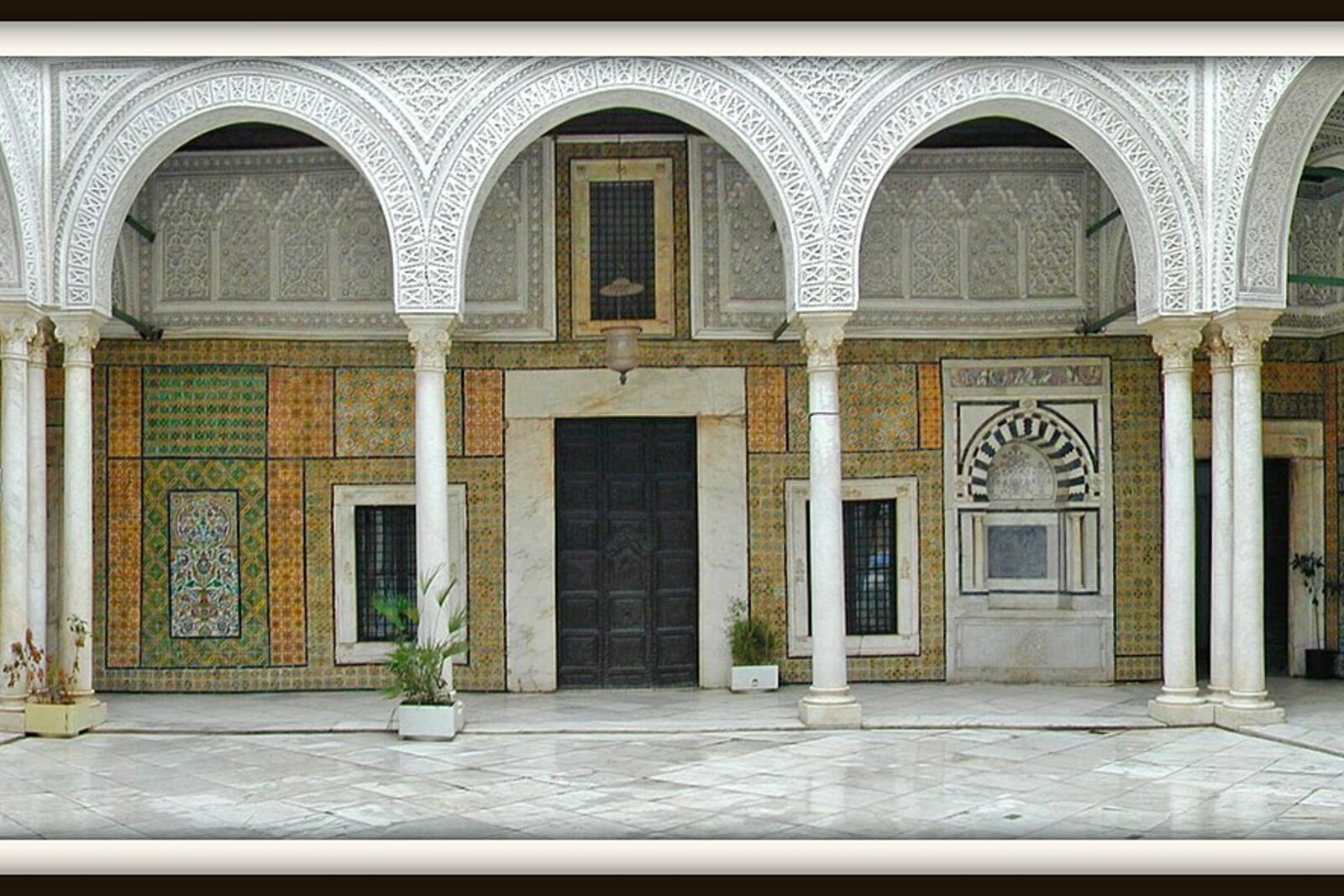
Look around first
What to notice
- Palace facade
- Marble courtyard
- East wing of the upper floor
- Municipal council hall
The story of the place
Since nineteen fifty-seven, researchers from the National Heritage Institute have worked behind the palace facade, compiling inventories of monuments and preparing restorations. The house is arranged around a marble courtyard; a large hall survives in the east wing of the upper floor. These chambers once served as a city residence for people from the bey's inner circle, and then briefly housed the institution responsible for the capital's affairs.
Hussein, whose name this palace bears, did not build it. By the middle of the nineteenth century, ministers and dignitaries had already lived here for several generations, expanding the old residence around its marble courtyard. Hussein left something else behind: Tunis's first municipal council and the story of its first failure.
The future general was brought to Tunis from Circassia as a slave while still a boy. He was raised at the court in Bardo Palace, then admitted to military school. He made a career in the beylical service and rose to the rank of general. In eighteen fifty-eight, Muhammad Bey, the ruler of Tunis, decided to entrust the care of the capital to a separate municipal council. He appointed Hussein as its chairman and housed the council in this palace. Hussein settled here as well. Later, the house became known as Dar Hussein—Hussein's house.
The council met in the large hall on the east side of the upper floor. Its members were tasked with paving streets, removing rubbish, cleaning drains, repairing city buildings, and overseeing the water supply. By decree, they were to receive levies from soapworks, gypsum production, carts, and urban real estate.
On paper, there was enough money. Officials in the finance department did not transfer it. By eighteen sixty-one, the treasury owed the Tunis Municipal Council two hundred forty-one thousand five hundred piastres. The collector of the housing tax was withholding another thirty-four thousand. Employees went unpaid for several months at a time. As early as eighteen fifty-nine, almost all city work was halted. Only Sidi Morjani Street—now Jamaa Ez-Zitouna Street—continued to be paved, because the residents paid for it themselves.
Hussein was answerable for the result to the same court to which he owed his rank and position. When he failed to obtain the money, he asked the head of government at least to issue a written statement: the chairman and his staff were not to blame for the council's inactivity. He was refused. Councilors began to resign, those who remained demanded their salaries, and Hussein left his post in eighteen sixty-five. The Tunis Municipal Council continued to exist, but soon moved out of the palace.
Since nineteen fifty-seven, Dar Hussein has been home to staff of the institution now called the National Heritage Institute: they compile inventories of monuments, conduct research, and prepare restorations. The hall of the first municipal council survives on the upper floor. Its employees waited months for money, the council itself left this place, and the name of the chairman who was refused even a statement clearing him remained on the palace.
Useful on site
A reliable stop for viewing from outside; do not count on regular free access to the interior spaces.
Checked: June 17, 2026. Check the official source before visiting.Treat this as an outside stop if the entrance is closed: regular access indoors is not a condition of the route.