 Guide On Map
Thessaloniki from a Roman arch to Byzantine walls
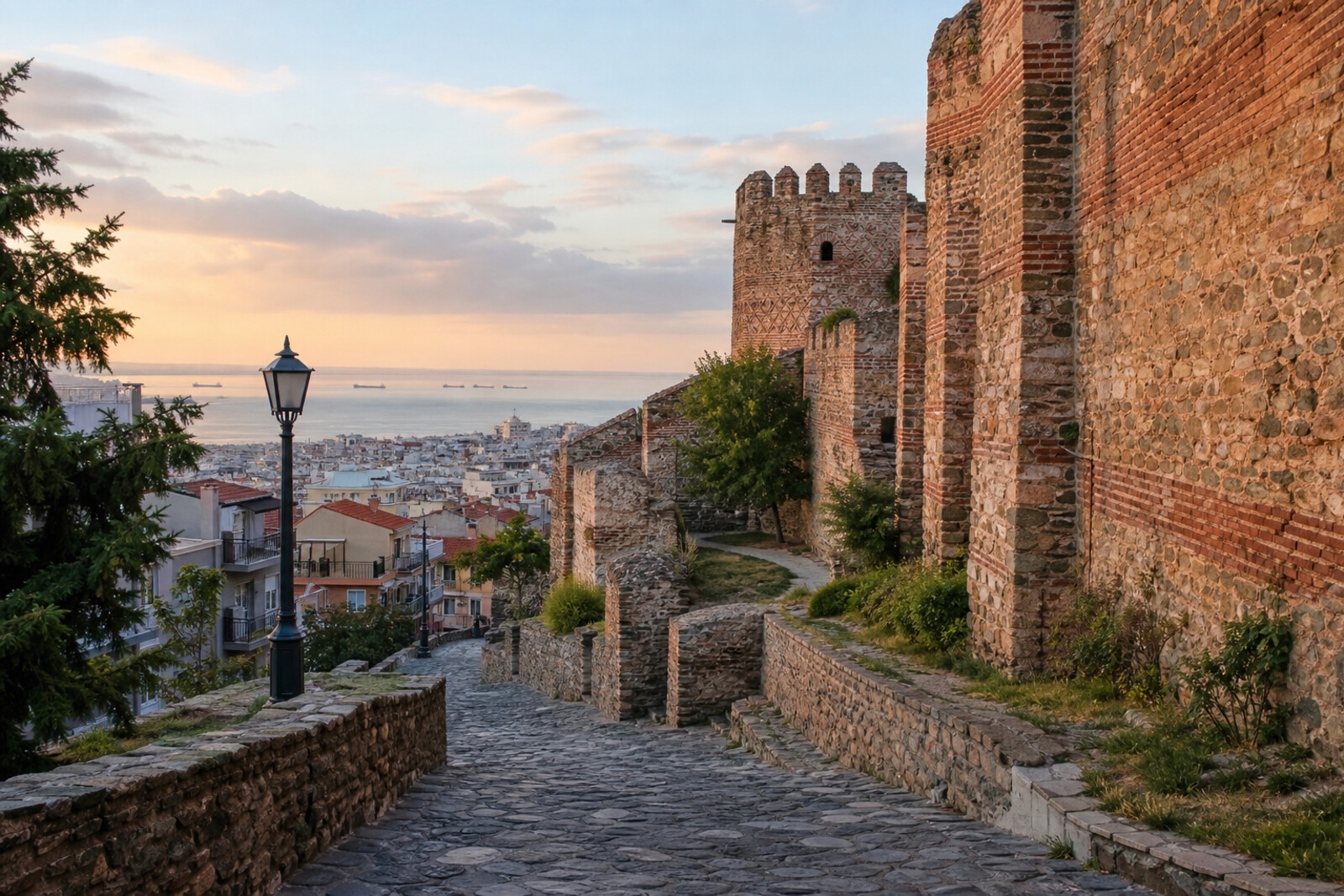
From the Arch of Galerius through ancient basilicas and Ano Poli to Trigoniou Tower
Guide On Map on your phone
Open the walk like a regular app
It takes about 10 seconds to install. No app store needed.
The whole path
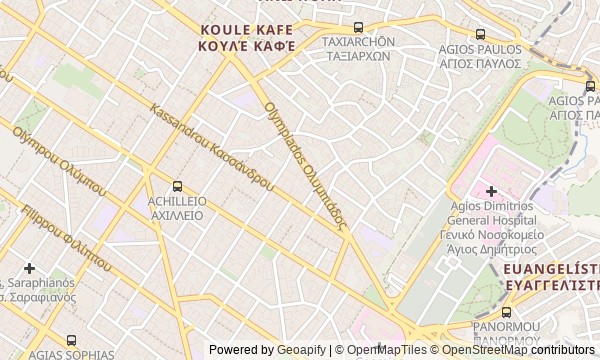
Route map
About the walk
You will begin at a Roman arch in the busy center and keep climbing: first to the Rotunda and early basilicas, then into the lanes of Ano Poli, toward monasteries and the upper line of the walls.
More than the eras will change along the way. So will the rulers, rites, names, and the very purpose of the buildings. Marble will preserve a version of victory that is too smooth. Figures will appear in a dome where the first patron never expected them. A column will keep a conqueror's short inscription. A family will be given space behind a curtain in a former classroom. And beneath the plaster, a fragment will emerge that forces an entire monastery to be renamed.
The story will calmly separate church tradition from archaeological evidence, and the official image from an eyewitness account. By the time you reach Trigoniou Tower, you will know how to read Thessaloniki itself: through marble reliefs, hidden mosaics, converted churches, and homes pressed against fortress masonry.
Why this order
The Arch and the Rotunda stand on the same ceremonial road: first you will unpack the official image of imperial victory, then see how a building from the same complex outlived its patron and several religions. From the Rotunda, the route turns toward the Church of Acheiropoietos, where the change of sanctuaries receives an exact date on a column. Higher up, the Basilica of Saint Demetrius continues the conversation, no longer about the seizure of a church but about the search for a shrine beneath it.
After the city's main basilica, the route climbs into Ano Poli. There, great historical changes shrink to half a classroom given to a refugee family. From residential lanes, the road leads to the Church of Hosios David: a discovered mosaic restores the name of a vanished monastery. The Monastery of Vlatadon continues the theme through people's lives—a persecuted teaching gains its own monastery and a metropolitan see.
At the walls, the order becomes military. The Gate of Anna Palaiologina links civil war to the rule of Ano Poli, and a short walk to Trigoniou Tower ends the route where weakened defenses could no longer hold back the attackers.
Those who want to connect Roman, Byzantine, and Ottoman Thessaloniki in one walk Lovers of mosaics, inscriptions, and disputed historical versions Those ready for a long climb to Ano Poli
Those looking for an easy route without steep streets Those who prefer a survey of facades without detailed stories Those who want to end the walk by the sea
Before you go
Wear shoes with sturdy soles: after the lower city come slopes, steps, and uneven surfaces, and smooth stone can be slippery. Bring water and sun protection—there is less shade on the upper stretches than the map suggests. On the day of your walk, check access to the Rotunda, the Crypt of Saint Demetrius, and the smaller churches separately: some stops are active religious sites, and visiting conditions may change because of services or work inside. Speak quietly indoors, follow local instructions, and ask permission before photographing worship, monks, or closed spaces. A saved offline map will help in the lanes of Ano Poli, where the most direct route is not always the easiest.
When to go
Start early enough to catch the lower interiors while they are open, but do not rush the upper section: save Trigoniou Tower for when the heat eases and the distant view over the bay is clearer. If the day is hot, it makes more sense to take a long break before the climb than to cut the final four stops.
Backup plan
If a church is closed, do not cross the stop off: at the Rotunda you can still read the cylindrical form and minaret, at the Church of Acheiropoietos the layout of an early basilica, and the monastery sites remain important because of their position on the slope. If you are tired, reduce the climb by taking public transport or a taxi to the area around the Monastery of Vlatadon or the walls, then walk the final section. If you need to shorten the route further, keep the sequence “Saint Demetrius — Ano Poli — gate — Trigoniou Tower”: it preserves the shift from urban memory to defense and keeps the ending from becoming a random viewpoint.
Route conditions
Surface. Paved — 3.5 km
Stairs. Flights: 3, 114 m in total
Access. Wheelchair — no; stroller — limited (stairs)
Facilities. Drinking water — 4
Elevation. Ascent — 137 m; descent — 12 m
OpenStreetMap extract of July 4, 2026: database data, not a check on the ground. Data © OpenStreetMap contributors, ODbL licence
Walk plan
Open in maps ↗- 1
Arch of Galerius
Here, victory turns into a marble story with a deliberate omission. - 2
Rotunda
The round building will show how different communities changed the purpose and name of a single sanctuary. - 3
Church of Acheiropoietos
The inscription on the column preserves the moment when the conquest entered an active church. - 4
Basilica of Saint Demetrius and the Crypt
The crypt sets church tradition against what archaeologists actually found beneath the basilica. - 5
Streets of Ano Poli
A former school shows how the great history of resettlement was reduced to an everyday scale. - 6
Church of Hosios David — Latomos Monastery
One uncovered mosaic makes it possible to identify the building of a monastery thought to have disappeared. - 7
Monastery of Vlatadon
Here, a persecuted teaching will culminate in its own monastery and the see of one of its supporters. - 8
Gate of Anna Palaiologina
The inscription will link the two passages to a lost civil war and power over the city that was preserved. - 9
Trigoniou Tower
The final stop will compare an eyewitness account of the breach with a tower built only after the assault.
Route features
Everything you need stays in the browser
Progress, saves and your trip plan are stored on this device.
Add Guide On Map to your home screen so the walk opens outside the browser.
How we handle sources, maps and corrections: our editorial standards