 Guide On Map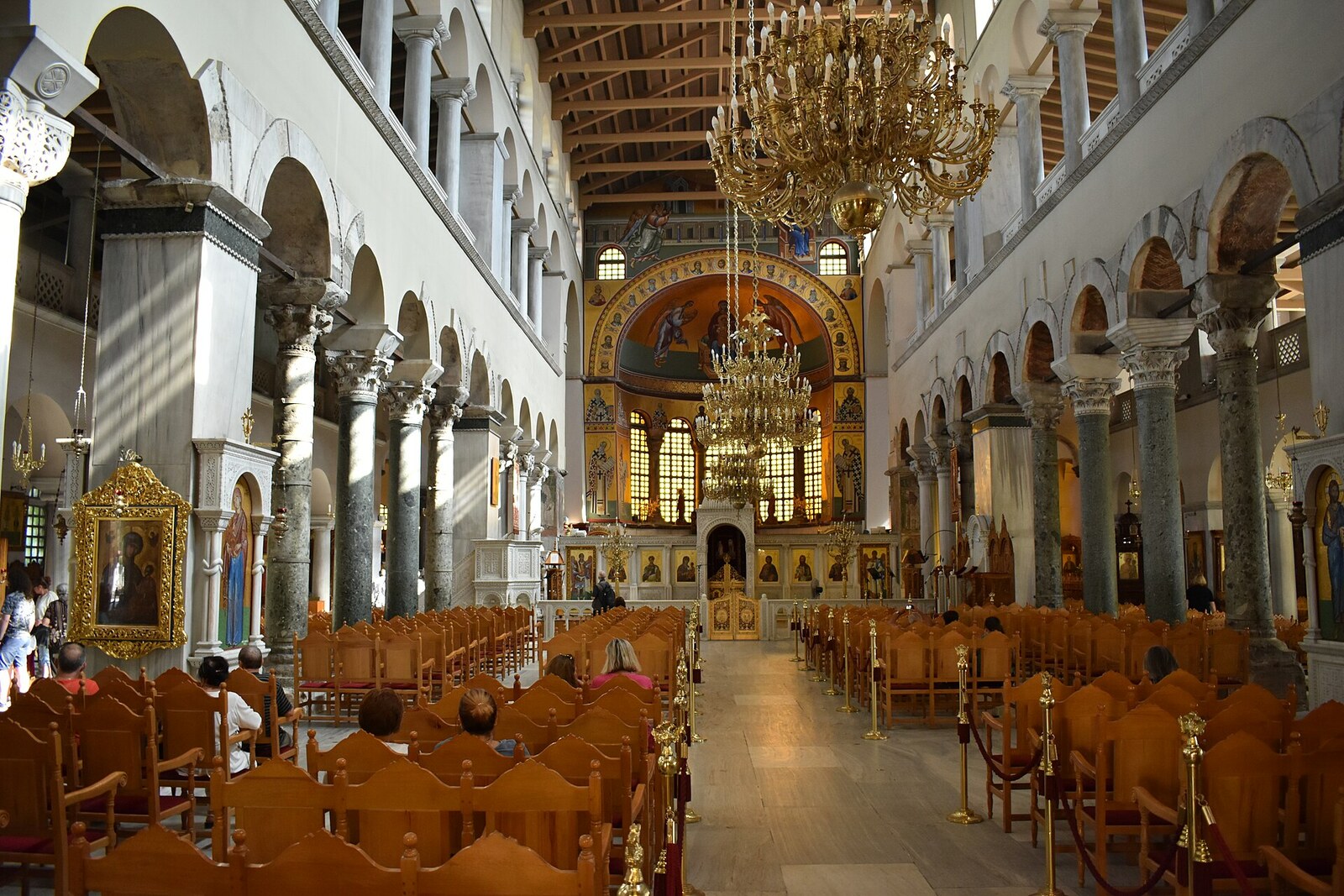
Look around first
What to notice
- Silver shrine
- Walls of the Roman baths
- Cruciform depression
- Small vessel
The story of the place
In the middle of the sixth century, Emperor Justinian I’s men went down beneath this basilica and began looking for the body of Saint Demetrius. The emperor wanted to obtain a bodily relic of the Thessaloniki martyr for Constantinople. According to a collection of miracles compiled later, flames burst from the ground and a voice forbade them to dig any further. The envoys took away only a handful of fragrant earth. This is church tradition, not an eyewitness account.
The body was sought here because this is where church tradition placed Demetrius’s death. A later vita describes him as a young Roman military commander and Christian teacher. His office, pay, and property tied him to imperial service, but he preached the faith that Galerius persecuted. Learning that arrest threatened him, Demetrius told his servant Lupus to distribute his property among the poor.
Galerius ordered the preacher imprisoned in a room near the public baths. The young Christian Nestor came there: he was about to face Lyaeus, the emperor’s favorite fighter, and asked Demetrius for a blessing. Nestor defeated and killed Lyaeus. Galerius lost his champion and ordered both men executed: Nestor was beheaded, while soldiers pierced Demetrius with spears in the bath chamber. According to the same vita, Lupus carried away his teacher’s bloodstained clothing and ring. This is how tradition explained the appearance of relics, although the faithful had no body.
Archaeology confirms the existence of Roman baths beneath the church, but not Demetrius’s chamber or his execution. The earliest undisputed evidence of the cult is an enormous basilica from the late fifth century, built roughly one hundred seventy-five years after the martyr’s presumed death. His name does not appear in the oldest surviving lists of Thessaloniki martyrs. Some historians believe that the cult of Demetrius came from Sirmium, a Roman city on the site of present-day Sremska Mitrovica, and that the local vita took shape later.
Doubt existed already among the Byzantines. At the end of the sixth century, Emperor Maurice again demanded that a fragment of the body be sent to him. Eusebius, the bishop of Thessaloniki responsible for the shrine, admitted that no one knew where the remains lay. Maurice received no bones either. In the nave, pilgrims were greeted by a silver ciborium—a roofed pavilion—called Demetrius’s tomb, although there was no body inside. In the former baths, attendants distributed holy water; later, myrrh was taken from here in small vessels. Townspeople came to ask for healing and protection, and Demetrius became the patron saint of Thessaloniki.
The fire of nineteen seventeen almost destroyed the basilica and exposed areas previously inaccessible to research. Archaeologists Georgios and Maria Soteriou found a cruciform depression beneath the altar, containing a small vessel and brown powder. It was interpreted variously as the remains of bloodstained cloth or as earth soaked in blood; the find did not become a proven tomb. The excavated rooms of the Roman baths were turned into today’s crypt and museum, and the restored church reopened in nineteen forty-nine.
The silver shrine in the nave now holds relics that the church recognizes as Demetrius’s remains: the head was returned from the Italian town of San Lorenzo in Campo in nineteen seventy-eight, and the other bones in nineteen eighty. Below remain the walls of the Roman bath and the site of the long-ago searches, where archaeologists still found no confirmed burial.
Useful on site
The church is usually open for long hours as an active church; the crypt follows a museum schedule, in summer most often 08:00—20:00 or longer on Friday, closed Tuesday, free admission.
Checked: June 24, 2026. Check the official source before visiting.Set aside separate time for the upper church and the crypt: access to the underground section may be arranged differently. During a service, do not cross the space before the altar, and explore the church without recording loudly.