 Guide On Map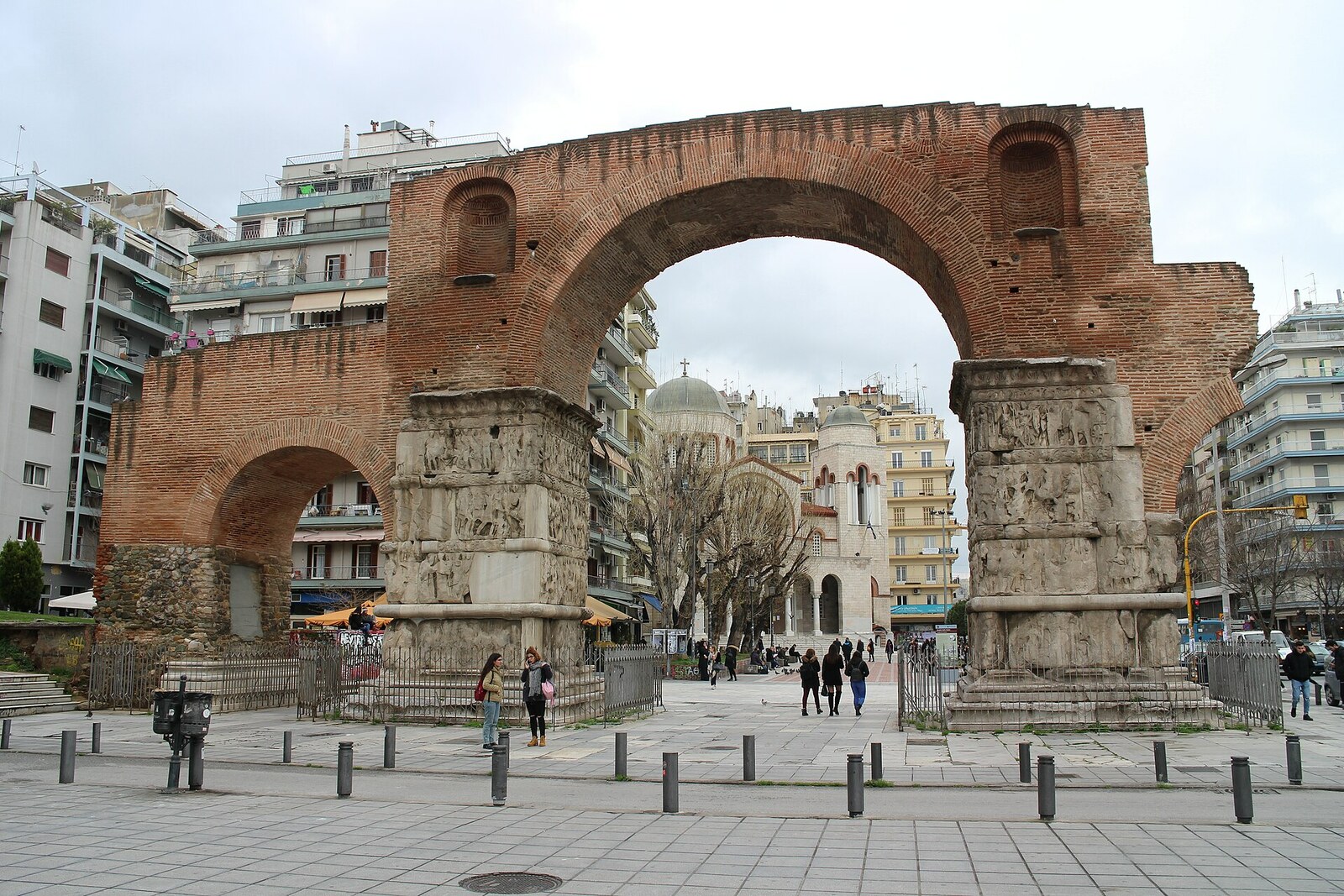
Look around first
What to notice
- Marble reliefs
- Three surviving supports
- Different paving in the sidewalk
- Figures of captives with children
The story of the place
The city's main street once ran along the line of present-day Egnatia Street, crossed by a ceremonial route between the palace and the Rotunda. At their intersection stood an arch with eight supports and passageways through which palace processions passed. Three supports survive from the structure; different paving in the sidewalk marks the position of the lost eastern pillars. Figures of people and traces of a ceremonial procession can still be made out on the marble reliefs.
On the surviving marble bands, one man is depicted again and again as taller than soldiers, captives, and envoys. This is Galerius, whose name the arch bears. In two ninety-three, the senior emperor Diocletian appointed him Caesar. Under the Roman Empire's four co-rulers, this was the title of the junior emperor, with his own provinces and armies. Galerius made his career in military service and entered the imperial family after marrying Diocletian's daughter. His position rested on the senior ruler's appointment and on success in campaigns.
In two ninety-seven, the Sasanian king Narseh, seeking to retain Armenia and northern Mesopotamia, defeated Galerius between Carrhae and Callinicum. Late Antique writers told how the enraged Diocletian supposedly forced the defeated Caesar, dressed in purple, to run for several miles beside his chariot. Historians treat this scene cautiously; the severe defeat and Diocletian's anger are confirmed more reliably.
Diocletian allowed Galerius to raise a new army. He went through Armenia and, the following year, suddenly attacked Narseh's camp near Satala. The king managed to flee; his wives, children, courtiers, and part of the treasury fell into Roman hands. Narseh sent an envoy to ask for peace and for the return of his family. After the treaty, he ceded the disputed territories to Rome, and his relatives returned home. Galerius came to the Balkans as a victor and in two ninety-nine chose Thessaloniki as his residence. Six years later, he received the senior imperial title of Augustus.
Between two ninety-eight and three oh five, the city authorities probably erected a triumphal arch here. Sculptors carved battles, captives, a Persian embassy, gifts, and spoils. They omitted Galerius's first defeat. In the surviving scenes, the Caesar towers over everyone else, Persians bow before his portable throne, and women and children walk together with the captives. This is an official account, composed after the outcome was decided.
The arch was placed at the intersection of two roads. The city's main street ran from west to east, roughly along the line of present-day Egnatia Street. Crossing it was a ceremonial route from Galerius's palace to the Rotunda. Eight supports formed three passageways on each side, and palace processions passed among depictions of the Persian victory.
Today, three of the eight supports remain. Different paving in the sidewalk on Egnatia Street marks the position of the lost eastern pillars. On the two surviving central supports, kneeling Persians, captive women with children, and Galerius, carved larger than all the others, are still visible. The craftsmen did not depict the defeat of two ninety-seven here.
Useful on site
Accessible outside around the clock as part of the urban space; the reliefs are best viewed in daylight.
Checked: June 24, 2026. Check the official source before visiting.View the reliefs from a safe place and do not linger in the roadway: the monument stands within a busy intersection. Viewing it from outside is sufficient for this stop.