 Guide On Map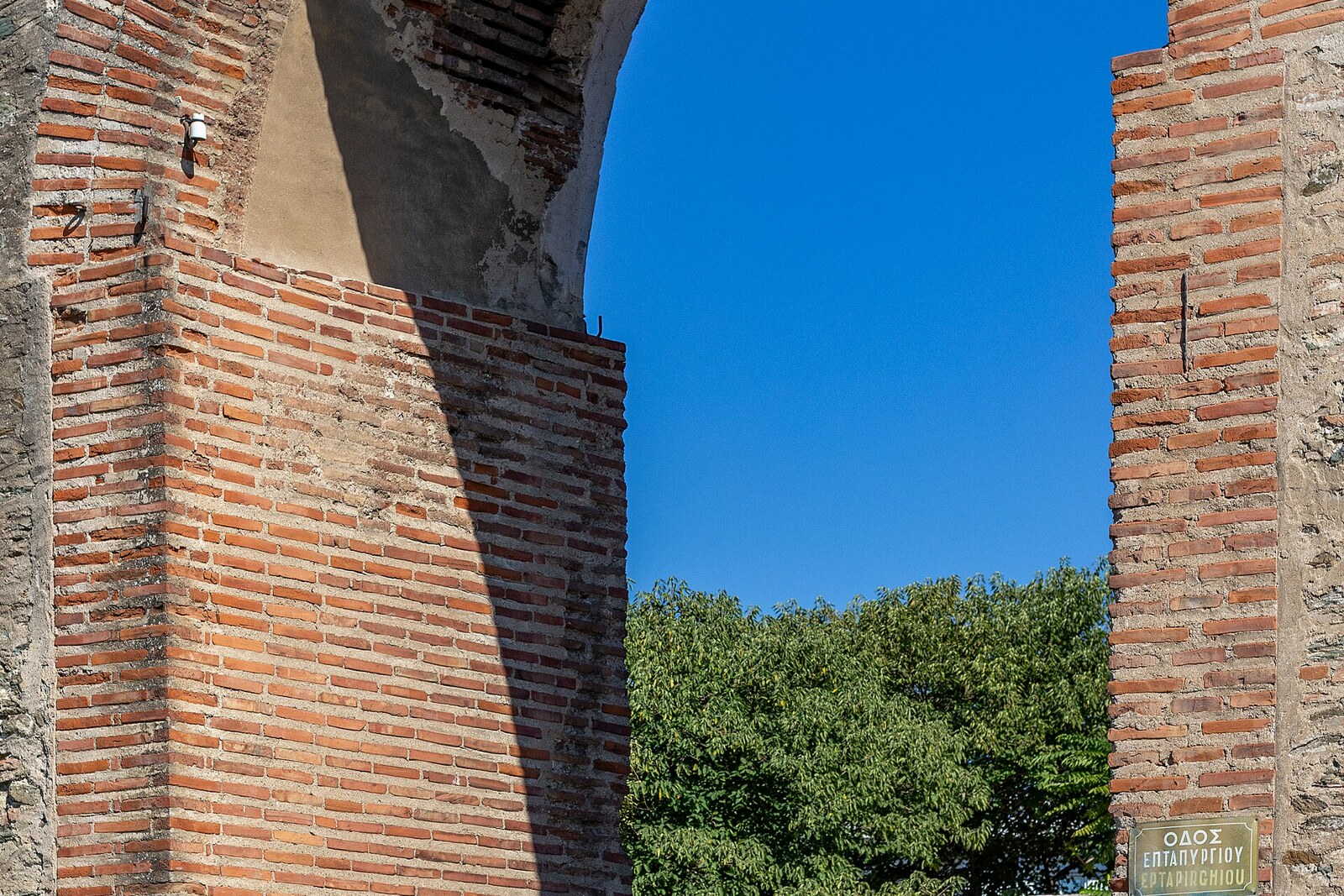
Look around first
What to notice
- Marble slab with an inscription
- Two passages
- Transverse wall
- Marble jamb
The story of the place
A marble slab in the support of one of the arches states who ordered a passage to be opened here. In thirteen fifty-five or thirteen fifty-six, the gate was built by order of “Lady and Despoina Anna Palaiologina.” This inscription gave the gate its name.
Anna was born Giovanna of Savoy, the daughter of the ruler of lands at the foot of the Alps. She came to be called Palaiologina after marrying the Byzantine emperor Andronikos Palaiologos, the Third; at the same time, she converted to Orthodoxy and took the name Anna. In June thirteen forty-one, Andronikos died. Her son John V Palaiologos was three days short of his ninth birthday. Anna became regent and had to preserve the imperial throne for the child.
The late emperor’s chief adviser, John VI Kantakouzenos, claimed the right to rule in the boy’s name. His supporters proclaimed him Emperor John VI. A civil war lasting six years began. Anna risked her son’s position and her own place at court; her government even sought funds for the struggle by pawning the imperial jewels. In thirteen forty-seven, she acknowledged defeat. Kantakouzenos entered Constantinople as senior emperor, John V Palaiologos remained junior co-emperor and married the victor’s daughter.
Four years later, Anna moved to Thessaloniki. Here the defeated regent acquired her own court, officials, and mint. She issued orders in her own name. On Thessaloniki’s copper coins, Anna holds a scepter and a model of the city, while her son is depicted on the other side. This was the price of her withdrawal from the struggle in the capital: she retained her title and governed Thessaloniki almost independently.
Meanwhile, John V Palaiologos continued the struggle for the throne. In thirteen fifty-four, he entered Constantinople and forced Kantakouzenos to abdicate. Anna’s former rival became a monk. Anna herself did not return to the capital. Already after her son’s victory, she ordered these gates to be built.
The site was chosen where the outer fortifications joined a transverse wall separating Ano Poli from the Acropolis of Thessaloniki. One small passage led from the Trigoniou area beyond the city perimeter, while the neighboring one allowed access to the fortified Acropolis of Thessaloniki. The inscription also names the official serving here during the construction: John Chamaetos, keeper of the fortress and chief judicial officer. His offices explain the purpose of the arches: people were allowed through them between the city, the outer side of the walls, and the fortress.
Anna governed Thessaloniki until the end of her life. Around thirteen sixty-five, she became the nun Anastasia and died in this city. Her former name, Anna Palaiologina, remains on the marble jamb, alongside the name of John Chamaetos and the date when the order was carried out. It was this inscription, preserved together with the two passages, that gave the gate its current name.
Useful on site
The exterior of the walls may be viewed freely; individual passages, towers, and sections may be closed for safety or restoration.
Checked: June 24, 2026. Check the official source before visiting.View the inscription from a distance, without climbing onto the masonry or touching the carved sections. Here, reading the wall and the surrounding terrain from outside matters more; no separate interior or ticket is needed to understand this stop.