 Guide On Map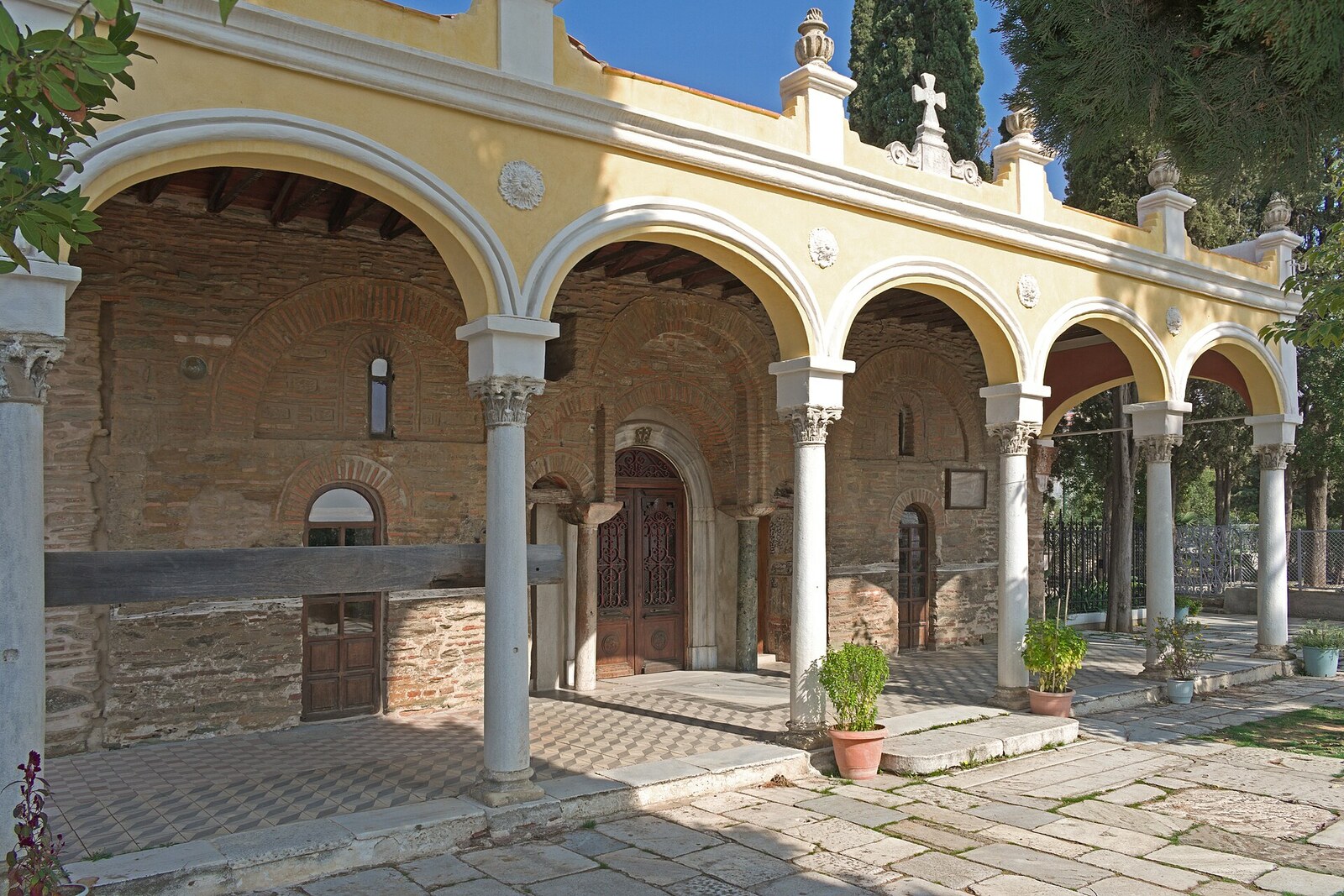
Look around first
What to notice
- The monastery’s main church
- The dome
- Two western supports
- Paintings in the passage
The story of the place
The name “Vlatadon” is the surname of two brothers. In the middle of the fourteenth century, the hieromonks Dorotheos Vlatis and Markos Vlatis founded a community here, and the people of Thessaloniki began to call it the monastery of the Vlatis brothers—Vlatadon.
The brothers belonged to the circle of Gregory Palamas, a monk and theologian who defended the hermits of Mount Athos. The hermits of Mount Athos claimed that during focused prayer, a person could experience the presence of God as the same uncreated light that the apostles saw at the Transfiguration of Christ. Palamas’s opponents declared this teaching heretical. The dispute reached the patriarchal court and became entangled with the struggle for the imperial throne.
In thirteen forty-four, Patriarch John Kalekas excommunicated Palamas and imprisoned him in the palace prison. Dorotheos Vlatis was held with him. He was a hieromonk: his occupation, position, and future all remained within the very church whose patriarch was now persecuting his teacher.
Three years later, the regent Anna of Savoy ordered Palamas released and secured the patriarch’s removal. A new council vindicated the theologian, and in thirteen fifty-one church hierarchs definitively recognized his teaching as Orthodox. Palamas took the see of Metropolitan of Thessaloniki. Dorotheos and Markos settled beside him and, between thirteen fifty-one and thirteen seventy-one, established the monastery here. The exact date has not survived.
The brothers did not receive an empty plot. An earlier church already stood on this site. They incorporated its walls into the new church, which is why the dome here rests not on the usual four columns but on the altar walls and two western supports. The monastery was first dedicated to Christ Pantocrator, and later to the Transfiguration of Christ—the very Gospel event whose interpretation led Palamas and his disciples through court and prison.
For Dorotheos, the dispute ended with the see his teacher had previously held: from thirteen seventy-one to thirteen seventy-nine, he was Metropolitan of Thessaloniki. The monastery founded by the brothers became a center for spreading Palamas’s teaching. Among the paintings from the second half of the fourteenth century, one of his earliest surviving images appears in the passage between the narthex and the main space of the church.
Of the brothers’ Byzantine monastery, only the main church has survived to the present day. The surrounding buildings were erected in nineteen sixty-eight for the Patriarchal Institute for Patristic Studies. Monks continue to hold services here, scholars work with theological texts, and above the entrance the name Vlatadon remains—the name of two hieromonks, one of whom was beside his teacher in prison and then occupied his Thessalonian see.
Useful on site
An active monastery; city tourist sources list 08:00—11:00 and 18:00—20:00, while individual language versions give similar but not identical intervals. Check before walking up.
Checked: June 24, 2026. Check the official source before visiting.Remember that this is an active monastery, not merely a historic site: keep quiet, do not enter service areas, and follow the signs on site. Manuscripts, icons, and relics are not necessarily available for unrestricted viewing.