 Guide On Map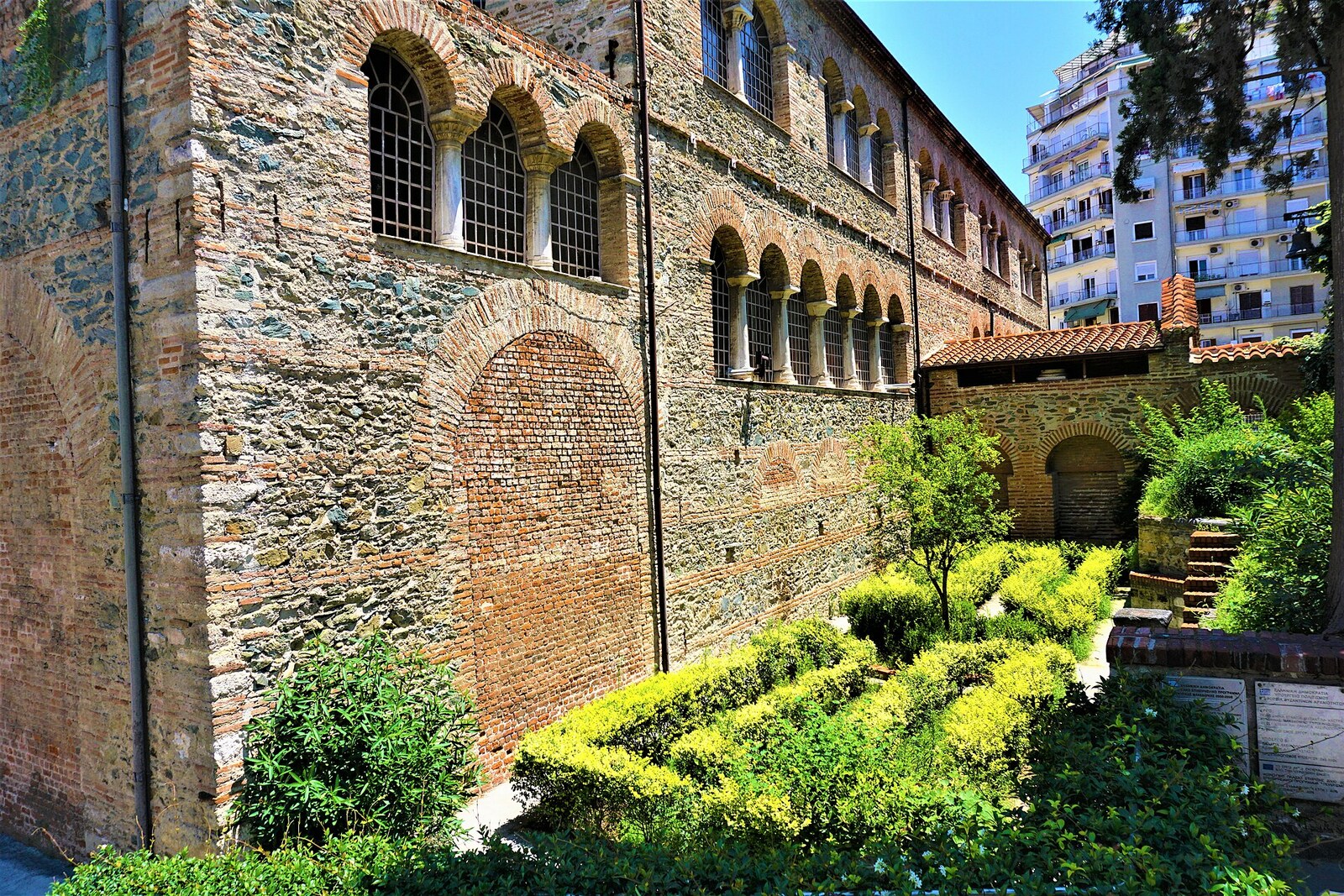
Look around first
What to notice
- Black inscription on the column
- Northern colonnade
- Marble capitals
- Altar apse
The story of the place
This basilica was once called the Great Church of the Theotokos. In the center of Thessaloniki, people gathered under its roof for communal prayer, and this hall was one of the largest in the city. Inside, the northern colonnade with marble capitals and the altar apse have survived. The name Acheiropoietos translates as “not made by hands” and is connected with an icon of the Theotokos venerated here, whose existence is documented, while its miraculous origin remains a church tradition.
On the white marble of the eighth column from the east in the northern row, a black inscription in Ottoman script has survived: “Sultan Murad Khan took Thessaloniki in the eight hundred thirty-third year.” This is a year in the Hijri calendar; in the modern calendar, it is one thousand four hundred thirty. The inscription appeared immediately after the assault. Murad II, the Ottoman sultan seeking the city’s surrender, ordered this church converted into a mosque and left a record of the outcome in its colonnade.
Seven years earlier, Andronikos Palaiologos, the Byzantine ruler of Thessaloniki, admitted that he had no forces of his own to defend it and handed the city over to Venice. In return, he demanded that the inhabitants keep their homes, customs, right to trade, and freedom to come and go, and that the Orthodox clergy retain their status. For port merchants, artisans, and shop owners, these terms determined whether they could support their families. The Venetians accepted the city and sent a garrison.
Murad demanded Thessaloniki for himself. Ottoman troops cut the city off from the surrounding fields and trade routes; by the spring of one thousand four hundred thirty, there were roughly enough defenders for one man per two or three wall battlements, and many had no weapons. Venetian commanders rejected proposals to surrender. On March twenty-ninth, Ottoman detachments climbed the walls and opened the gates. The city, taken by assault, was handed over to the army for plunder. A Byzantine eyewitness, himself among the captives, wrote of roughly seven thousand inhabitants led away. Murad subsequently ransomed some of the captives and called on the fugitives to return, but the homes of those who did not return were given to new settlers.
After the plunder, the sultan came here. The basilica stood in the center and had one of the city’s largest halls, suitable for communal prayer. Murad performed a prayer of thanksgiving here, then ordered the space adapted for Muslim worship. A mihrab was made in the apse, showing the direction of Mecca; a pulpit for the preacher was placed beside it, and a minaret was built outside. The Christian community lost its church, while the Ottoman inhabitants gained the first Friday mosque of conquered Thessaloniki.
By then, the name Acheiropoietos had already become attached to the church. It had previously been known as the Great Church of the Theotokos; its present name first appears in a document from one thousand three hundred twenty. The Greek word means “not made by hands.” It referred to an icon of the praying Theotokos kept here. According to church tradition, the image was created not by a painter but by a miracle. Written evidence confirms the existence of the venerated icon; its miraculous origin belongs to faith. After the church was converted into a mosque, all trace of the icon is lost.
The Ottomans called the building Eski-Cuma, the Old Friday Mosque, and more often Eski-Cami, the Old Mosque. At the beginning of the twentieth century, restorers dismantled the minaret and removed the Muslim liturgical fittings; in one thousand nine hundred twenty-nine, an Orthodox church was consecrated here again. The icon that gave it its name is no longer here. Nothing remains of the minaret either. But inside the active church, Murad’s short line can still be read: the sultan took Thessaloniki.
Useful on site
An active church with irregular tourist access; in 2025, improvement works and the presentation of the monument were reported, so check entry on site.
Checked: June 24, 2026. Check the official source before visiting.This is an active church: during a service, stay near the entrance or wait for a suitable moment to look around. If you cannot get inside, you can still appreciate the scale and simple basilican volume from outside.