 Guide On Map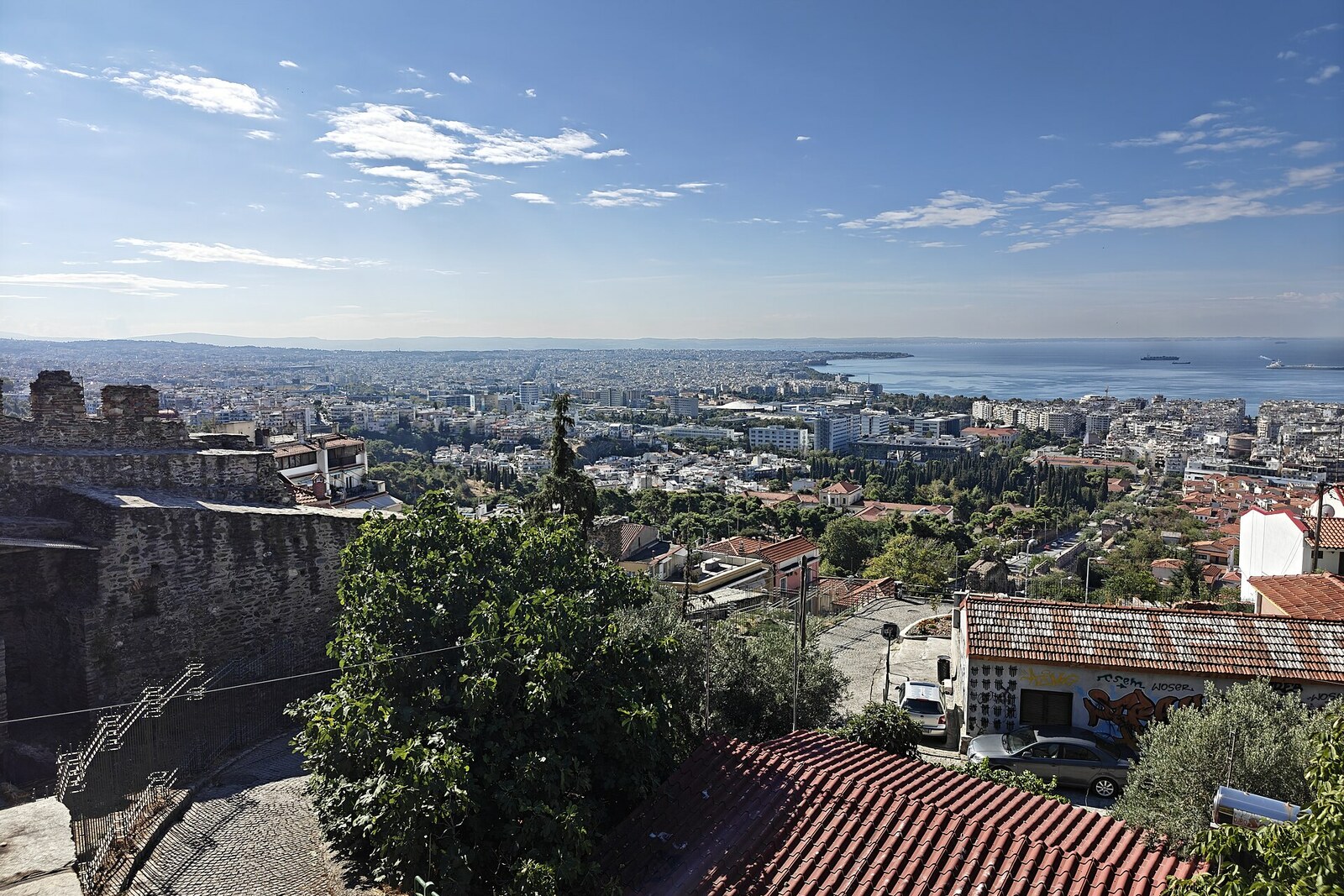
Look around first
What to notice
- Round tower
- Stone belt
- Three artillery positions
- Double masonry inside
The story of the place
At the upper part of Thessaloniki's eastern city wall stands a round artillery tower, inside which an older rectangular fortification has survived. It was built for cannon: three positions covered the northern and eastern approaches, and the fire reached the sea. A stone belt around its cylindrical body gave the tower two Ottoman names, Tower of the Chain and the Girdled Tower; later, gunpowder and weapons were stored here. From outside, the round form is visible, while inside the old masonry in places becomes a second wall.
On the night leading into March twenty-ninth, fourteen thirty, Paolo Contarini, the Venetian governor of Thessaloniki, and Andrea Donato, commander of the city garrison, received a report: by the Vardar River, the Ottomans had prepared six vessels to attack the Venetian galleys in the harbor. These ships brought reinforcements and kept open the Venetians' route of retreat. Contarini and Donato ordered Antonio Diedo, commander of three recently arrived galleys, to take his men off the walls and defend the port.
The residents were not told about this order. They saw the Venetian sailors heading down and decided that the garrison was preparing to abandon the city. This explanation seemed entirely plausible. After years of blockade, the mercenaries were paid in wheat instead of money; when rations were delayed, some defected to the Ottomans. Other defenders sold their weapons to buy food. During the last inspection, there was one man for every two or three sections of parapet. When they learned that Diedo was leaving, some Thessalonians left the wall and went home.
At dawn, Sultan Murad II directed the main assault here, at the upper part of the eastern wall. This section between Trigoniou Tower and the site of the future Heptapyrgion Fortress was maintained worse than the others; from here, the sultan could follow the advance and see the space inside the fortifications. Ottoman archers fired at everyone who appeared above the parapet. The remaining defenders—women among them—threw stones, scarcely seeing their target, and retreated from the battlements one by one.
By the fourth hour after dawn, one of the Ottoman soldiers had set a ladder against the corner of an old tower near Trigoniou Tower. At the top, he encountered only a badly wounded Venetian. The soldier killed him and called his companions. Others climbed up after him; at the same time, the Ottomans entered through breaches in several other places. Contarini and Donato reached the galleys and escaped, while Contarini's son was killed. When they returned to Venice, both commanders were held in custody on charges of negligence. Their careers continued, however: just two years later, both were again involved in the affairs of the Venetian Republic.
Ioannes Anagnostes, a Thessalonian church lector, survived the assault inside the city and was taken captive along with thousands of residents. Later, he recorded how the ladder was set where no one remained—by Trigoniou Tower. It is unclear whether he meant a separate tower, the triangular projection of the northern wall, or this entire corner of the fortifications. The current name came from his account.
The round tower before you appeared only after the assault. Ottoman military builders enclosed the earlier rectangular tower within a new cylindrical fortification designed for cannon. That is why the masonry inside forms complex passages and in places looks like a double wall. Three artillery positions made it possible to fire on the approaches from the north and east; the range of the cannon covered the space as far as the sea. Later, gunpowder and weapons were stored here.
In Ottoman times, the tower was called Zincirli Kule—Tower of the Chain—and Kuşaklı Kule—the Girdled Tower. These names came from the stone band that encircles the cylindrical body like a belt. It is no longer possible to determine exactly which corner of the old fortification received the first ladder. Inside the present round masonry, the earlier rectangular tower remains, and on the city map there is the word by which a captive eyewitness marked the site of the breach.
Useful on site
The area by the tower is accessible as an open city site; tourist sources indicate that the tower's interior is usually open during the day, around 09:00—15:00, but the end of the route does not depend on going inside.
Checked: June 24, 2026. Check the official source before visiting.At the edge and on uneven stone, keep away from hazardous areas, especially in wind or on wet surfaces. Even without access inside the tower, the main part of this stop is the view from outside and the connection between the fortifications and the terrain.