 Guide On Map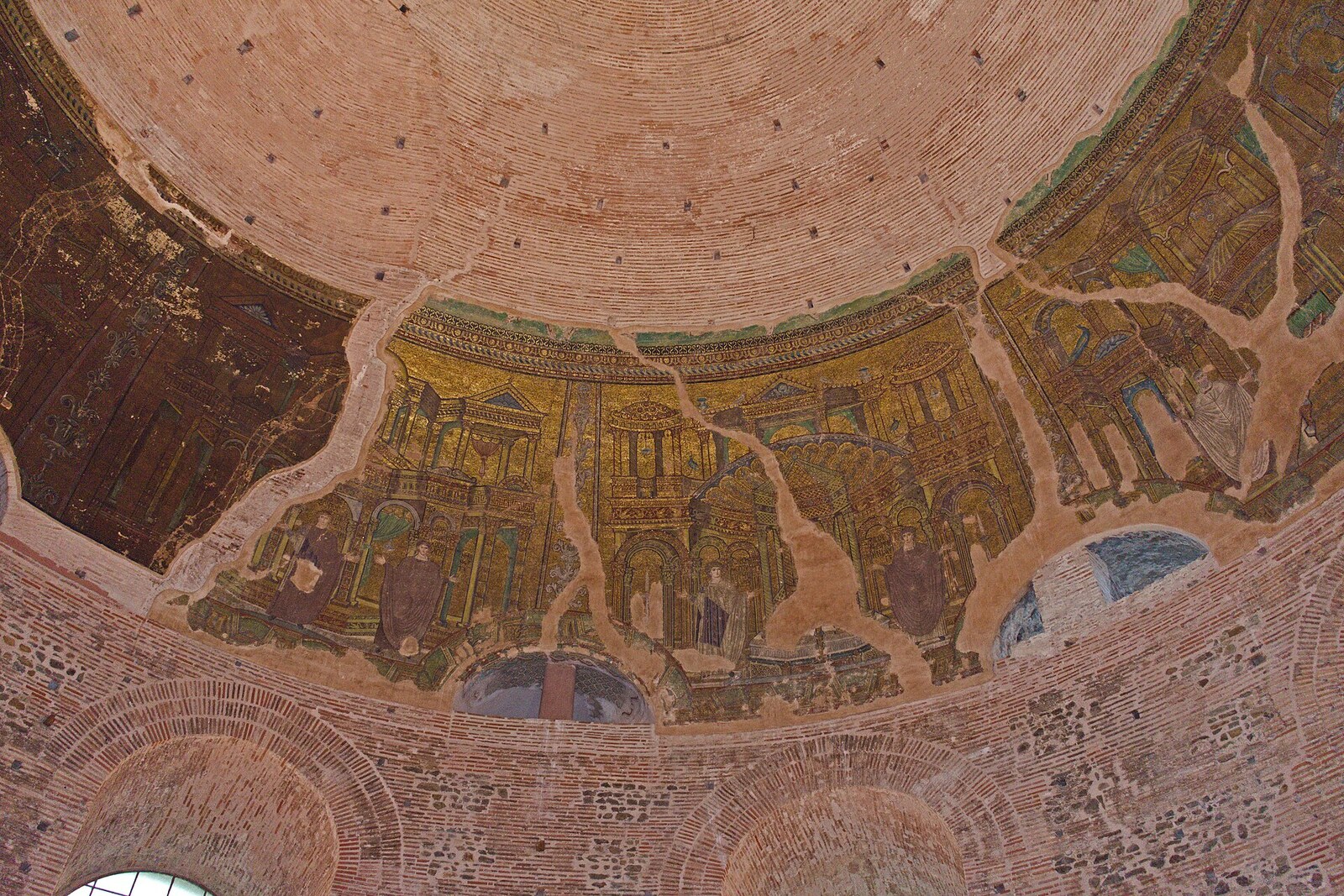
Look around first
What to notice
- Dome mosaics
- Minaret
- Grave by the eastern apse
- Altar apse
The story of the place
The name “Rotunda” became established because of the circular plan of the domed hall. It closed the ceremonial road with colonnades leading from the arch, while the imperial palace stood farther south. Researchers still debate the building's original purpose; one version links it to religious ceremonies. The surviving minaret rises by the eastern apse, and a grave stands beside it.
Beneath the dome of the round hall in Galerius's complex stand men with their hands raised in prayer. Inscriptions give their names, occupations, and the months in which the Church commemorates them. They include priests, bishops, and soldiers. Researchers consider these figures martyrs; some of the names are linked to the Great Persecution of Christians. The hall was built under one of the rulers who carried out that persecution.
Around the year three hundred six, a ceremonial road with colonnades led here from the Arch of Galerius. The imperial palace stood farther south. The intended purpose of the round building at the end of the road is not known for certain: it may have been for religious ceremonies. For a long time it was called Galerius's unfinished tomb, but the emperor's burial was found at Felix Romuliana, his country residence in what is now Serbia. Galerius was never buried here.
From the year three hundred three, the emperors required Christian churches to be destroyed, sacred books to be burned, and believers to be forced to sacrifice to the Roman gods. Refusal could cost a person their position, property, freedom, or life. Galerius carried out this policy in the eastern provinces and continued it after becoming senior emperor.
In the spring of three hundred eleven, he was seriously ill and understood that he was dying. On April thirtieth, Galerius ended the persecution. He did not become a Christian, and in the edict itself he still called believers obstinate. He acknowledged something else: it had not been possible to force them back to their former cults. Christians were allowed to gather again, and in return Galerius asked them to pray for the emperors, the state, and their own safety. He died soon afterward and was buried at Romuliana.
A few generations later, Christian patrons converted the round hall of his palace complex into a church. Their names have not survived, but the changes they made have: an altar apse was created in the eastern wall, and the dome was covered with mosaics. At the center was Christ, borne by angels; fragments of this figure and a preparatory charcoal drawing on brick remain. Below, martyrs were placed. The soldiers among them stand without weapons. A substantial part of this lower row is still above the entrance facing Galerius's road.
For more than a thousand years, the building served as a Christian church dedicated to the Archangels, and in the sixteenth century it became the city's cathedral. Then Hortacı Süleyman Efendi obtained it for his community—a sheikh who led the neighboring dervish lodge. At the turn of fifteen ninety and fifteen ninety-one, a written decree by the sultan allowed the cathedral to be transferred to Muslims. The grand vizier Koca Sinan Pasha, the sultan's chief minister, paid for the conversion. A minaret was built beside it, a fountain for ablutions was installed in the courtyard, and the mosque was named after Süleyman. After the sheikh died, he was buried here as well, outside by the eastern apse.
This was not the building's last transfer from one community to another. In nineteen twelve, the mosque was closed, and the Rotunda was briefly returned to Orthodox clergy; later it became an archaeological monument where services are held only occasionally. The minaret survives at its full height, and Süleyman's grave remains beside the apse.
Travelers of the eighteenth and nineteenth centuries established the name “Rotunda”: it describes the building's circular plan. Another name also appears on the modern sign—the Church of Saint George. Christians venerate George as a warrior-martyr, but he has no history of his own with this building. When the Rotunda was converted into a mosque, liturgical vessels were kept in the small neighboring Chapel of Saint George. Later, its name passed to the huge round church. The name on the sign came from the chapel; the man after whom the mosque was named for more than three centuries lies behind the eastern apse.
Useful on site
Usually open as an archaeological monument; tourist listings give a summer window of about 08:00—20:00, while the Ministry of Culture's ticket information requires checking on the day of your visit.
Checked: June 24, 2026. Check the official source before visiting.Walk around the round structure outside and compare it with the minaret; access inside is needed for the mosaics. Do not assume that visiting the interior will automatically follow the same schedule as the neighboring churches.