 Guide On Map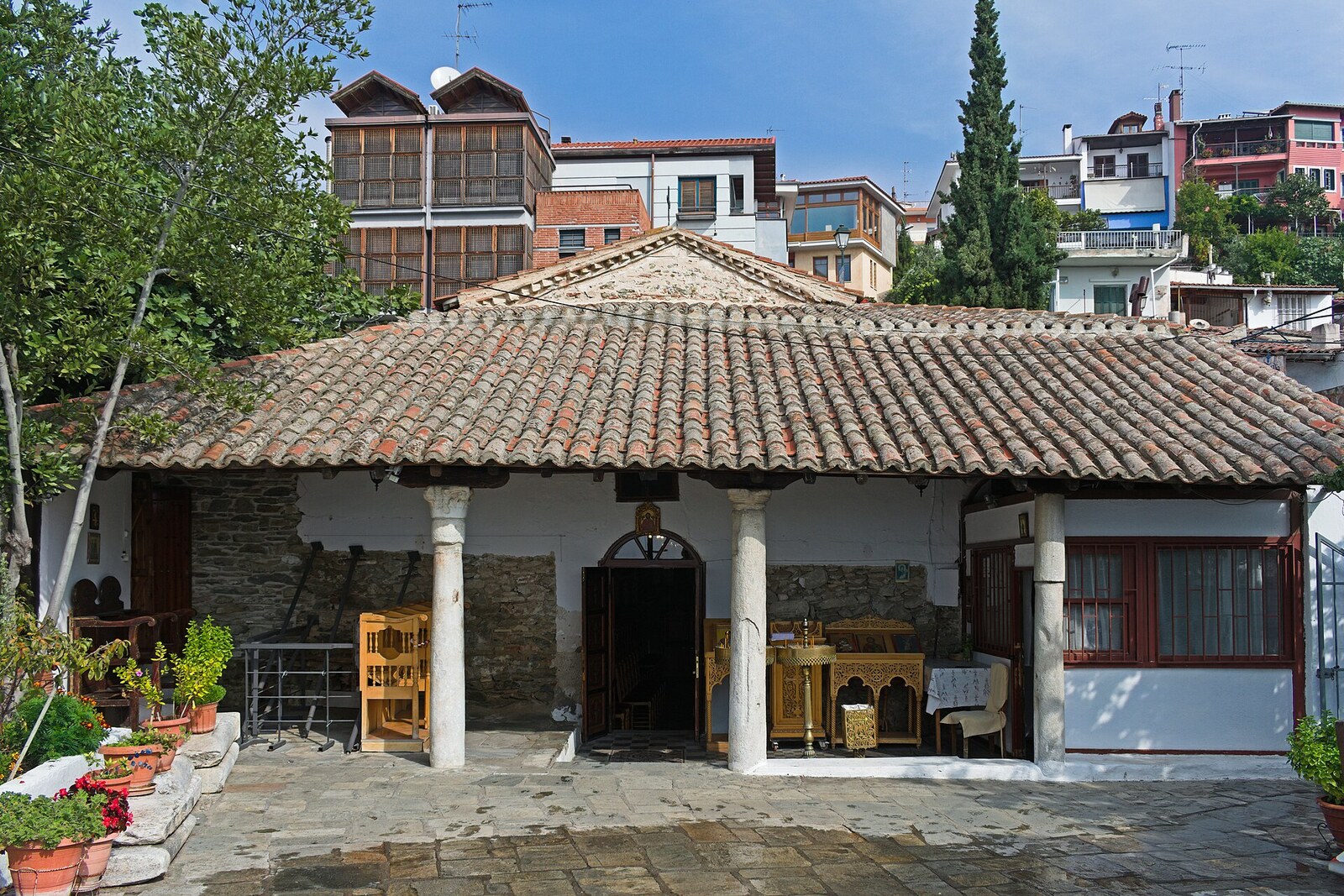
Look around first
What to notice
- The mosaic in the apse
- The radiant circle
- Winged figures with books
- The river with fish
The story of the place
Only one main church survives from Latomos Monastery—its katholikon, built in the late fifth or early sixth century. It is now the active Church of Hosios David. The western part of the building has been lost, and the entrance has been moved to the south side. The main object inside remains in its original place: an early Christian mosaic stands in the altar apse, and it enabled scholars to restore this building's forgotten history.
In March nineteen twenty-one, Andreas Xyngopoulos, curator of Thessaloniki's Byzantine antiquities, examined the former mosque. Thick plaster had fallen away in places in the apse. Beneath it, a winged lion, the edge of a radiant circle, and the raised hand of a human figure could be seen. From these three fragments, Xyngopoulos suggested that he was looking at the vision of the prophet Ezekiel. The entire composition was later uncovered.
At its center was a young, beardless Christ, seated on a rainbow inside a radiant circle. He is surrounded by a winged man, eagle, lion, and ox with books. Two prophets stand at the sides, and a river with fish flows below. The exact interpretation of the mosaic remains disputed: the artist combined details from several biblical visions.
The historian Charles Diehl was reminded by this scene of a medieval work by Abbot Ignatius. It told of the Egyptian monk Senouphios, who for many years asked God to show him Christ as he would appear to judge the world. According to tradition, at the beginning of the ninth century, Senouphios heard a voice telling him to go from the Nitrian Desert to Thessaloniki, to the Monastery of the Stonemasons. The old monk took only a cloak and a staff and set out.
The monks in Thessaloniki replied that they had no such image. Senouphios decided that the devil had deceived him and returned to Egypt. There, the voice sounded again, more insistently than before. He made the same journey a second time.
One day, Senouphios was sitting alone in the altar here. According to Ignatius, a storm and an earthquake began; the oxhide, brick, and mortar that covered the mosaic collapsed. Senouphios saw precisely the image he had sought, thanked God, and died at once. This is a monastic tradition, not an event that can be confirmed by documents.
But the description of the uncovered mosaic proved sufficiently accurate. Diehl compared Ignatius's text with Xyngopoulos's discovery and established that the damaged former mosque was the katholikon of the vanished Latomos Monastery. Its name meant the Monastery of the Stonemasons and came from the quarries nearby. Thus, the found image restored the building's former name.
The present dedication appeared at the same time as the church's clearing, in nineteen twenty-one. Hosios means “venerable.” David of Thessaloniki was a local ascetic of the sixth century, called the Dendrite, meaning one who lived in a tree: according to his life, he spent three years in an almond tree. His biography is not connected with Latomos; the church was given his name in honor of a venerated Thessalonian saint. Today, services are held under the name Church of Hosios David, while Christ of Latomos remains in the altar apse—the image through which the monastery thought to have disappeared was found.
Useful on site
A small active church; tourist sources disagree: 09:00—15:30 and Sunday 07:00—12:00 are often listed, while other directories give 10:00—17:00 and Monday closed. Check again on the day of your visit.
Checked: June 24, 2026. Check the official source before visiting.The interior is very small, so enter in small groups and do not block the view for others. The mosaic is visible only inside; during a service or when access is limited, calmly examine the exterior volume and the church's position among the residential buildings.