 Guide On Map
The Trial of Joan of Arc and Old Rouen
From Rouen Castle to Place du Vieux-Marché
Guide On Map on your phone
Open the walk like a regular app
It takes about 10 seconds to install. No app store needed.
The whole path
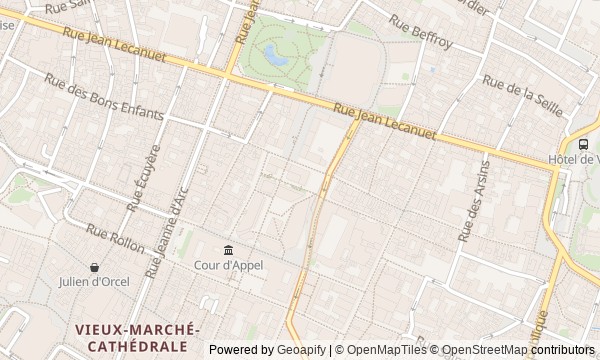
Route map
About the walk
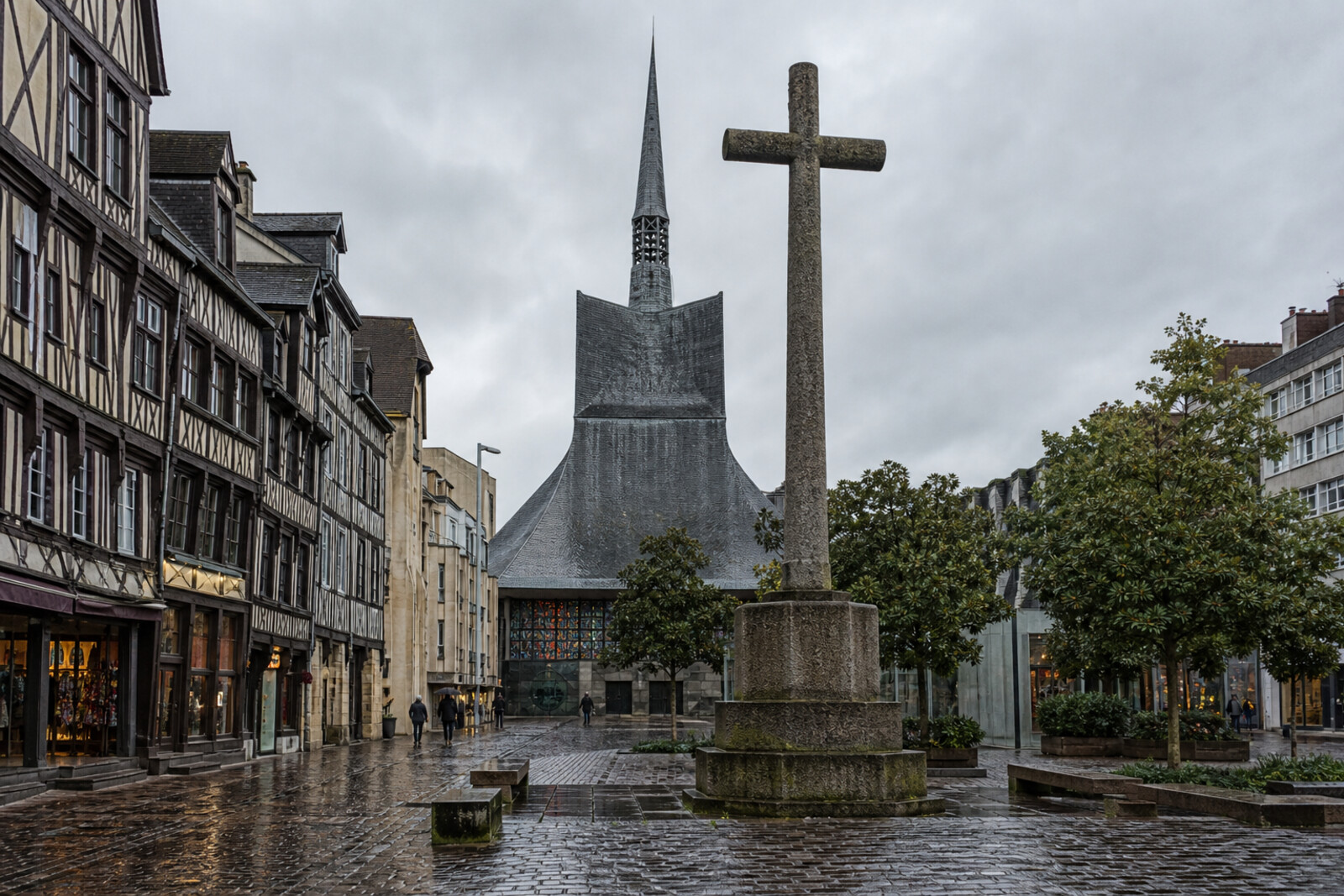
You will begin at the only surviving tower of Rouen Castle and finish at Place du Vieux-Marché, beneath the curved roof of a modern church. The route passes the actual prison site, a monastic garden, Rouen Cathedral, Archbishop's Palace of Rouen, and the city's clock. This is not a biography of Joan of Arc, but a walk through the machinery of her trial in Rouen—from the right to judge to the overturning of the verdict.
Questions will remain along the way. Why was a winch prepared in the room but never used? What was written on the short sheet whose original disappeared? How did two words from a city judge take the place of a separate ruling? And why did old stained glass make it necessary to lower the floor of a new church?
The story rests on records, later testimony, and surviving stone. It separates what is established from what remains disputed, without concealing the breaks in the sources. By the end, you will be able to tell apart the site of the threat, the site of imprisonment, and the site of the decision—and see how Rouen first assembled the judicial chain, then took it apart link by link.
Why this order
Joan of Arc Tower comes first to separate a famous name from the real place of imprisonment; that is why the remains of Tour de la Pucelle follow, within the grounds of the former castle. From the prison, the route leads to Saint-Ouen Abbey Church, where the prisoner's position changed before the gathered city. After that public scene, Rouen Cathedral returns the story to the hidden condition behind the whole trial: the right to judge in Rouen. Neighboring Archbishop's Palace of Rouen continues this legal line, but with the decision that overturned the earlier case. Gros Horloge then widens the frame: alongside ecclesiastical power, the city comes into view, reclaiming its own tower through cautious wording. The street beneath the clock leads straight to Place du Vieux-Marché, the trial's final address. The modern Church of Saint Joan of Arc ends the walk on the same square: after the vanished grave, what remains is the story of rescued glass and a building altered for its sake.
Those who want to trace the trial through real addresses Those who care about documents, testimony, and disputed details Those who enjoy routes where the fabric of a city explains its history
Those looking only for an overview of Rouen's main monuments Those who want an easy retelling of Joan of Arc's life Those not ready for a calm conversation about a trial and an execution
Before you go
Check visiting conditions for Joan of Arc Tower and the Joan of Arc Historial separately if you want to go inside: the route does not assume admission is included automatically. Saint-Ouen Abbey Church, Rouen Cathedral, and the Church of Saint Joan of Arc are active places of worship, so access may depend on services and other events. Bring headphones and expect to spend time outdoors: at Tour de la Pucelle, the former Saint-Ouen Cemetery, and Place du Vieux-Marché, the story matters more than any surviving interior.
When to go
Choose daylight hours: it is easier to make out the foundations of the vanished tower, the details of Gros Horloge, and the layout of the square. Do not schedule the walk right before another event—the palace and churches may require separate time, and in the noisier stretches you may want to find a quiet place to listen.
Backup plan
A closed door does not break the route's sequence. At Joan of Arc Tower, it is enough to see the surviving mass and the tower's later completion; at Archbishop's Palace of Rouen, walk through the courtyard and look at the buildings; at Saint-Ouen Abbey Church, listen in the open space of the former cemetery; at the modern church, read the line of the roof from outside and its connection to the market. If you cannot visit the Joan of Arc Historial, save its exhibition for another day, but do not skip the site itself: the move from the actual cell to the place where the court worked preserves the meaning of the whole walk.
Route conditions
Surface. Paved — 2.7 km; unpaved — 25 m
Access. Wheelchair — limited; stroller — limited
Facilities. Toilets — 5; drinking water — 6
Elevation. Ascent — 10 m; descent — 28 m
OpenStreetMap extract of July 4, 2026: database data, not a check on the ground. Data © OpenStreetMap contributors, ODbL licence
Walk plan
Open in maps ↗- 1
Joan of Arc Tower
Here, the route separates the place where Joan was threatened with torture from the tower where she was actually held prisoner. - 2
Tour de la Pucelle
The surviving masonry will bring the story back to the cell where clothing became part of the accusation. - 3
Saint-Ouen Abbey Church
This stop will show how a public concession changed the verdict and prepared a new accusation. - 4
Rouen Cathedral
The cathedral introduces the legal authorization without which the Rouen trial could not have begun. - 5
Joan of Arc Historial
Here, the judicial thread unfolds from the accusation to the official restoration of the family’s name. - 6
Gros Horloge
The city clock will show how the people of Rouen regained their tower after municipal self-government was suppressed. - 7
Place du Vieux-Marché
Here the ecclesiastical procedure ended, and no separate ruling by the city court was issued. - 8
Church of Saint Joan of Arc
The finale will link this place of remembrance with stained-glass windows saved from the destruction of another church in Rouen.
Route features
Everything you need stays in the browser
Progress, saves and your trip plan are stored on this device.
Add Guide On Map to your home screen so the walk opens outside the browser.
How we handle sources, maps and corrections: our editorial standards