 Guide On Map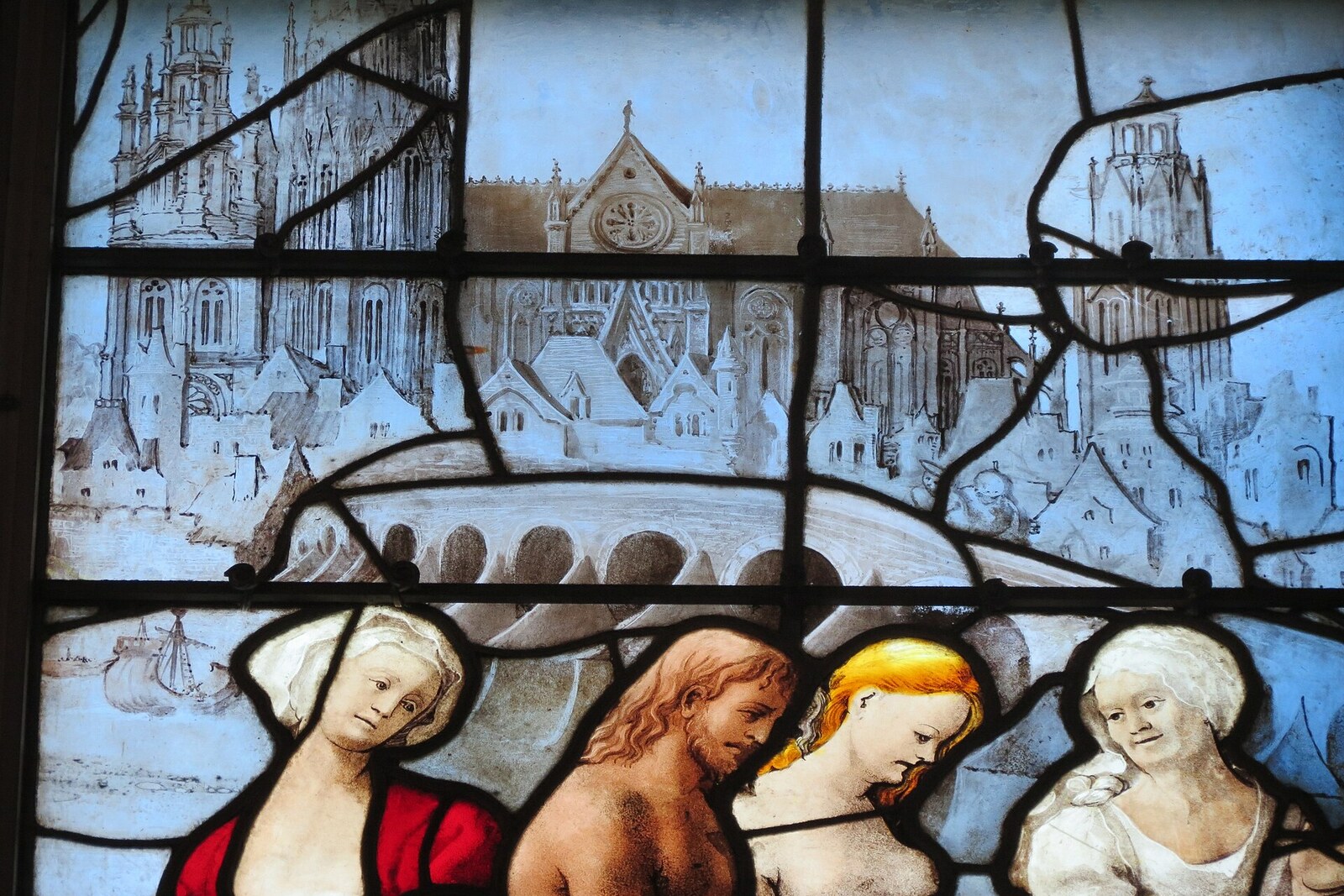
Look around first
What to notice
- Curved roof
- Thirteen old stained-glass windows
- Interior staircases
- Sunken garden
The story of the place
Louis Arretche designed a single complex here: a parish church, a civic memorial to Joan of Arc, and a covered market. That is why the market stalls adjoin the church beneath the continuation of its curved roof. Joan's name is connected with the address: the church was built beside the site of her execution so that services and official commemorations of the canonized Joan could take place here.
Yet the church's full name is longer: Saint-Vincent — Church of Saint Joan of Arc. Saint-Vincent was the name of another church in Rouen, which stood at the lower end of what is now Rue Jeanne-d'Arc. It contained thirteen large sixteenth-century stained-glass windows. In nineteen thirty-nine, heritage-protection staff removed the valuable glass and packed it into crates, fearing wartime destruction. In May nineteen forty-four, bombing destroyed Saint-Vincent Church. The decision made five years earlier saved the stained-glass windows, but they were left without a building.
The design for the new church on Place du Vieux-Marché was discussed for decades. In January nineteen seventy-two, the city council finally approved Arretche's proposal. It had no place for the surviving stained-glass windows. They were to remain in storage or someday be exhibited in a museum.
Then Yvonne Néel, a woman from Rouen and a member of the society of friends of the city's monuments, intervened. She pressed for the stained-glass windows to return to a functioning church. On April twenty-eighth, nineteen seventy-two, Néel met with Arretche and persuaded him to revise the design that had already been approved.
The architect lowered the floor level by two meters, increased the height of the north wall, added interior staircases, and deepened the garden outside. The resulting wall accommodated all thirteen windows—about five hundred square meters of old glass. They were restored and installed here in nineteen seventy-eight. The following year, the archbishop consecrated the building as a parish church that had inherited the name and congregation of the destroyed Saint-Vincent Church.
The staircase to the church hall descends below the square for the sake of these windows. The two meters beneath your feet appeared after Yvonne Néel's conversation with Louis Arretche.
Useful on site
Admission is free. The city page lists opening hours Friday–Sunday, 10:00–12:00 and 14:00–17:00; the tourist office publishes broader seasonal hours for 2026. Check on the day of your visit.
Checked: June 24, 2026. Check the official source before visiting.Walk around the outside of the building as far as the square allows; if the interior is accessible, enter quietly and give your eyes time to adjust to the light from the stained-glass windows.