 Guide On Map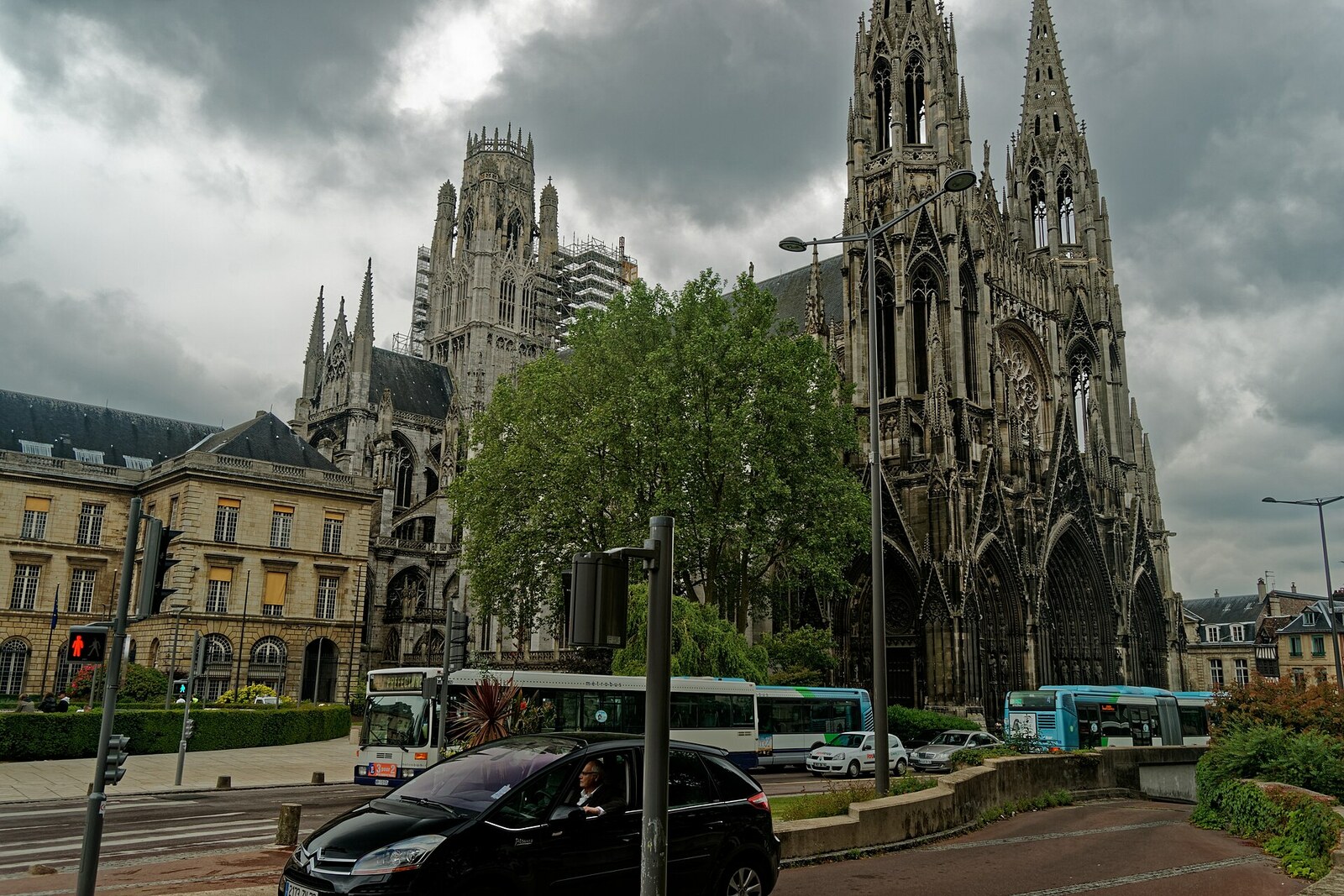
Look around first
What to notice
- The church of the former abbey
- The garden beside city hall
- The city hall building
- The commemorative plaque by the entrance
The story of the place
Before you stands the main church of a former Benedictine monastery. Saint Ouen was the name of a seventh-century bishop of Rouen. At birth, he was called Dado; in church history he became known as Dado (Saint Ouen). He was buried here in six hundred eighty-four. Pilgrims began coming to the grave, and an abbey later grew up around the basilica. The monks have long since gone: their former dormitory is occupied by city hall, while the immense church is used for services and concerts.
On May twenty-fourth, fourteen thirty-one, events took place outside, in the monastery cemetery. Two platforms were set up there. Joan of Arc stood on the smaller one; on the larger one sat her judges, bishops, and an English cardinal. Townspeople were gathered behind a barrier. Nearby, an executioner and a cart waited.
Joan was a prisoner for whom the English had paid the Burgundians ten thousand livres. Two years earlier, she had helped the French troops lift the Siege of Orléans and had led Charles VII to his coronation in Reims, claiming that she acted at God’s command. Now Pierre Cauchon, bishop of Beauvais and the chief judge, sought a public renunciation of these words. Such a renunciation was called an abjuration: the accused acknowledged that her earlier statements were mistaken and promised to submit to the Church court. Refusal meant being handed over to the secular judge and the stake.
The Paris theologian Guillaume Érard was tasked with delivering a sermon and obtaining an answer. He declared that Charles VII, by believing Joan, had bound himself to heresy. Joan interrupted him: her king was a good Christian. When she was required to submit to the Church, she agreed to place her case before the pope’s judgment. She was told that the pope was far away and that the local bishops had the right to judge on their own.
Cauchon began to read out the prepared death sentence. Without waiting for the end, Joan yielded. She agreed to obey the judges, repeated the proposed formula, and her mark appeared on the sheet.
What exactly was written on that sheet is not reliably known. The original of the short document has not survived. Witnesses questioned a quarter of a century later remembered a text of six to eight lines. The final court record included a far more extensive abjuration—about seventy-five lines—in which Joan supposedly acknowledged that her revelations and the voices of the saints were fabrications. She herself later said that she had yielded only out of fear of the fire.
Cauchon replaced the death sentence with life imprisonment—according to the court’s formula, “on the bread of sorrow and the water of grief.” Joan was led away from the platform alive. The judges had obtained a recorded abjuration, without which her return to her former words and men’s clothing could not have been declared a relapse into heresy.
At the request of Joan’s mother, Isabelle Romée, the case was retried. On July seventh, fourteen fifty-six, papal judges declared the earlier trial, the verdicts, and the abjuration invalid. That same day, the decision was publicly proclaimed in Saint-Ouen Cemetery after a general procession and a sermon—where the verdict against her daughter had once been read.
The old cemetery and both platforms have disappeared. A garden beside city hall now occupies their place. A commemorative plaque by the entrance cautiously calls what happened here “the ordeal known as the abjuration.”
Useful on site
Free admission. The city page states that it is open on Saturdays and Sundays 10:00–12:00 and 14:00–17:00; the tourist office publishes broader seasonal hours. Check on the day of your visit.
Checked: June 24, 2026. Check the official source before visiting.Listen from outside, even if the church is open: the event in question took place not beneath the vaults, but beside the abbey.