 Guide On Map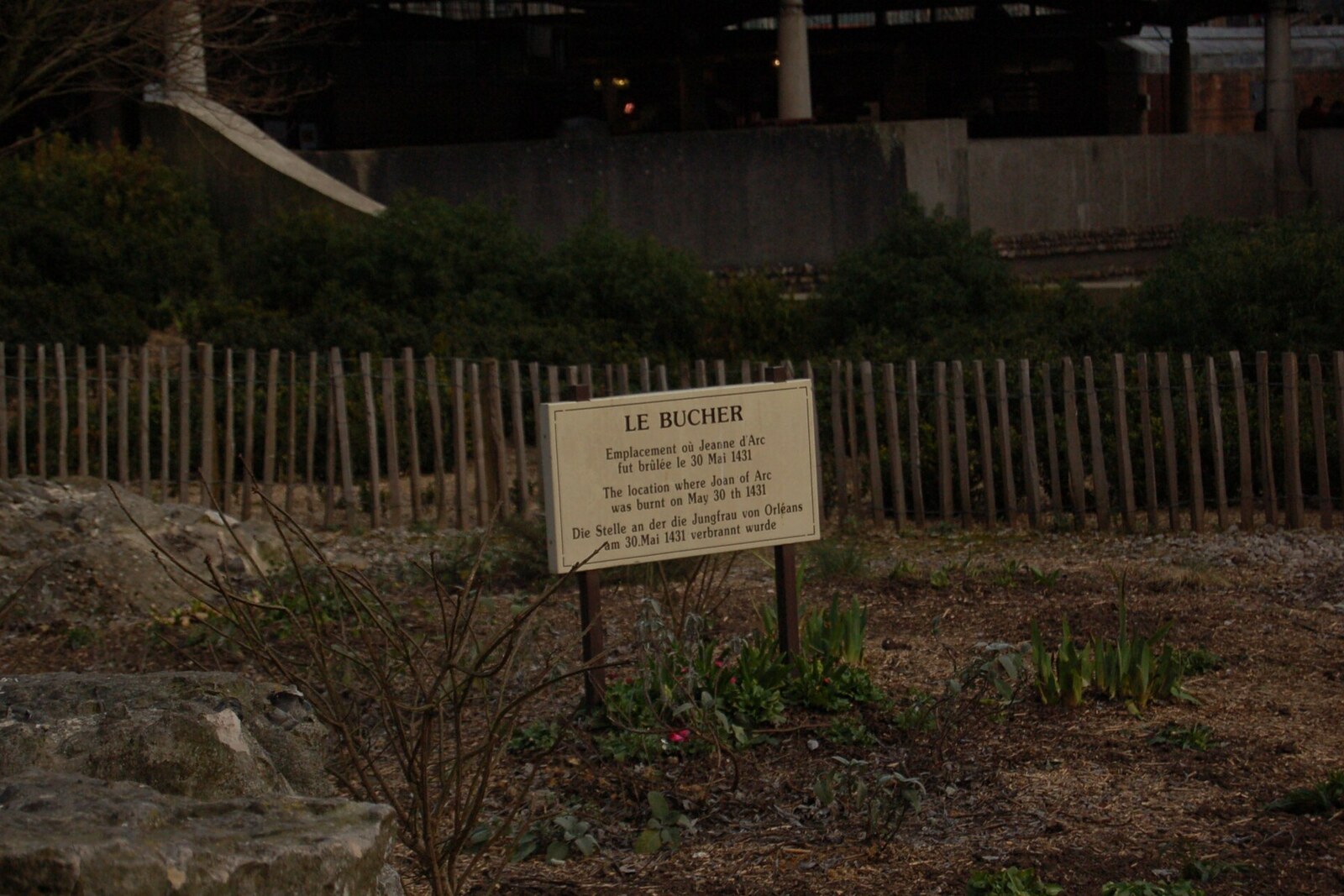
Look around first
What to notice
- The large cross
- The stone foundations of the Church of Saint-Sauveur
- The Old Market Square
The story of the place
Vieux-Marché means “Old Market.” In fourteen thirty-one, the square was smaller than it is today: a market hall, two churches, and a pillory stood here. Public executions were usually carried out here as well. That is why, on the morning of May thirtieth, the organizers of the trial brought Joan of Arc here, to the platforms and firewood already prepared.
After returning to men's clothing, the ecclesiastical judges declared Joan to have relapsed into her former heresy. At Place du Vieux-Marché, the theologian Nicolas Midi delivered the final sermon, and Pierre Cauchon read out the decision: the Church rejected the condemned woman and handed her over to the secular court. In the usual course of events, the city judge was now supposed to issue his own sentence.
No such sentence followed. Guillaume Manchon, the chief clerk of the trial, later testified that the bailiff of Rouen—the city's royal judge—merely waved his hand and ordered: “Take her away, take her away.” English soldiers immediately led Joan to the stake. Two words replaced the proceeding that was supposed to determine what the secular court would do with the prisoner handed over to it.
Jean Massieu remained nearby, the ecclesiastical official who had led Joan from prison to interrogations during the trial. She asked him for a cross. One English soldier made a small cross from a stick; Joan kissed it and pressed it to her chest. Then a large processional cross was brought from the neighboring parish Church of Saint-Sauveur. The Dominican Martin Ladvenu, who accompanied Joan to the stake, held it raised when the royal executioner Geoffroy Thérage set fire to the wood from below.
Thérage earned his living by carrying out judicial punishments. After Joan's death, the soldiers ordered him to rake back the fire so that those gathered could see the body: the organizers of the execution feared rumors that the prisoner had managed to escape again. The executioner was then ordered to gather the ashes and remaining bones and throw them into the Seine. No grave remained for Joan's supporters to visit.
That same day, Thérage came to the Dominican monastery to see Ladvenu and Isambart de la Pierre. According to Isambart's later testimony, the executioner said that he feared eternal damnation for having burned a saint. For a man who professionally carried out death sentences, the consequences of this execution began immediately after the work was finished.
The large cross in the square marks the site of the stake, but there are no remains beneath it. The stone foundations in the middle of Place du Vieux-Marché belong to the vanished Church of Saint-Sauveur—the very church from which they brought the cross that Joan asked to be held before her.
Useful on site
The open city square is accessible without a ticket; the church, market, and establishments operate on their own schedules.
Checked: June 24, 2026. Check the official source before visiting.Find a quiet edge of the square and listen, keeping in mind that the medieval site was more confined and more densely built up than it is today.