 Guide On Map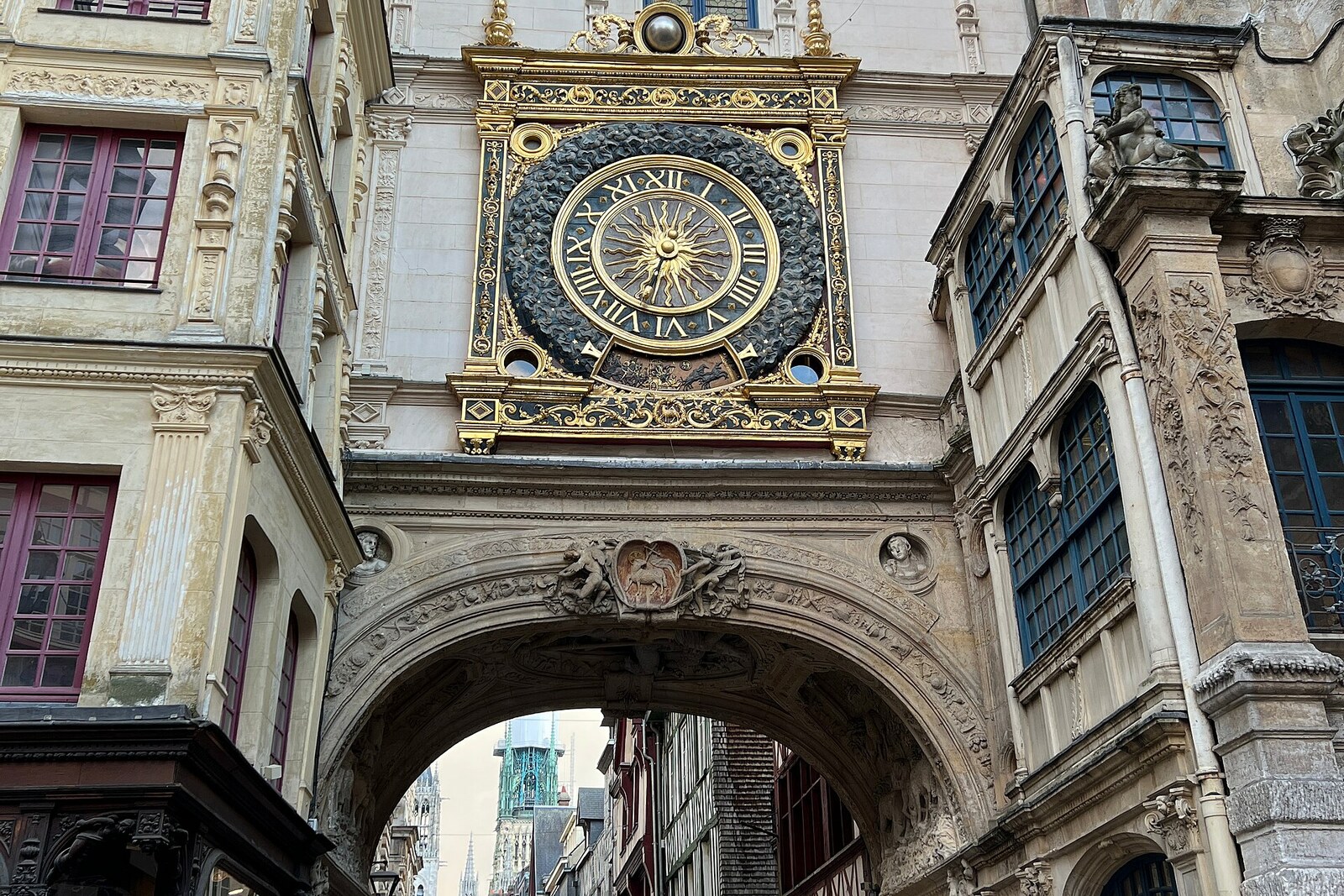
Look around first
What to notice
- Gothic bell tower
- Renaissance pavilion
- Dials above the arch
- Gros Horloge arch
The story of the place
Gros Horloge literally means “Great Clock.” In French, the word “horloge” was masculine at the time; the monument’s name and the street named after it preserved the old grammar. Here, one name brings together a Gothic bell tower, the clock mechanism inside it, and a later pavilion with dials above the arch.
The clock appeared after the people of Rouen lost their former tower. On February twenty-fourth, thirteen eighty-two, royal tax collectors began levying a new tax on wine, salt, and other goods. Workers and small craftsmen, who lived by wage labor and their own production, rose in revolt. It was called the Harelle, after the Norman cry “haro!” used to call for help.
The participants in the uprising rang the city alarm bell tower. The Rouvel Bell called people together here. The crowd sacked the homes of wealthy merchants; several people were killed. At the end of March, the French king Charles VI entered Rouen with an army to subdue the city. Several participants were executed, and the disputed tax was collected anyway. The king abolished the commune—elected municipal self-government—stripped Rouen of its trading privileges, ordered the bells removed, and ordered the tower from which the signal had sounded demolished.
Seven years later, the city councilors found an acceptable formulation for bringing back the tower. They asked not for a new belfry, but for a structure for a public clock. Permission was granted. On August fifth, thirteen eighty-nine, the city record entered the decision to build a “tower for a clock.” In the very next entry, on September first, the councilors already called it a belfry.
The clockmaker Jean de Felain, who had been entrusted with starting the city mechanism, completed the work that same year. The weights had to be raised, the gears oiled, and the ropes watched constantly. Felain was appointed the first keeper of the clock; he and his wife were given living quarters by the tower, while his workshop faced the street. Thus, maintaining a single mechanism became a family occupation and remained a special post for almost six centuries.
When Joan of Arc was alive, the present arch did not yet exist. From fourteen ten onward, the early dials stood above the Porte Massacre, which stood here; the stone Renaissance pavilion and the dials visible today were built only between fifteen twenty-seven and fifteen twenty-nine. The exact route by which Joan was taken from the castle to Place du Vieux-Marché is unknown, so it cannot be claimed that she passed beneath the clock.
Behind the modern dials, an electric drive installed in nineteen twenty-eight is at work. Jean de Felain’s mechanism no longer moves the hand, but it is still in the tower erected on the remains of the demolished belfry.
Useful on site
Freely accessible from outside. Interior route: high season April 1–September 30, Tuesday–Sunday 10:00–13:00 and 14:00–19:00; low season October 1–March 31, Tuesday–Sunday 14:00–18:00. Full ticket 7,85 euros, reduced ticket 4 euros.
Checked: June 24, 2026. Check the official source before visiting.Stand to one side of the main flow of pedestrians: all the key details are visible from the street, and there is no need to enter the building for this account.