 Guide On Map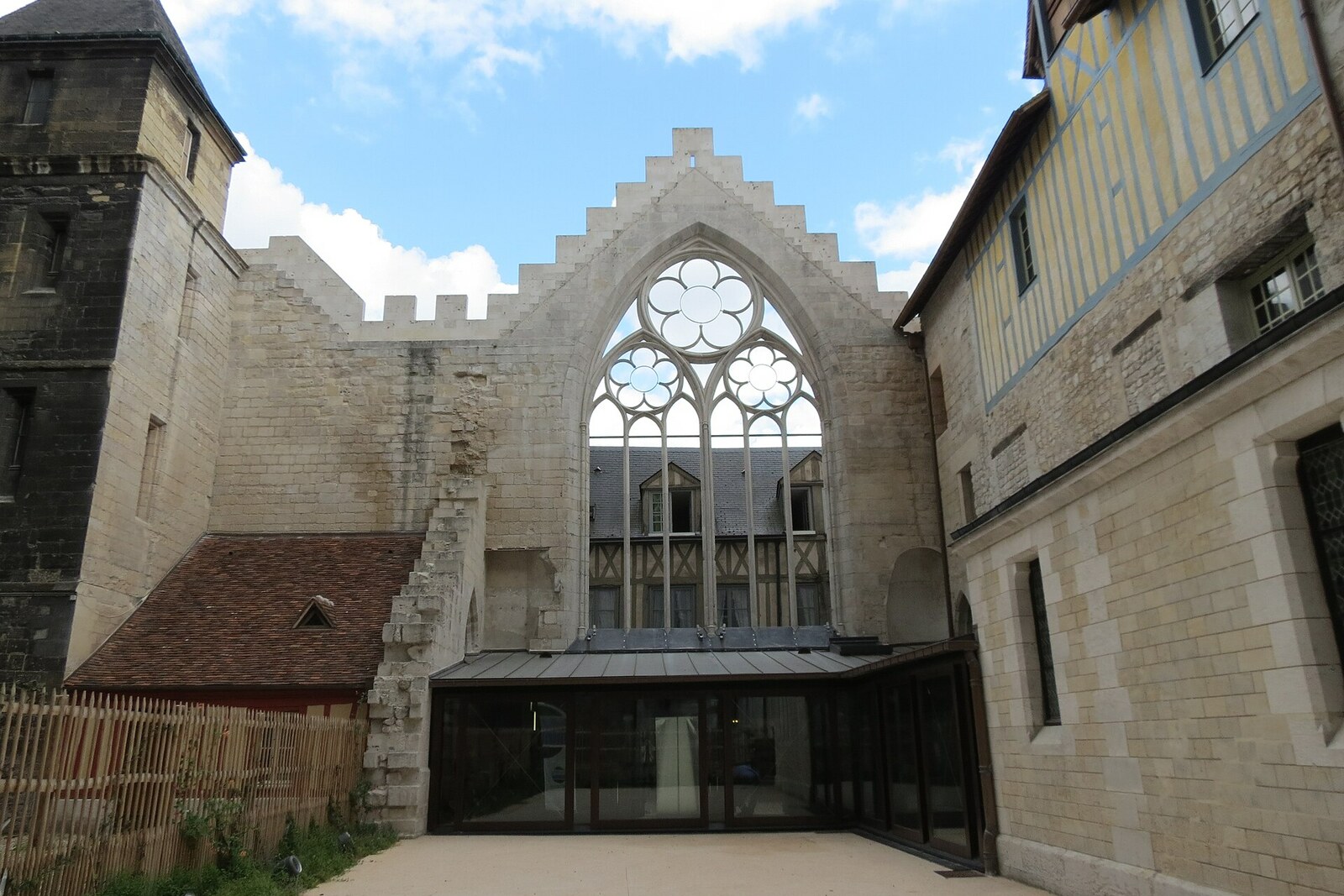
Look around first
What to notice
- Large Gothic opening
- Courtyard of the Archbishop's Palace of Rouen
- Reception area of the Joan of Arc Historial
- Palace rooms
The story of the place
On July seventh, fourteen fifty-six, at eight in the morning, in the great hall of this palace, Jean d'Arc awaited the decision in the case of his sister, who had been burned a quarter of a century earlier. He was one of the plaintiffs and sought the annulment of the verdict that had declared Joan a heretic.
Their mother, Isabelle Romée, began the suit. A widow from a farming family, she settled near Orléans after her husband’s death and lived on a small pension from the city liberated by her daughter. The verdict pursued both the dead Joan and the living d'Arcs: the church court had left the family with the stain of being related to a convicted heretic. Isabelle and her sons asked Pope Callixtus III to review the case.
The pope appointed a new commission. It was headed by Jean Juvénal des Ursins, Archbishop of Reims and an experienced jurist, who was to determine whether the trial of fourteen thirty-one could be considered lawful. The investigators reread the records and gathered testimony from people who had known Joan in Domrémy, Orléans, Paris, and Rouen.
The chief evidence against the former judges was the twelve articles of accusation. Pierre Cauchon had sent this digest to theologians for them to assess Joan’s words. The commission now established that exculpatory details had been removed from the articles, incriminating ones had been added, and some answers had been altered so that their meaning changed. The scholars gave their opinions without seeing what Joan had actually said.
The conclusion required a church court, so the case was completed here. The Archbishop's Palace of Rouen served at once as a residence, an administrative center, and a place of ecclesiastical justice; its great hall was a usual setting for proceedings of this kind.
Juvénal des Ursins announced the decision before Jean d'Arc and the representatives of the absent Isabelle and her son Pierre. The judges declared the trial, both verdicts, the abjuration, and all their consequences invalid. In a separate ruling, they decreed that neither Joan nor her relatives had stained themselves with dishonor. Jean d'Arc left the hall as a member of a family from which the church court had officially lifted the accusation.
The hall itself no longer exists: it was dismantled at the end of the sixteenth century. Its site is now occupied by the courtyard and reception area of the Joan of Arc Historial, while a large Gothic opening has survived along Rue Saint-Romain. The museum occupies part of the functioning Archbishop's Palace of Rouen and builds its multimedia narrative around the investigation of fourteen fifty-six: the testimony of twenty-three witnesses leads the visitor through the palace rooms. Joan’s story has many addresses in Rouen, but it was from here that her name was officially cleared.
Useful on site
Open Tuesday–Sunday 10:00–19:00; last start of the multimedia route 17:15; closed on Mondays, 25 December, 1 January, and 1 May. Ticket: full price 12 euros, reduced price 9 euros.
Checked: June 24, 2026. Check the official source before visiting.The Joan of Arc Historial exhibition requires a separate visit; without it, linger in the courtyard and imagine the court not in a dungeon, but in a working residence.