 Guide On Map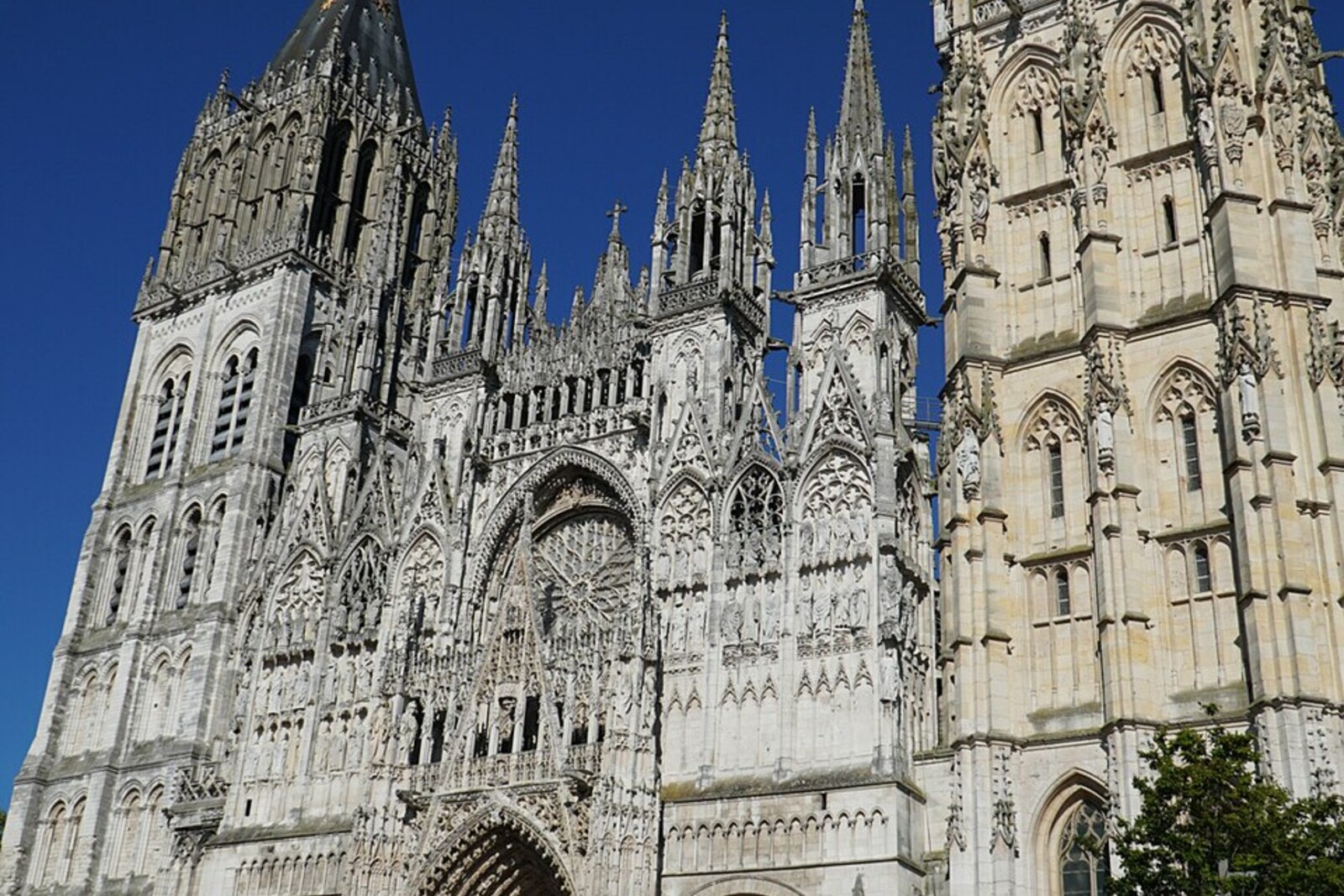
Look around first
What to notice
- The cathedral nave
- The archbishop’s chair
- Joan of Arc Chapel
- Stained-glass windows by Max Ingrand
The story of the place
Joan of Arc was not questioned in the nave of this cathedral. Yet it was the people of Rouen Cathedral who allowed her trial to take place in Rouen.
Notre-Dame means “Our Lady”: the cathedral is dedicated to the Virgin Mary. It is called a cathedral because it contains the chair of the Archbishop of Rouen. At the end of fourteen thirty, the archiepiscopal office remained vacant, and the diocese was governed by the Chapter of Rouen Cathedral—a body of canons, the senior clergy of Rouen Cathedral. While there was no archbishop, only the chapter could allow an outside bishop to judge within Rouen.
This authorization was needed by Pierre Cauchon, Bishop of Beauvais, who sought Joan’s ecclesiastical condemnation. She had been captured near Compiègne, in his diocese, so he could demand that she be tried. But the English council chose Rouen as the place of the trial: its administration, garrison, and the prison holding Joan were here. In another diocese, Cauchon’s authority ended.
Cauchon himself could no longer return to Beauvais after the city went over to Charles VII. He lived in Rouen, carried out assignments for the English government, and the treasury reimbursed him for one hundred fifty-three days of negotiations, after which Joan was handed over to the English. He now needed to turn a captive held by soldiers into a defendant before an ecclesiastical court.
On December twenty-eighth, fourteen thirty, the Chapter of Rouen Cathedral granted his request without recorded opposition. The canons conferred on Cauchon what was known as territory: the right to act temporarily in Rouen as an ecclesiastical judge specifically in Joan’s case. They did not move the hearings to the cathedral, nor had they yet passed a sentence. Their letter removed the obstacle without which the Bishop of Beauvais had no jurisdiction over Joan here.
On January ninth, Cauchon opened the investigation. When convening the first public hearing in February, he explicitly referred to the authorization of the Chapter of Rouen Cathedral. The treasurer, archdeacons, and canons of this cathedral then became among the assessors. The right he had obtained allowed Cauchon to conduct the entire trial, from the first interrogations to the sentence. For Joan, the chain begun by the chapter’s letter ended at the Vieux-Marché; Cauchon himself later became Bishop of Lisieux and died fourteen years before the trial he conducted was declared invalid.
The Joan of Arc Chapel is now in the south transept of Rouen Cathedral. The former Chapel of the Holy Spirit was dedicated to her in nineteen fourteen, and after the war Max Ingrand created stained-glass windows for it. On one of them, Joan’s path runs from Compiègne, where Cauchon found grounds for his claims, to Rouen, where the canons of this cathedral gave him the authorization he lacked.
Useful on site
Free admission. Official cathedral page: Monday 14:00–19:00, Tuesday–Friday 9:00–19:00, Sundays and holidays 8:00–18:00; services may restrict visits. The city page provides seasonal details and closures on Monday morning, January 1, May 1, and November 11.
Checked: June 24, 2026. Check the official source before visiting.The façade makes for a complete stop without entering; inside, keep quiet and bear in mind that this is an active cathedral.