 Guide On Map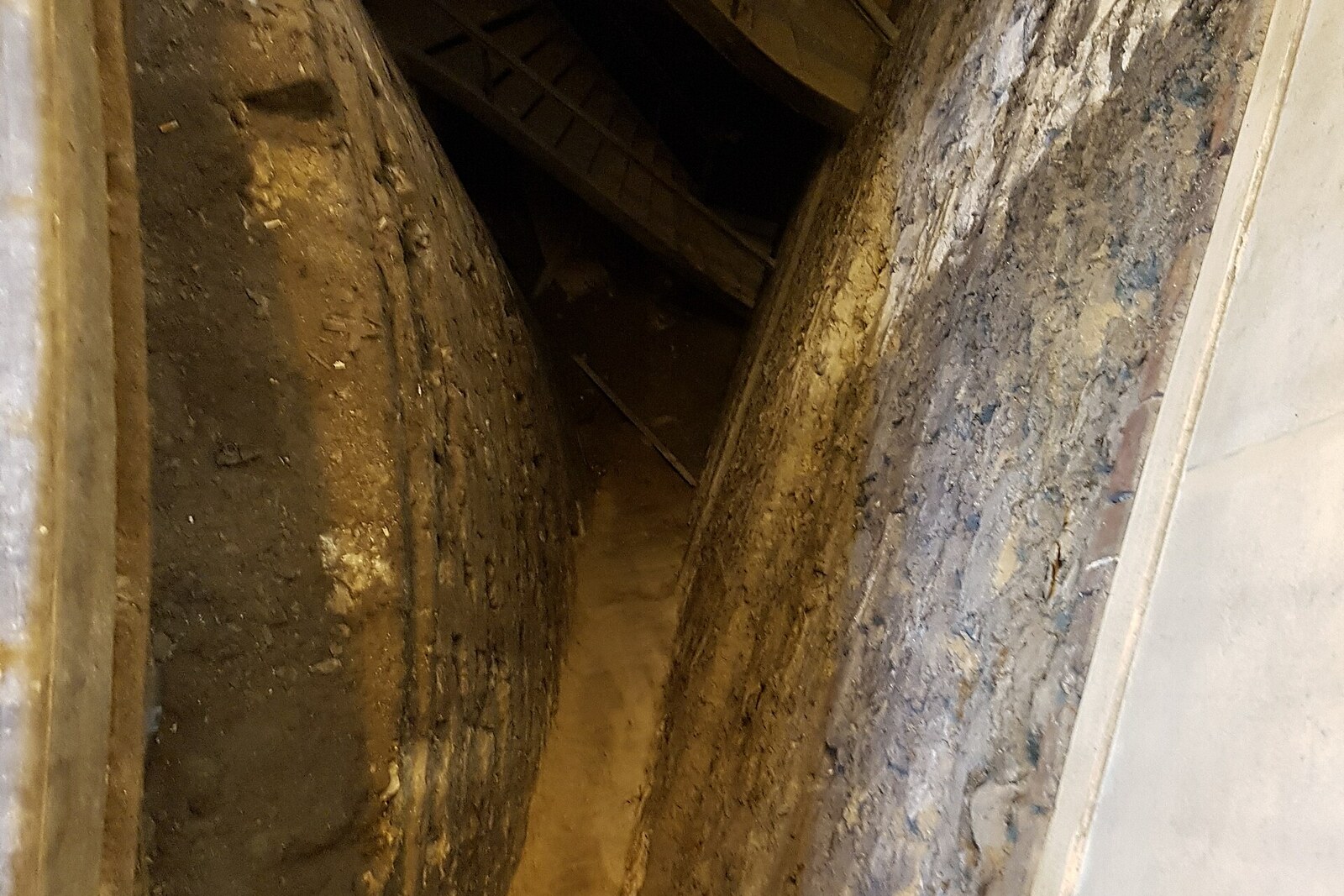
Look around first
What to notice
- The base of the round tower
- The stone staircase
- The well
- The courtyard of the Art Nouveau house
The story of the place
In the inner courtyard of an Art Nouveau house, stones have survived both the fortress wall and the tower itself. Around twelve oh seven, King Philip II Augustus ordered it built on the side of the city facing the fields. In the early twentieth century, the old base was found during construction of the house and incorporated into the new courtyard along with the well and stone staircase. Researchers reconstructed the layout of the rooms: another eight steps led upward from the spiral staircase, while the empty space of the courtyard now remains above the surviving masonry.
The tall donjon where Joan of Arc was threatened with torture stands elsewhere. Her prison was here, in a round tower of the fortress wall. All that remains of it are a well, a stone staircase, and the base, enclosed in the courtyard of a house on Rue Jeanne-d'Arc.
The tower was built around twelve oh seven by order of King Philip II Augustus. It was then called Tour devers les Champs—the tower on the side of the fields. The name Tour de la Pucelle, “Tower of the Maid,” appeared after Joan's imprisonment: the Maid was what Joan herself was called.
She was about nineteen years old. She had helped the French claimant Charles VII reach his coronation in Reims, and then fell captive to his opponents. The English, who regarded the French crown as the inheritance of their underage king Henry VI, brought Joan to Rouen—the principal city of the part of France they occupied—and handed her over to church judges on a charge of heresy.
An accused person at an ecclesiastical trial was supposed to be kept in a church prison under the supervision of women. Joan was left in the English fortress. The court usher Jean Massieu, who took her to interrogations, later spoke of five English guards: three slept inside the cell, and two kept watch outside the door.
Joan's men's outfit consisted of a jacket and chausses—close-fitting stockings joined to the jacket by many ties. According to the testimony of the court notary Guillaume Manchon, the prisoner explained that this made the clothing harder to tear off. She complained to the judges that one of the guards had tried to rape her. Here, men's clothing served as protection and at the same time was included among the evidence of her disobedience to the Church.
On May twenty-fourth, fourteen thirty-one, at Saint-Ouen Cemetery, Joan renounced her previous statements under threat of immediate execution and agreed to wear women's clothing. Instead of the church prison with a female guard that had been requested, Pierre Cauchon sent her back to this tower, to the same soldiers.
A few days later, Joan was found again in men's clothing. Witnesses later described what happened differently. Massieu claimed that the guards took the dress from her bed and left her old outfit, although she asked them to return the women's clothing so that she could get up and go to the latrine. Manchon recalled a different explanation from her: among men, she put on what better protected her from violence. A trap arranged in advance cannot be considered indisputably proven. Something else is certain: the change of clothing took place in this cell, where the prisoner continued to be held among soldiers.
On May twenty-eighth, Cauchon came here with several judges. Joan said that men's clothing was more suitable among men, and again declared that the voices she had heard came from God. The judges called this a relapse into heresy—a return to beliefs the accused had already renounced. Such a relapse allowed her to be handed over for execution. Two days later, Joan was burned at the Place du Vieux-Marché.
In fourteen fifty-six, the earlier verdict was overturned; the accounts of Massieu and Manchon were included in the records of the retrial. By that time the tower itself could still be recognized, but it was dismantled later. In nineteen oh eight, the architect Édouard Danet began building an Art Nouveau house here and came upon the base. He had to incorporate the stones he found into the inner courtyard.
According to researchers' reconstruction, Joan's cell was on the first floor; from the spiral staircase, another eight steps led up to it. The surviving masonry lay beneath the prisoner's feet. The room where the returned clothing became the grounds for a new verdict is now above it—in the empty space of the courtyard.
Useful on site
Not a regularly open attraction; listen as an outdoor stop at 102 Rue Jeanne-d'Arc.
Checked: June 24, 2026. Check the official source before visiting.Do not look for a complete ruin or a museum room: view the remains from the accessible space and do not go beyond the barriers.