 Guide On Map
Plovdiv Above Plovdiv: Center and Old Town
From the Bishop's Basilica of Philippopolis through Old Town and Kapana to the Ancient Theatre of Philippopolis
Guide On Map on your phone
Open the walk like a regular app
It takes about 10 seconds to install. No app store needed.
The whole path
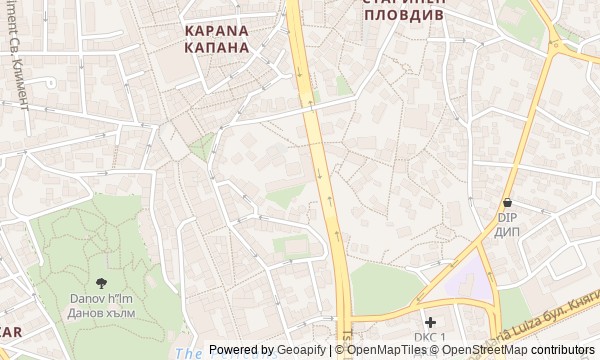
Route map
About the walk
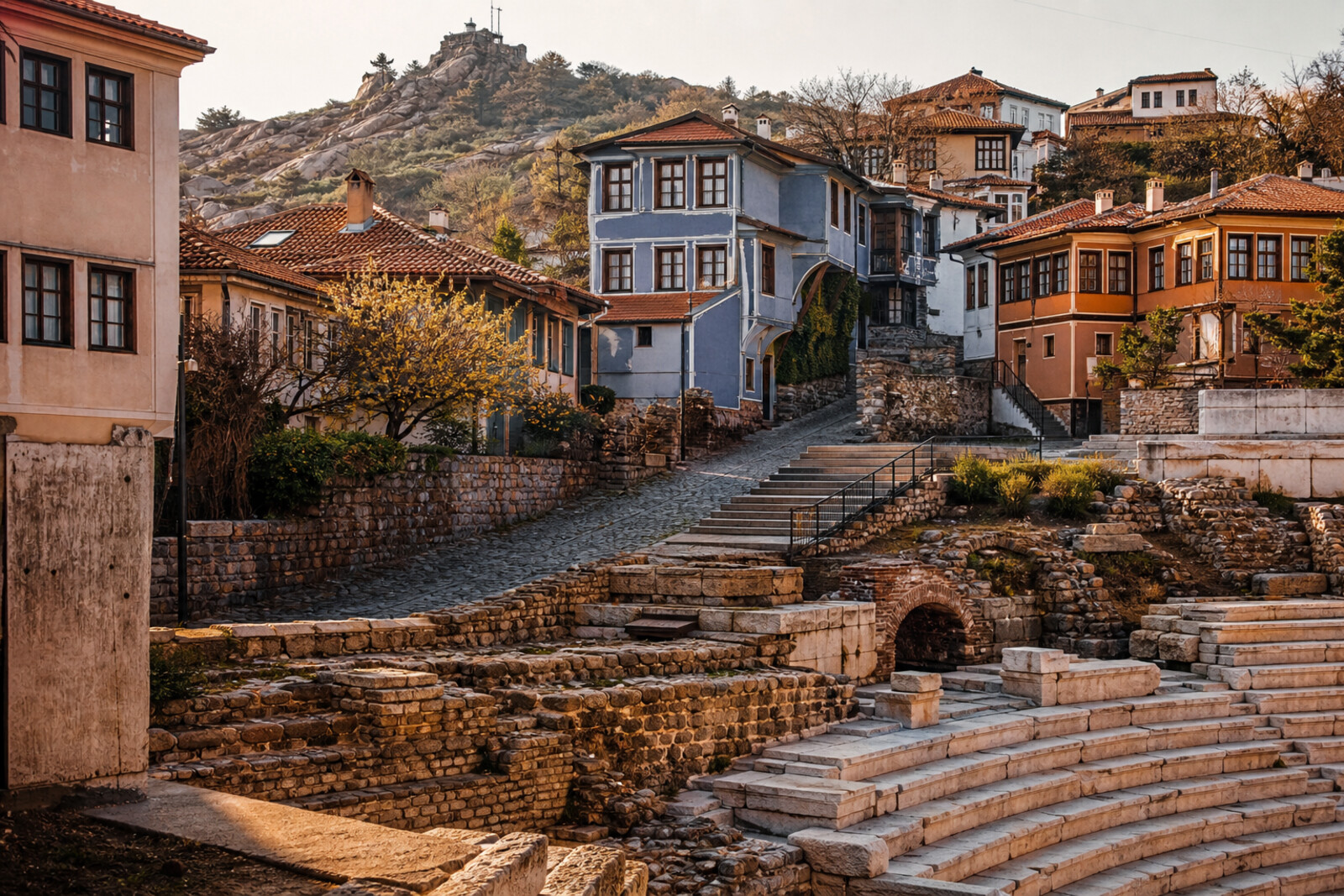
You will begin at Central Square, where modern construction uncovered an ancient layer, then pass the Roman Forum on your way up to Old Plovdiv. Beyond a fortress arch, the road leads to the citadel on Nebet Tepe, then descends to a merchant's house, the narrow streets of Kapana, and the square by Dzhumaya Mosque. Another city appears beneath the paving of the main street, and the walk ends in the stone bowl of the Ancient Theatre of Philippopolis.
This is a walk through places that were never preserved in one chosen century. Some were saved by a delay, a newspaper article, or a change of owner. Others gained a new age because someone happened to find a stone. The story will be calm and exact. It follows material clues: an inscription with a lost name, a bill for someone else's choice, nine layers of paint.
By the end, you will be able to tell the Roman base of Hisar Kapia from its medieval arch, and understand where the stadium continues beneath the main street.
Why this order
The Basilica and the Roman Forum stand in the same lower center: first you will see the main Christian church, then, nearby, the place where the city council made its decisions. From the Roman Forum, the road climbs to Hisar Kapia. The gate takes you inside the old fortified city, and the next ascent to Nebet Tepe carries the defensive line on to the citadel. The descent to Hindliyan House shifts from collective defense to private life; from its merchant rooms, the route continues into Kapana, where trade leaves the house and spreads into a network of craft streets. These lanes lead to Dzhumaya Mosque and directly to the Roman Stadium of Philippopolis beside its square: two neighboring places show how the city gathered people in different eras. From the stadium's northern curve, the road follows the direction of the hidden arena and rises to the Ancient Theatre of Philippopolis—another Roman place for an audience, where the route ends with a new dating.
Those who enjoy archaeological discoveries with a human resolution Those who look closely at inscriptions, masonry, mosaics, and traces of rebuilding Those interested in stories of rescued buildings and city districts
Those looking for a level route without stairs, climbs, and cobblestones Those seeking a quick overview of all of Plovdiv's main sights Those who do not enjoy detailed historical stories
Before you go
Wear shoes with sturdy soles: after the level center, the route climbs over the cobblestones of Old Town. Access inside the Basilica, Odeon, Hindliyan House, mosque, and theatre may depend on the day, services, events, or museum schedules, so check official information for your chosen date in advance. For the mosque, choose clothing appropriate for an active place of worship, and be prepared to limit your visit to the exterior. At the theatre, concerts and stage installation sometimes change access to particular areas.
When to go
About 4 hours with visits to the Basilica and Hindliyan House, and a close look at the theatre; about 3 hours if you see most interiors only from outside.
Backup plan
If some interiors are closed, the route still holds together: at the Odeon, trace the modern cut through the Roman Forum; at the mosque, compare its solid volume with the open section of the stadium; and at Hindliyan House, focus on the facade and the layout of the merchant street. In rain, do not linger on the slippery cobblestones of Kapana or the open sections of Nebet Tepe; give more time to the Basilica and any accessible covered displays. If the climb proves too difficult, end the walk in the lower city after Kapana: the first five stops form a complete story of how public spaces succeeded one another.
Route conditions
Surface. Paved — 2.3 km (data covers 88% of the route)
Stairs. Flights: 7, 107 m in total
Access. Wheelchair — no; stroller — limited (stairs)
Facilities. Toilets — 7; drinking water — 9
Elevation. Ascent — 48 m; descent — 30 m
OpenStreetMap extract of July 4, 2026: database data, not a check on the ground. Data © OpenStreetMap contributors, ODbL licence
Walk plan
Open in maps ↗- 1
Bishop's Basilica of Philippopolis
An inscription beneath the upper mosaic floor will turn a long-standing hypothesis into proven status as the principal church. - 2
Roman Forum and Odeon
A fragment of an imperial letter will show who was left with the bill for a losing political choice. - 3
Hisar Kapia
A merchant’s house explains how old gates stopped protecting the city and became part of a museum building. - 4
Nebet Tepe
The wall line and reservoir preserve the trace of the citadel that ceased to be maintained after the war of fourteen ten. - 5
Hindliyan House
A cross-section of nine layers of paint shows how merchant rooms were divided among twenty-three families. - 6
Kapana
The surviving network of lanes will turn out to be the result of a demolition that never happened and a long debate among architects. - 7
Dzhumaya Mosque
The surviving roof will provide a point of entry into the history of a building that was saved from dismantling but not immediately returned to worshippers. - 8
Roman Stadium of Philippopolis
The northern edge of the arena will connect the spectator seating with the section of wall through which the night assault entered the city. - 9
Ancient Theatre of Philippopolis
An inverted pedestal in a later staircase moves the construction of the theatre back by three decades.
Route features
Everything you need stays in the browser
Progress, saves and your trip plan are stored on this device.
Add Guide On Map to your home screen so the walk opens outside the browser.
How we handle sources, maps and corrections: our editorial standards