 Guide On Map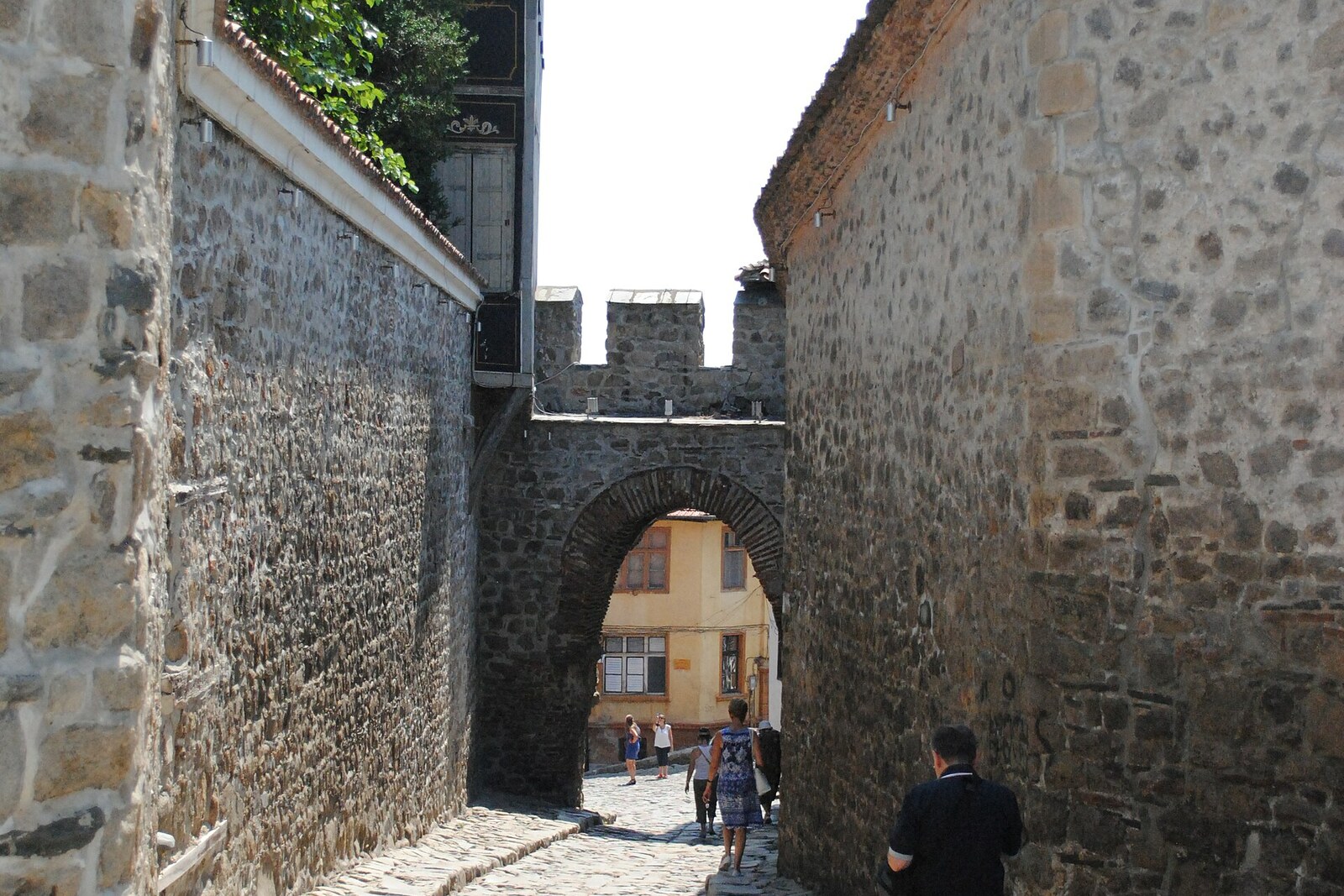
Look around first
What to notice
- Fortress-gate arch
- Stones with bands of red brick
- Eastern façade of Kuyumdzhioglu House
- Medieval wall beneath the house
The story of the place
In the narrow passage between the cobbled pavement and the tall façade, the boundary of the upper, fortified city can still be read. The arch of Hisar Kapia led through the eastern entrance toward the citadel; below the pavement lie the remains of Roman gates, while the visible masonry dates to the Middle Ages. Stones stitched through with bands of red brick continue into the wall beneath the house and its basements. The rooms beside the old masonry now store the museum collections.
In eighteen forty-seven, the Plovdiv merchant Argir Kuyumdzhioglu commissioned the master builder Georgi Stanchovski to construct an enormous house by the old eastern entrance to the city. Kuyumdzhioglu traded in aba—a dense woolen cloth—and kept a trading house in Vienna. He invested his earnings in a residence by which Plovdiv’s merchant class was to judge his wealth.
The site was inconvenient: a steep slope, old masonry, and a passage that could not be occupied. This passage was called Hisar Kapia—Ottoman Turkish for “fortress gate.” It once led into the fortified upper part of Plovdiv. Beneath the cobbled pavement, the foundations of Roman gates, probably from the second century, have survived, while the present arch was built mainly between the eleventh and thirteenth centuries. After the Ottoman conquest, the city expanded beyond the hills, and the gates no longer needed to protect the former citadel.
Stanchovski did not dismantle the fortress wall. He set the eastern façade of Kuyumdzhioglu House on it and incorporated the ancient masonry into the foundation and basement rooms. The difference in elevation helped turn an obstacle into an advantage: on the courtyard side, the house has two residential floors, while above the descent it rises to four. Thus, rooms for a wealthy merchant appeared above the former defensive line, with service rooms below them.
The Kuyumdzhioglu family later left Plovdiv, and the heirs began renting out the house. It successively housed a girls’ boarding school, a hat workshop, a vinegar production facility, and a flour warehouse. In the late nineteen twenties, the tobacco merchant Antonio Colaro bought the building, intending to adapt it as a tobacco warehouse. Colaro went bankrupt, and the house was put up for sale.
Plovdiv mayor Bozhidar Zdravkov sought a permanent home for the city’s ethnographic collection. In nineteen thirty-eight, he intervened in the sale, after which the municipality and the Ministry of Public Education agreed to establish a municipal house-museum here. For Kuyumdzhioglu, the house had been proof of merchant success; for Colaro, it was meant to become a warehouse; under Zdravkov, it itself became the museum’s main exhibit. Visitors began to be admitted in nineteen forty-three.
Today, the Regional Ethnographic Museum – Plovdiv stands above Hisar Kapia. The medieval wall still serves as the foundation of its building, and the rooms beside the old masonry are used to store the museum collections. In the arch itself, stones outlined with pieces of red brick are visible; the Roman foundation remains below the pavement.
Useful on site
Free street passage, with no ticket office or fixed hours.
Checked: June 24, 2026. Check the official source before visiting.The arch can be viewed freely from the street; the neighboring Ethnographic Museum requires a separate visit.