 Guide On Map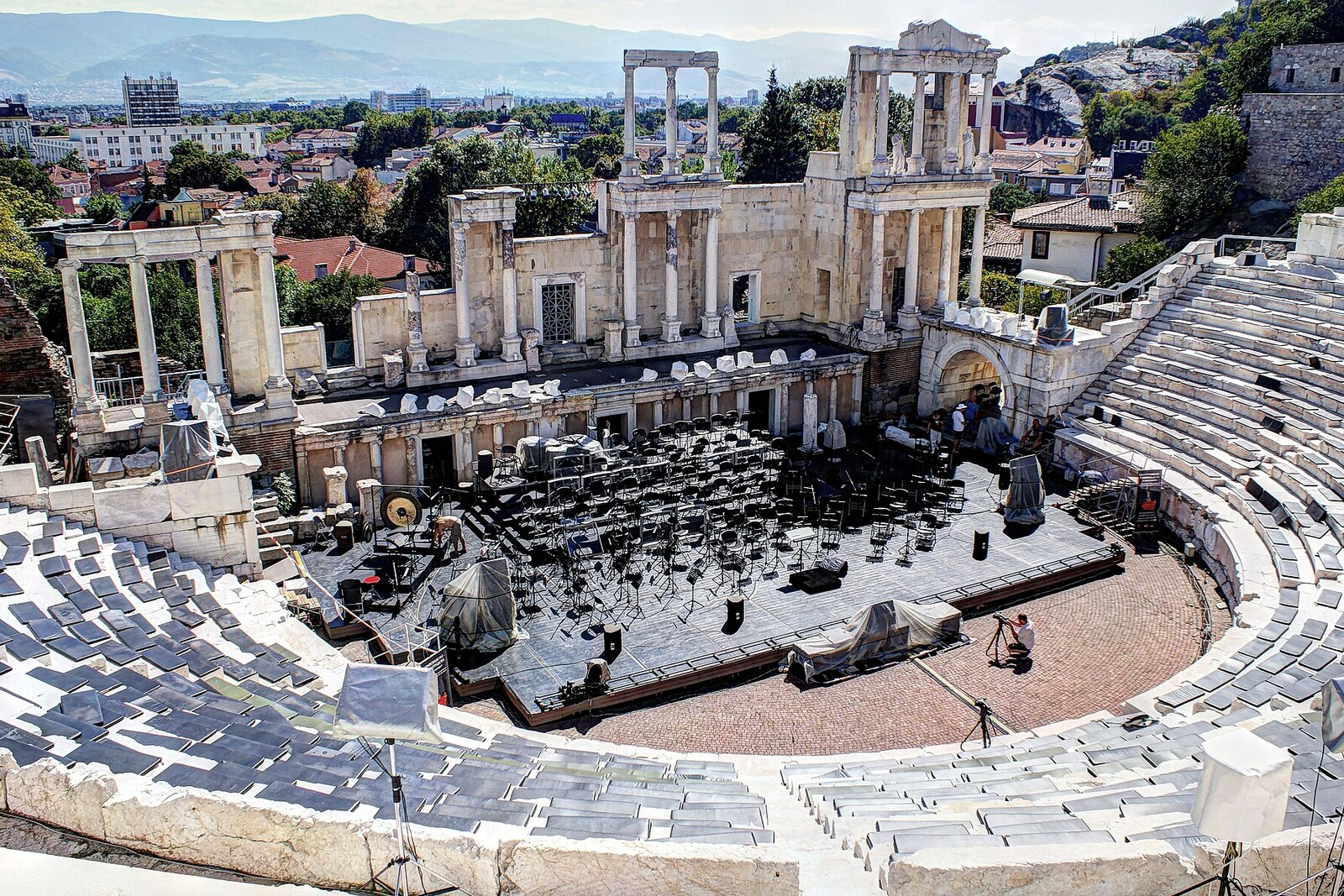
Look around first
What to notice
- Twenty-eight stone rows
- Semicircular orchestra
- Stage building
- Columns above the stage
The story of the place
The builders turned the natural rocky slope between Dzhambaz Tepe and Taksim Tepe into an auditorium with twenty-eight stone rows; at the bottom are the semicircular orchestra and the stage building with columns. In ancient Philippopolis, representatives of the cities of Roman Thrace came here not only for performances, but also for assemblies. Places for magistrates, provincial officials, and groups of citizens were carved into the marble seats: honored guests sat by the orchestra, while the others occupied separate sectors.
In two thousand sixteen, a team led by archaeologist Maya Martinova-Kyutova investigated a Late Antique staircase beside the semicircular area in front of the stage. One of its steps was a fragment of a marble statue base. A statue had once stood on it; after the theatre was destroyed, the stone was turned over and incorporated into the masonry.
The inscription on the base was read by Nikolay Sharankov, a specialist in ancient Greek texts. It named Titus Flavius Cotys, a descendant of a Thracian royal family that had received Roman citizenship. Cotys held the office of first archon, meaning the chief city magistrate of his year, who was in charge of public works. He was elected high priest of the province's imperial cult three times: he represented the cities of Thrace at ceremonies honoring the Roman ruler.
Such offices required private wealth. A city leader was expected to pay for festivities or construction and thereby earn public recognition. The inscription says that Cotys adorned his native city with magnificent buildings; archaeologists also link the theatre's construction to his money. His reward was a bronze statue before the spectators and the delegates of the province. The name of the person who commissioned the statue survives only in part.
The statue was placed here because the theatre's activities were not limited to performances. Representatives of the cities of Roman Thrace met here. Seats for city magistrates, provincial officials, and particular groups of citizens were carved into the marble seating. The auditorium literally displayed the order of the assembly: honored guests sat closer to the orchestra—the area between the rows and the stage—while the others occupied marked sectors. For this, the builders used the natural rocky slope between Dzhambaz Tepe and Taksim Tepe: twenty-eight rows rise along the rock, while the stage building closes the bowl at the bottom.
The discovery of the base changed the age of the whole structure. Previously, the theatre had been dated to one hundred sixteen or one hundred seventeen, to the time of Emperor Trajan: his name survives in a construction inscription on the architrave. Cotys lived earlier. His statue proved that the theatre already existed in the nineties of the first century, under Emperor Domitian. Trajan's inscription is now linked to a later phase of work, and the start of construction has been moved back by about three decades.
Cotys's bronze figure disappeared. The marble base outlasted it because later builders turned the monument into a step. Modern performances, concerts, and operas are once again held on the former stage, and the date of its appearance is known thanks to the stone that lay for many centuries in the staircase with its inscription facing inward.
Useful on site
Daily: April–October 09:30–18:00, November–March 09:00–17:30; break 12:30–13:00. Events and setup may change access to the stage.
Checked: June 24, 2026. Check the official source before visiting.Access to the stage and individual sectors may change because of events; a visit and a ticket for a performance should be planned separately.