 Guide On Map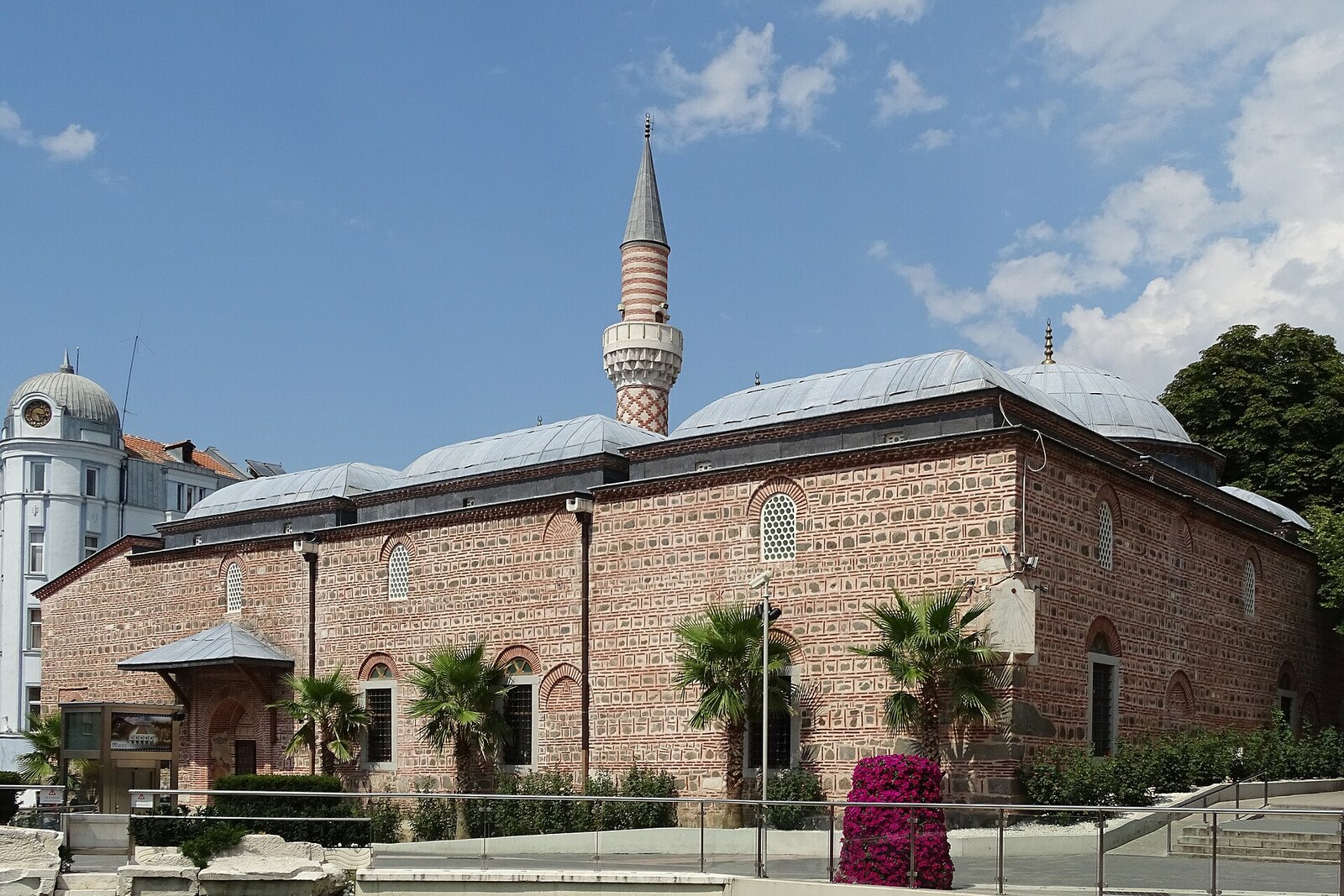
Look around first
What to notice
- The roof above the prayer hall
- The artificial terrace
- The staircase to the entrance
- The large prayer hall
The story of the place
A huge prayer hall rises above the square, with a staircase leading to its entrance from a raised embankment. When the market bustled around it, residents from different neighborhoods gathered here on Fridays for congregational prayer, and the building’s size matched that role. The name Dzhumaya preserves the memory of Friday, while Muradiye recalls the sultanic charitable endowment that supported the mosque itself and its attendants. Researchers date the present walls to about fourteen twenty-five, although an old city tradition named another Sultan Murad as the patron.
In the summer of eighteen seventy-eight, workers were already removing the roof from this mosque. The Russo-Turkish War had ended, Russian troops were stationed in Plovdiv, and many Muslim buildings were being dismantled or taken over for other uses. Before the war, the city had counted thirty-three mosques and prayer houses; by November, only one would remain suitable for worship.
On July twenty-second, Yusuf Rıza and Nashid Rashid arrived here—Ottoman representatives of the International Rhodope Commission. The commission gathered information about the fate of refugees and destroyed property. Its report recorded that their arrival stopped the dismantling of Muradiye, “the mosque of Murad.” The document does not say who ordered the roof to be removed or exactly what the commissioners said. The result is known: the workers stopped dismantling the building.
Saving the walls did not yet return the prayer hall to people. In the autumn, Russian units used Muradiye as a warehouse. After they left, Plovdiv’s Muslim community asked for two thousand liras, held in the provincial treasury, to be released for repairs to this mosque and Imaret Mosque. Community members counted on money from former charitable endowments that had supported the buildings and their attendants. They were refused: officials said that the status of those funds had not yet been settled. Major repairs to Muradiye were carried out only in nineteen eight.
The name “Dzhumaya” explains why such an immense hall was needed. “Juma” means Friday congregational prayer, and Ulu Dzhumaya means the main Friday mosque. On Fridays, worshippers from different neighborhoods gathered here, so it was built in the middle of what was then the market. The builders raised the mosque on an artificial terrace and linked it to the market rows with a staircase. The market has disappeared, but its direction remains: the city’s pedestrian street and square still converge at the entrance.
Historians dispute which of the two sultans named Murad conceived the original plan. An old tradition named Murad I, who conquered Plovdiv. More recent research dates the present building to about fourteen twenty-five, when Murad II ruled; expense records from the late fifteenth century link the mosque to a sultanic charitable endowment. That is why it retained two names: Muradiye recalls its patron, and Dzhumaya its purpose.
In July eighteen seventy-eight, only part of the roof had been dismantled. Friday prayer is still held beneath it today.
Useful on site
Active mosque; no official tourist schedule has been published. Entry depends on prayers and the decision of the attendants.
Checked: June 24, 2026. Check the official source before visiting.This is an active place of worship: do not disturb prayer, and enter only when visiting is appropriate; the painted decoration is visible only from inside.