 Guide On Map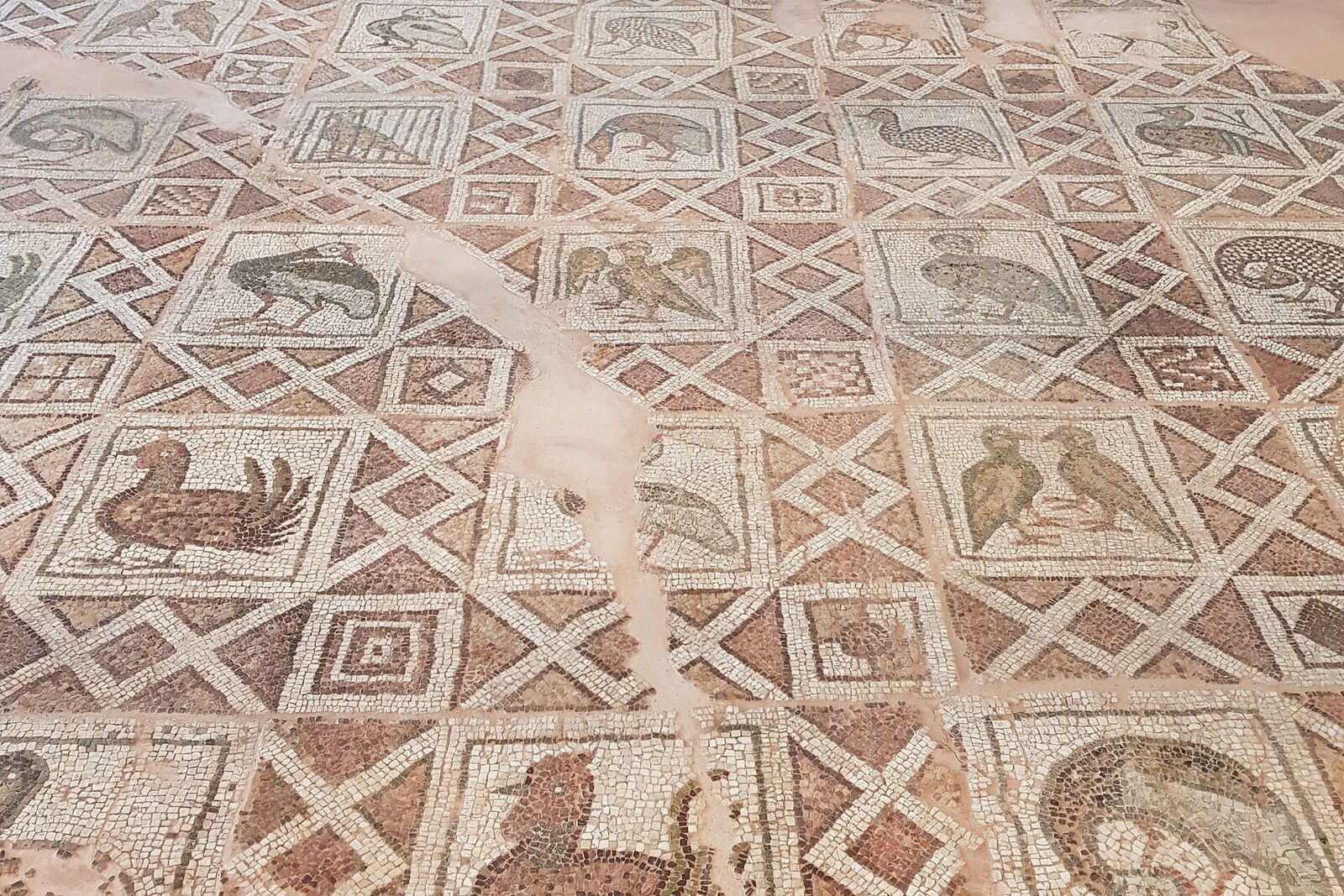
Look around first
What to notice
- Fragment of the Greek inscription
- Two mosaic floors
- Image of an altar table and two vessels
- Northern nave
The story of the place
Under the protective roof, two mosaic surfaces are exposed, now separated onto different levels. In Late Antiquity, beside the city forum, stood Philippopolis’s principal Christian church: three naves converged on an apse, before which was a marble platform for the bishop and clergy. At the lower level, images of an altar table and vessels for communion have survived, while the northern part of the church was uncovered again after the section of street above the ruins was dismantled.
In the early nineteen eighties, construction workers were building an underpass beneath Central Square when they came upon a mosaic floor. Elena Kesyakova, an archaeologist at the Plovdiv Regional Museum, was given a rescue excavation in the middle of an urban construction site. Beneath the mosaic, the plan of an enormous three-naved church emerged, but it could not be investigated in full: the northern half of the building extended beneath a road still in use.
From nineteen eighty-three to nineteen eighty-six, Kesyakova uncovered the central and southern naves, the altar area, and a courtyard with colonnades. Philippopolis—the ancient name of Plovdiv—had placed this church beside the city forum. In the central nave stood a marble-clad raised platform for the bishop and clergy. Based on its size and position, Kesyakova concluded that she had found the city’s principal Christian church, where the bishop officiated. She had no direct proof, however. The object was given a more cautious name: the Large Basilica.
The excavations then stopped. Economic hardship and changes in the country left archaeologists with only the means to protect what had been found. Some sections of mosaic were removed and transferred to museum storage, while others were covered with sand. The unexcavated northern nave remained beneath the road. A temporary shelter was erected over the ruins, but it collapsed in the late nineteen nineties, and the mosaics began to deteriorate. For almost three decades, Kesyakova’s conclusion remained a professional hypothesis, buried along with most of the building.
In two thousand fifteen, Kesyakova returned here as an archaeological supervisor. Elena Kantareva-Decheva’s conservation team was preparing the mosaics for a future exhibition. The upper floor had to be removed in sections, reinforced, and then reassembled. When it was lifted in the southern nave, an earlier mosaic layer was discovered.
At the center of this layer, craftsmen of Late Antiquity laid out an altar table and two vessels—for wine and water used during communion. A Greek dedicatory inscription ran alongside. The beginning of the name has been lost: epigraphists propose Marcian or Lucian. The title and the ending of the name, however, have survived. The inscription states that the mosaic was laid in the time of a bishop whose name ended in “kian.”
These few letters confirmed Kesyakova’s conclusion. Before the archaeologists stood the church of the city’s episcopal see, active from the fourth century to the end of the sixth century. A large Christian community gathered here, while the bishop and clergy occupied the raised platform before the apse. Thus the Large Basilica received its current name—the Bishop's Basilica of Philippopolis.
The finds also forced changes to the museum project. The city dismantled the section of road above the northern nave, and the team led by archaeologist Zhenya Tankova uncovered the remaining half of the church. The conservators now had two ancient mosaic floors, one lying above the other. The lower one was preserved in its original location. The upper one, which had to be removed for work beneath it, was reassembled on the second floor of the protective building.
A fragment of the inscription remains in the southern nave: “in the time of Bishop … kian.” The upper mosaic floor, which concealed these words until two thousand fifteen, is now displayed one floor above.
Useful on site
Daily 09:00–18:00; adult ticket — 7.57 euros.
Checked: June 24, 2026. Check the official source before visiting.The main sights are inside the museum complex; do not rush, and compare the mosaics up close and from the upper viewing points.