 Guide On Map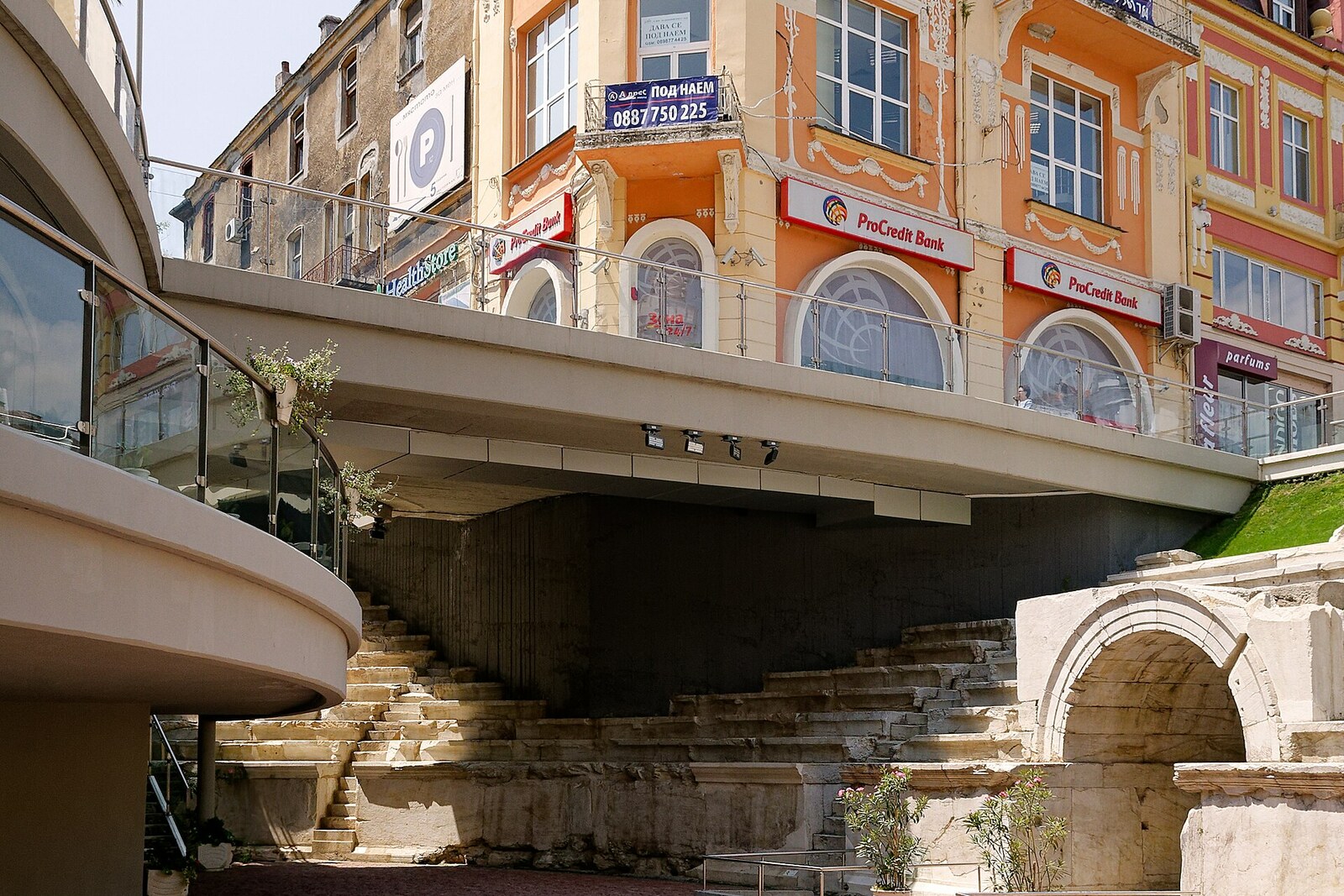
Look around first
What to notice
- Northern rounded section of the stadium
- Stone seating
- Fragment of the city wall
- Pedestrian street above the arena
The story of the place
From beneath the pedestrian street emerges the northern semicircle of the ancient arena, with stone rows for spectators. In the early second century, under Emperor Hadrian, a running track about two hundred forty meters long was laid here, and stands were built for tens of thousands of people. During the Pythian Games, not only athletes competed at this site: heralds, trumpeters, musicians, and poets performed as well. Behind the rows at the northern edge, a section of the city wall survives.
At the turn of the years two hundred fifty and two hundred fifty-one, Titus Julius Priscus, governor of Thrace, summoned the inhabitants of Philippopolis here. The army of Cniva, a Gothic leader, was approaching the city, and Emperor Decius sent a letter ordering them to wait for the Roman army behind the fortress walls.
The stadium was chosen for the general assembly. It was built in the early second century, under Emperor Hadrian: the running track stretched for about two hundred forty meters, and the stands held tens of thousands of people. The Pythian Games were usually held here. Alongside the athletes, heralds, trumpeters, musicians, and poets competed. Now Priscus needed its capacity to convey one order to one city.
Decius advised the inhabitants not to go out into the field against the Goths. The townspeople had no military experience, and the emperor promised to bring trained units. Dexippus, writing in the same century, gives another reason for the caution: Decius feared that armed Thracians would put forward their own claimant to the throne. He himself had become emperor only very recently, after the troops proclaimed him, and he knew well how quickly a provincial army could create a new sovereign. Priscus served Rome as governor; his office and his life depended on the outcome of the siege.
Cniva first failed to take the fortifications and withdrew his men. Then a man from the besieged city came to the Goths and pointed out a weak section of wall near the stadium. Dexippus does not name the defector or identify him with Priscus. At night, five scouts returned to the wall. They climbed up where the fortification was lower, and an elite detachment followed them. The Goths captured the towers and let the rest of their warriors into the city.
Philippopolis was plundered, and many inhabitants were killed or taken captive. Ancient authors give enormous numbers of victims, but historians consider them exaggerated. After the city fell, Priscus appears in later accounts already as an ally of Cniva and a rival of Decius: the Goths proclaimed the governor emperor. Whether he took part in the conspiracy before the assault or tried to save himself afterward cannot be determined. The new title did not help him—Priscus soon disappears from the sources, probably having died.
Now the northern rounded end of the stadium is open, while the main part of the track runs beneath the pedestrian street and neighboring buildings. A fragment of the city wall survives north of the seating. The specific stone by which the first scouts climbed is unknown; what remains before your eyes is the arrangement itself: the stands inside the fortifications and the wall at the stadium’s northern edge, where a man from the besieged city led the attackers.
Useful on site
The open sphendone is free; projection hall daily: April–October 09:30–18:00, November–March 09:00–17:30, break 12:30–13:00.
Checked: June 24, 2026. Check the official source before visiting.The main part of the stadium is hidden; view the accessible fragment as a key to the structure beneath the houses and shops.