 Guide On Map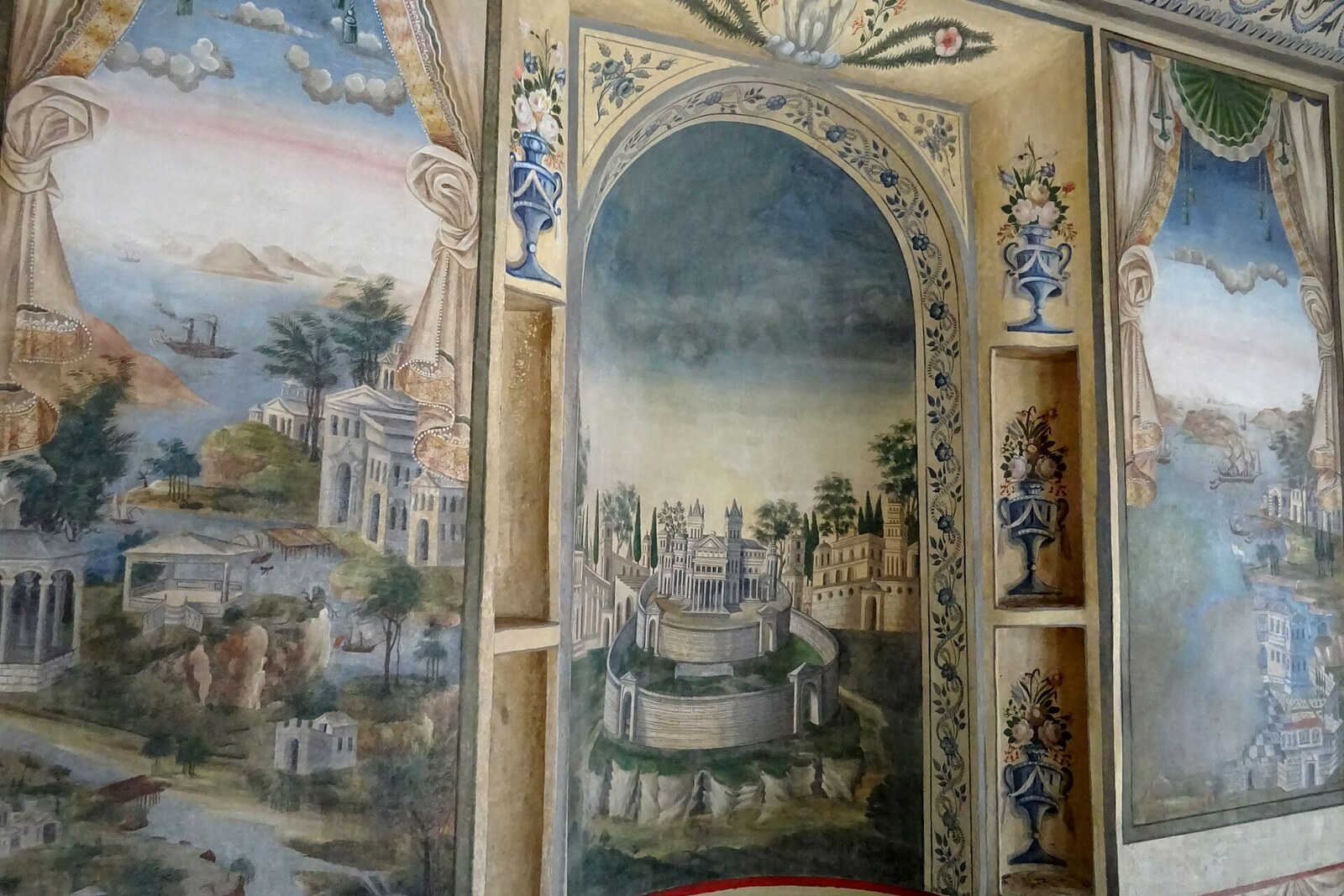
Look around first
What to notice
- A cross-section of nine layers of paint
- Murals with views of St Petersburg, Venice, Stockholm, and Alexandria
- The stone storeroom with iron doors
- The room of the private bath
The story of the place
Valuables were kept behind the iron doors of the stone storeroom, while the kitchen, laundry, and servants' rooms were placed in a separate wing: this large house in the Old Town functioned as a merchant household, where goods and people had different routes. The living rooms even included a bath with a heated floor; the walls were painted with views of St Petersburg, Venice, Stockholm, and Alexandria. The building appeared in eighteen thirty-four for a prosperous Armenian merchant whose business rested on silk, textiles, leather, spices, and grain. It is now a museum, and one preserved cross-section of wall holds nine layers of later paint.
In nineteen fifteen, the owners themselves moved out of this house. The Hindliyan family gave the rooms to Armenian refugees: deportations and mass killings of Armenians were taking place in the Ottoman Empire, and people arriving in Plovdiv needed housing.
The house had been intended for a very different life. Between eighteen thirty-four and eighteen thirty-five, it was built for Stepan Hindliyan, a wealthy Armenian merchant and landowner. He made his money from silk, textiles, leather, spices, and grain, and business often took him to India. Because of these journeys, the merchant was nicknamed Hindliyan, and the house received its current name from that nickname.
The household was arranged so that goods, servants, and owners would barely get in one another's way. Valuables were kept in a separate stone storeroom—a maaze—with iron doors and heavy bolts. The kitchen, laundry, and servants' rooms were placed in a service wing. The residential part included a private bath with underfloor heating, and the walls were covered in murals: niches came to hold St Petersburg, Venice, Stockholm, and Alexandria—cities from the world in which the owner traded.
After the Hindliyan family's decision, this house of one wealthy lineage had to be divided among twenty-three families. About sixty people were housed here. The large central hall, called the hayet, and the formal rooms were partitioned to create separate living spaces. The residents repainted the walls, each in their own color; the images of cities gradually disappeared beneath several layers of paint.
By the end of the nineteen sixties, twenty-three families still lived in the house. Atanas Krastyev, the first head of the Old Plovdiv administration, campaigned for the restoration of old city houses. The residents were moved into apartments, and restorers began dismantling the partitions and stripping away paint. They reached the original murals only after the ninth layer.
In nineteen seventy-four, the restored house was declared a cultural monument; it is now a museum. The restorers left one section of wall as a cross-section: above the merchant mural lie nine multicolored stripes—the paint from the rooms into which the house was once divided for twenty-three families.
Useful on site
Tuesday–Sunday: April–October 09:30–18:00, November–March 09:00–17:30; break 13:00–13:30. Closed Monday.
Checked: June 24, 2026. Check the official source before visiting.The main details are inside and require a separate museum visit; from outside, only the appearance of the house is accessible.