 Guide On Map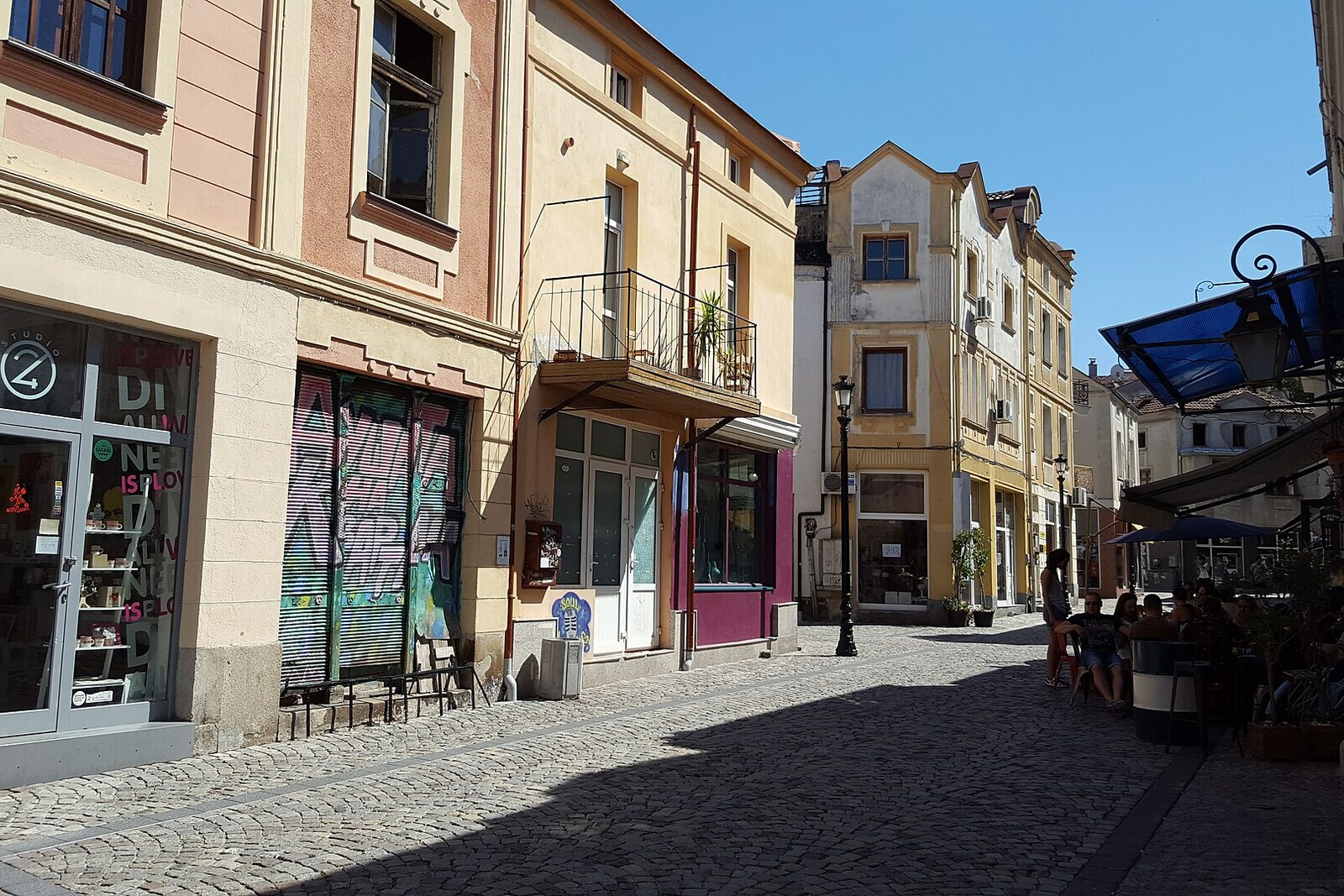
Look around first
What to notice
- Signs for Zhelezarska Street, Zlatarska Street, Kozhuharska Street, and Abadzhijska Street
- Narrow lanes
- Small houses
The story of the place
Kapana means “trap” in Bulgarian, but historians link the name to the Ottoman kapan—a wholesale market where goods were weighed, taxed, and handed over to merchants. In the fifteenth century, Un Kapan, the Flour Kapan, and Büyük Kapan, the Great Kapan, stood here. Craftsmen gathered, each on their own street. Ironworkers worked on Zhelezarska Street, goldsmiths on Zlatarska Street, tanners on Kozhuharska Street, and abadzhi, who sewed clothes from coarse woolen cloth, on Abadzhijska Street. These names have survived on the current street signs.
The network of narrow streets could have disappeared in nineteen sixty-eight. That year, the city held an international competition for the redevelopment of central Plovdiv. None of the submitted designs preserved Kapana. The winners proposed clearing the neighborhood and erecting three large commercial buildings beside the Hali, joined into a single complex. Municipal departments had time to prepare working drawings and began expropriating houses on Yoakim Gruev Street and Zlatarska Street.
Antoaneta Topalova, a young architect from Plovdiv just beginning her professional life, worked on one of the competition teams. Her own team did not propose preserving the neighborhood either. Topalova changed her mind after an architectural congress in Madrid: there she found herself in an old commercial district of a similar scale and saw that dense historic development could remain part of a modern city.
After returning, Topalova began looking among her senior colleagues for people willing to stop the demolition. She was told that the decision had already been made and that it was too late to argue. She then wrote an article for the local newspaper, “Measure Three Times, Cut Once.” The editors did not publish the text for several months, then placed it in a small block on the last page. That was enough for the discussion to move beyond the design offices.
Almost at the same time, Stefan Valchev, the head of regional commerce responsible for the future complex, was transferred to Sofia. After his departure, the supporters of clearing the area lost the project’s chief manager. Implementation of the competition plan in the part concerning Kapana was halted, and Topalova and her like-minded colleagues had the opportunity to prepare an alternative.
In nineteen eighty-one, a group of architects, artists, and designers led by Topalova presented a new project. The specialists measured façades and entire street silhouettes, marked valuable buildings, and separated pedestrian passageways, automobile traffic, and goods-delivery routes. Small houses, workshops, and courtyards were to form a cultural and crafts district. The project received a silver medal at the architectural biennale in nineteen eighty-five, but it was not fully carried out. After the changes of the late eighties, private property was restored, and coordinating street widenings or the clearing of entire blocks became practically impossible. In this way, the owners of individual houses entrenched the dense network that the architects had managed to document and protect.
Kapana’s present purpose emerged on this preserved foundation. In two thousand fourteen, employees of the municipal fund “Plovdiv—two thousand nineteen” announced a competition for ten vacant premises. The winners were compensated for a year’s rent; in return, they had to open a workshop, studio, gallery, or another creative space here and hold at least four public events. Thirty-nine applications were submitted; the ten selected teams took up design, architecture, photography, contemporary art, programming, and urban media. At the same time, workers relaid the old cobblestones and closed some streets to cars.
Today, cafés, bars, and restaurants are far more noticeable here among the workshops and galleries. But they all fit into the same short blocks, with fifteenth-century craft names hanging above them. The three commercial buildings never occupied Kapana: on the site set aside for them, the houses and streets remain that Antoaneta Topalova’s group once measured.
Useful on site
The streets are accessible at all times; individual workshops, galleries, and establishments keep their own hours.
Checked: June 24, 2026. Check the official source before visiting.What matters here is not a particular interior but the street network itself; take particular care on wet cobblestones.