 Guide On Map
Koutoubia Mosque, Jemaa el-Fnaa, and the Souks of Marrakech
From the Koutoubia Mosque esplanade through Jemaa el-Fnaa to Mouassine Fountain
Guide On Map on your phone
Open the walk like a regular app
It takes about 10 seconds to install. No app store needed.
The whole path
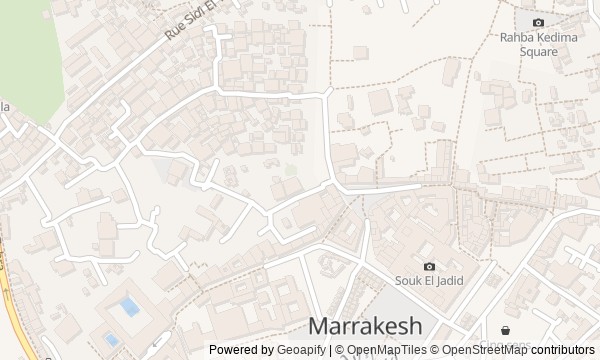
Route map
About the walk
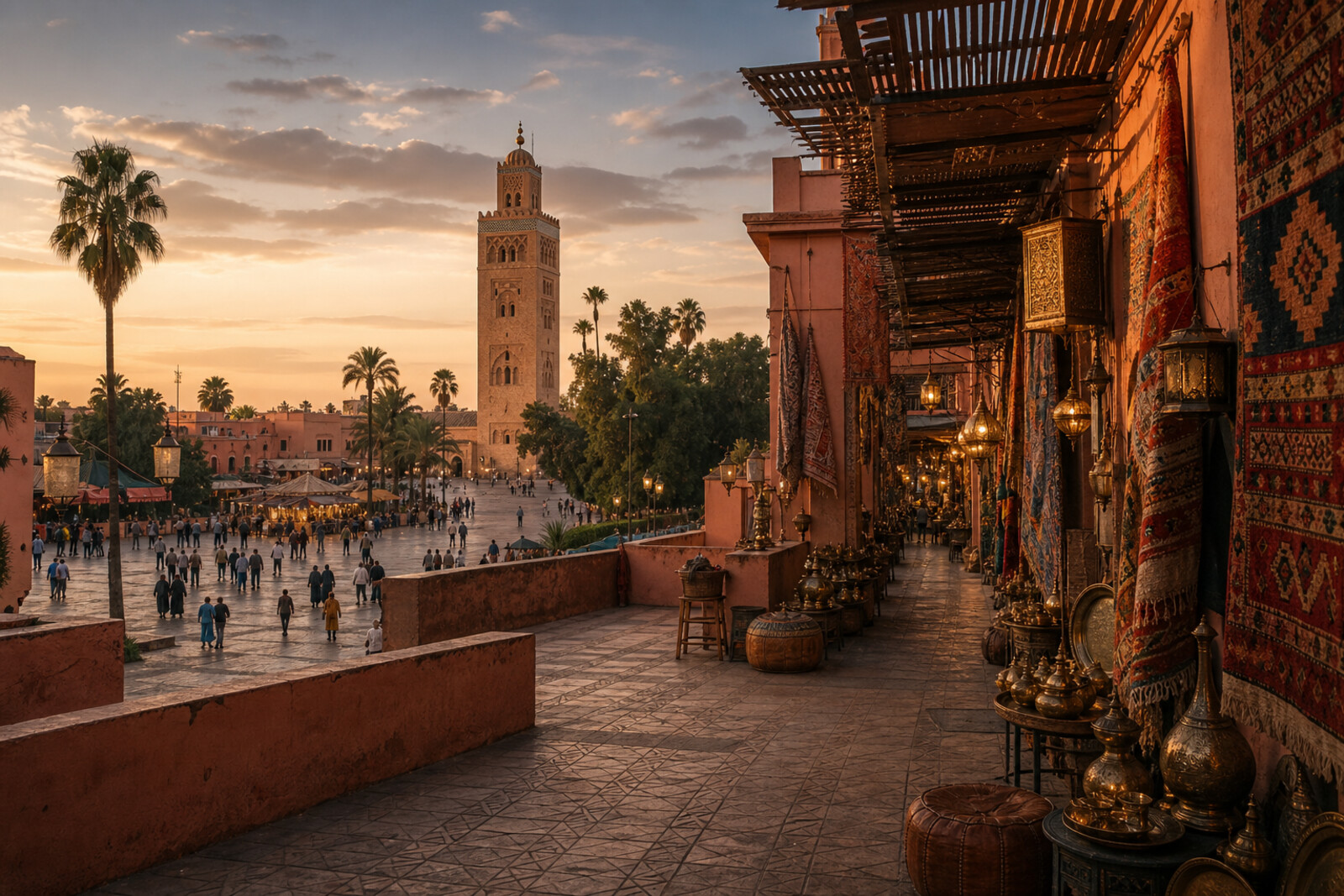
You will begin on the Koutoubia Mosque esplanade, where the working mosque stands beside a grid of exposed foundations. The answer to why there are two of them lies in the arches set into those foundations. Then you will look up at Koutoubia Minaret, where an old legend hides family gold above the reach of palace searches.
You will cross Jemaa el-Fnaa from south to north. First, you will see how an art with neither walls nor a stage is protected. Then you will linger at a circle of spectators and hear about a boy who had to bring a few coins home every evening.
Under the souks' roofs, open space gives way to narrow trading passages. The names of crafts outlive the craftspeople themselves; in the carpet courtyard, you will hear about people whose names almost no one recorded; old shelves become part of a new family business.
The story will stay calm and precise: a legend remains a legend, and a hypothesis a hypothesis. At the dry fountain, you will understand how the center of Marrakech distributed space, voice, customer, and water.
Why this order
First, you will make sense of Koutoubia Mosque's low foundations and the design of its double sanctuary; then, at the minaret, you will move from a caliph's decisions to the legend of a man who found a hiding place above his city. From the tower, you will reach the southern edge of Jemaa el-Fnaa: here, you first need to understand how the square was defended as a setting for oral art, and only then, in the northern circles, follow one storyteller's fate within that setting. From the square's northern section, you will enter Souk Semmarine—the flow of people becomes a flow of shoppers, and an old craft name explains the entrance to the souks. After the main trading street, the Souk Zrabi courtyard reveals the order of an auction; nearby Rahba Kedima continues the story of trade in a family shop adapted for visitors. At the final turn toward Mouassine Fountain, the conversation shifts from a private shop to the forced remaking of an entire neighborhood; the fountain's dry arches remain its visible result.
Those who want to understand how the medina works, not just walk through the market Those interested in urban crafts and how people make a living Those who value a clear distinction between facts, hypotheses, and legends
Those looking only for light legends and shopping Those not prepared for a story about human trafficking Those who care more about individual monuments than a connected history of the city center
Before you go
Expect to see Koutoubia Mosque and its archaeological traces from outside; the route does not include entry to the working mosque. In the square, leave enough room around performers' circles and do not take close-up photos of people without permission. If you pause at a performers' circle, it is appropriate to support the artist with money, but do not treat every approach as an invitation to film for free. In the souks, keep to a predictable path, step aside before stopping, and let carts, mopeds, and porters pass. Bargaining makes sense only when you genuinely intend to buy: first look at the material and workmanship, then discuss the price. At Rahba Kedima, be cautious about sellers' healing claims, and at Mouassine Fountain do not block the narrow passage for a photograph.
When to go
Start in the second half of the day, so you can look at the masonry, foundations, and decoration of Koutoubia Mosque in good light, then reach the northern side of Jemaa el-Fnaa closer to the evening bustle. If architecture and trading details matter more, walk the route by day; if the performers' circles and the square's changing character matter more, allow time for a pause and return to it after the souks.
Backup plan
In hot weather, shorten your time on the open esplanade and in the square's southern section while keeping the stops in the souks' shaded passages. If the crowds are too dense, do not try to cross the center of Jemaa el-Fnaa directly: observe how it works from the edge and continue toward Souk Semmarine. If the evening performers' circles have not yet formed, do not wait for them indefinitely—continue through the trading section and return to the square separately if you wish. If access to a particular detail is closed or blocked, listen to the story from an accessible public side; the route does not require entering courtyards, religious buildings, or workshops. If you tire of the noise, end the walk early at Mouassine Fountain: its quiet finish preserves the route's meaning even without returning to the square.
Route conditions
Surface. Paved — 1.5 km (data covers 76% of the route)
Facilities. Toilets — 9; drinking water — 9
Elevation. Ascent — 4 m; descent — 7 m
OpenStreetMap extract of June 18, 2026: database data, not a check on the ground. Data © OpenStreetMap contributors, ODbL licence
Walk plan
Open in maps ↗- 1
Koutoubia Esplanade
An archaeological discovery will explain why the two structures formed a single sanctuary. - 2
Koutoubia Minaret
A legend will test whether the city's most conspicuous landmark can become a reliable hiding place. - 3
Jemaa el-Fnaa: the southern edge
Here it will become clear why international heritage-protection rules had to change for the sake of oral traditions. - 4
Jemaa el-Fnaa: the northern circles
One biography will show what a storyteller’s income depended on and why the trade did not continue in the family. - 5
Souk Semmarine
The shift from farriers to varied trade will explain how the main entrance to the market changed. - 6
Souk Zrabi
The surviving order of trade will reveal this courtyard's most burdensome former function. - 7
Rahba Kedima
A family shop will show how local trade was reshaped for the tourist customer. - 8
Mouassine Fountain
The separated watering place will be the last evidence of the quarter's forced redevelopment.
Route features
Everything you need stays in the browser
Progress, saves and your trip plan are stored on this device.
Add Guide On Map to your home screen so the walk opens outside the browser.
How we handle sources, maps and corrections: our editorial standards