 Guide On Map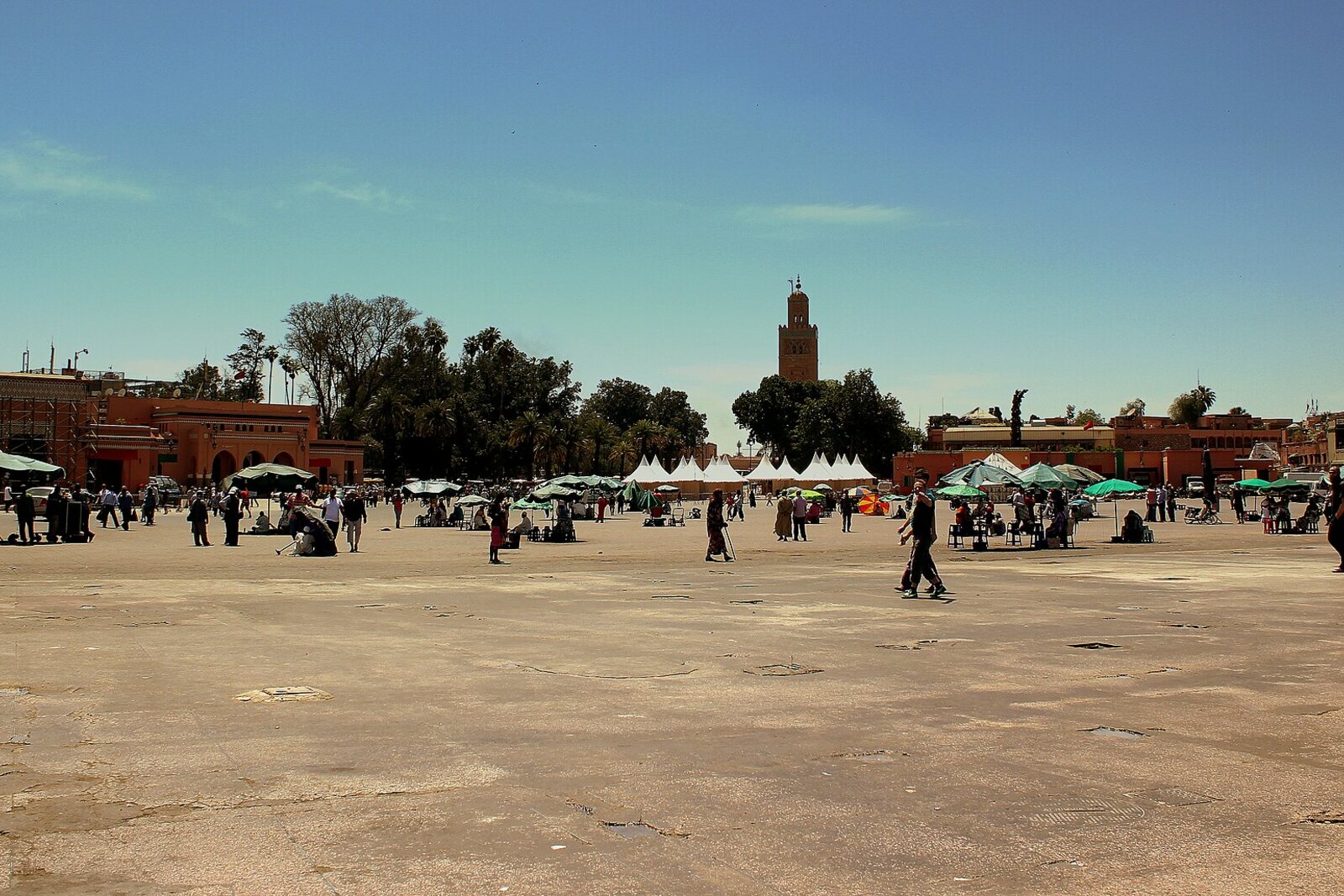
Look around first
What to notice
- Open pavement
- Circles of spectators
- The former bank building
The story of the place
There is no undisputed translation of the name Jemaa el-Fnaa. The word “jemaa” can mean an assembly or a Friday mosque, while “fnaa” is associated with death, destruction, and an open space in front of a building. The familiar translation, “assembly of the dead,” refers to public executions and the displayed heads of the condemned, but historians cannot prove that this is how the name originated.
There is another version. At the end of the sixteenth century, the Saadian sultan Ahmad al-Mansur—not Yaqub al-Mansur from the history of the Koutoubia Mosque—planned to build a large mosque here. According to a later chronicle, the ruler wanted to call it Jemaa el-Hna, the “mosque of tranquility.” After plague epidemics and the failures of the final years of his reign, construction was stopped. The unfinished mosque supposedly received the mocking name Jemaa el-Fnaa, the “mosque of destruction.” This is a historical hypothesis, not an established etymology. Neither the mosque itself nor any discernible foundations remain on the square today.
What remained was an open area between the roads, the entrances to the medina, and the souks. The flow of shoppers and visitors provided an income for people who did not need permanent premises. A storyteller, musician, or acrobat would begin performing, and spectators would close around them in a circle—a halqa. The performer lived on the money collected from this audience. If the circle broke up, so did the income. Such performances have been documented here since at least the seventeenth century.
In the mid-nineteen nineties, the municipality approved plans for an underground parking garage and a fifteen-meter building with a glass facade beside the square. The medina was already on the World Heritage List, and Jemaa el-Fnaa itself had been protected by Moroccan law since nineteen twenty-two. But the existing rules could protect walls and the outlines of the square; the work of a storyteller, dependent on open space and a constantly changing audience, was not regarded as a separate object of protection.
Juan Goytisolo, a Spanish writer who lived beside the square for part of each year and advocated preserving its oral arts, opposed the construction. He earned his living from printed novels, yet it was Marrakech's storytellers who changed his idea of literature. He devoted the final chapter of his novel Makbara to Jemaa el-Fnaa, then later read it in Madrid to draw attention to the threat facing the square. Goytisolo deliberately called the loss of one halayki—a professional storyteller or performer—a heavier loss than the death of two hundred bestselling authors: a book can be republished, but an unrepeated story disappears with the person.
At a meeting of the municipality, the writer asked for the plans to be reconsidered. In his recollection, the response was icy silence. Then, in January nineteen ninety-six, he gave the Director-General of UNESCO a proposal to declare Jemaa el-Fnaa “oral heritage of humanity.”
UNESCO had no such category. The organization's staff decided it could not be invented for a single Moroccan square: general rules were needed, under which states could protect stories, music, rituals, and crafts together with the setting where people pass them on. Goytisolo and Moroccan researchers prepared the materials, and in June nineteen ninety-seven specialists from different countries gathered in Marrakech. The performers themselves, whose work was being discussed, were barely involved in creating the new system.
The plans for the glass building and the underground parking garage were canceled. In nineteen oh one, Jemaa el-Fnaa became one of the first masterpieces of oral and intangible heritage proclaimed by UNESCO. Two years later, countries adopted an international convention on safeguarding intangible heritage; later, the square was transferred to its Representative List.
At the southern edge stands the building of the first Marrakech office of the State Bank of Morocco, built in nineteen twenty-two. In nineteen twenty-two, there was an attempt to protect the outlines of the square by law; a century later, the former bank was turned into Morocco's first museum devoted to its intangible heritage. Inside, it presents the history of the halqa and its performers. Outside, the glass structure never appeared, and circles of spectators still gather directly on the open pavement.
Useful on site
The public square is accessible during the day; after the 2025–2026 renovations, individual sections, paving, and the arrangement of rows may have changed. This stop is better in daylight.
Checked: June 30, 2026. Check the official source before visiting.Watch from the edge, without lingering where pedestrian flows cross. Do not rely on old photographs: the placement of stalls may change.