 Guide On Map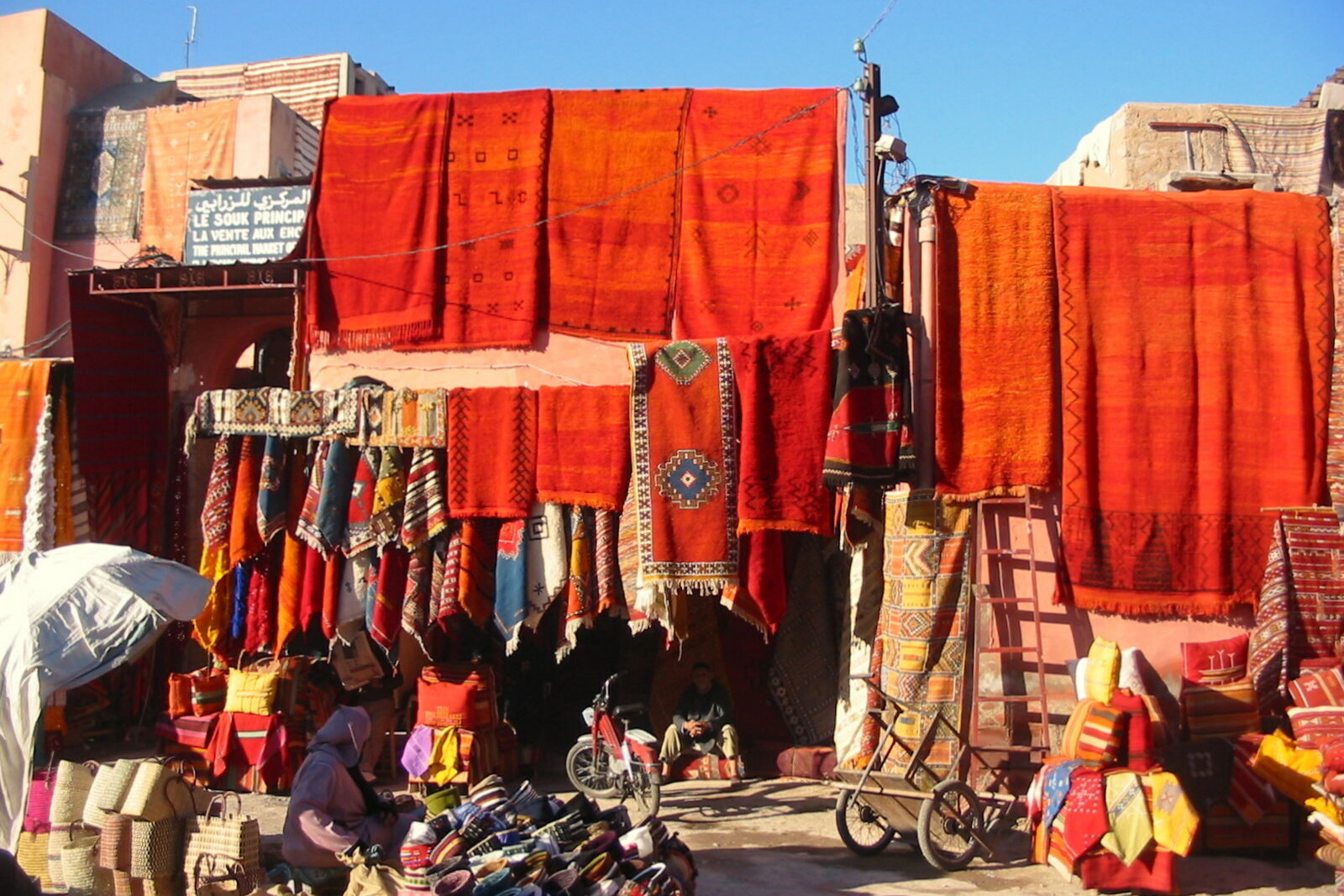
Look around first
What to notice
- Entrance inscription
- Two stone vessels
- Carpets along the walls
- Rolled lots
The story of the place
Wool was traded in this courtyard first; later, carpets took over the same space. Two stone vessels stand in the center, while rolled lots wait by the walls for merchants to gather toward evening. The broker lays out the goods by the vessels, takes bids, and hands the roll to whoever named the final price; in the shop, the purchase receives a price for the ordinary buyer.
In Moroccan, “Zrabi” means “carpets.” The inscription at the entrance calls this place the Main Carpet Market, and the small courtyard the Berber Sale. The name refers first and foremost to carpets woven in Amazigh, or Berber, settlements in the Atlas Mountains. At the sale itself, they are traded by urban brokers.
Toward evening, except on Fridays, a broker lays out carpets beside two large stone vessels in the center of the courtyard and offers them to merchants one at a time. Buyers name a price; the broker seeks the next bid because he receives a commission on a completed sale. The winner carries the carpet to his shop and sets a retail price there. So the goods change hands here even before meeting an ordinary buyer.
In eighteen eighty-two, the French doctor Adolphe Marçais saw almost the same procedure in this courtyard. At other times, wool and fabrics were sold here, while on Wednesdays, Thursdays, and Fridays, shortly before sunset, brokers led in people who had been enslaved.
Most were women. Some were brought with caravans across the Sahara, while others were abducted in Morocco itself. Buyers wanted maidservants, cooks, and concubines; brokers wanted a high bid and a commission. Each broker led up to three women around the courtyard: the first walked ahead, and the others followed her. A prospective buyer signaled and chose one.
The woman was made to stand or sit before him. The buyer examined her teeth, eyes, hands, and feet, asked her age and what she could do. Then he named a price or refused. In the latter case, the broker led her around the courtyard again and announced the latest bid to the next row of buyers. When bidders stopped topping the price, the deal was concluded, and the woman was taken away by a new owner. Her former family might not even know which city she had ended up in.
Witnesses from the early twentieth century described women with children and very young girls here. Almost no one recorded their names: reports listed their age, skills, appearance, and sale price. After the establishment of the French Protectorate in Morocco, public auctions of people were banned, although private trade disappeared more slowly.
Wool had been traded in this courtyard before, so carpets took its place. Now the broker follows the same circuit with a new or used carpet. When the bids end, the merchant takes the rolled lot to the shop. The courtyard and the auction procedure have survived; no names remain of the women who were once led here around the circle.
Useful on site
The public passage is open; the visibility of the carpet display depends on open shops and current trade. Zrabi's historical and commercial labels require local verification before the text is strengthened.
Checked: June 30, 2026. Check the official source before visiting.Ask for carpets to be unrolled only if you are seriously interested, and do not take a beautiful story as proof of age or origin. For an expensive purchase, ask separately about the material, condition, and delivery terms.