 Guide On Map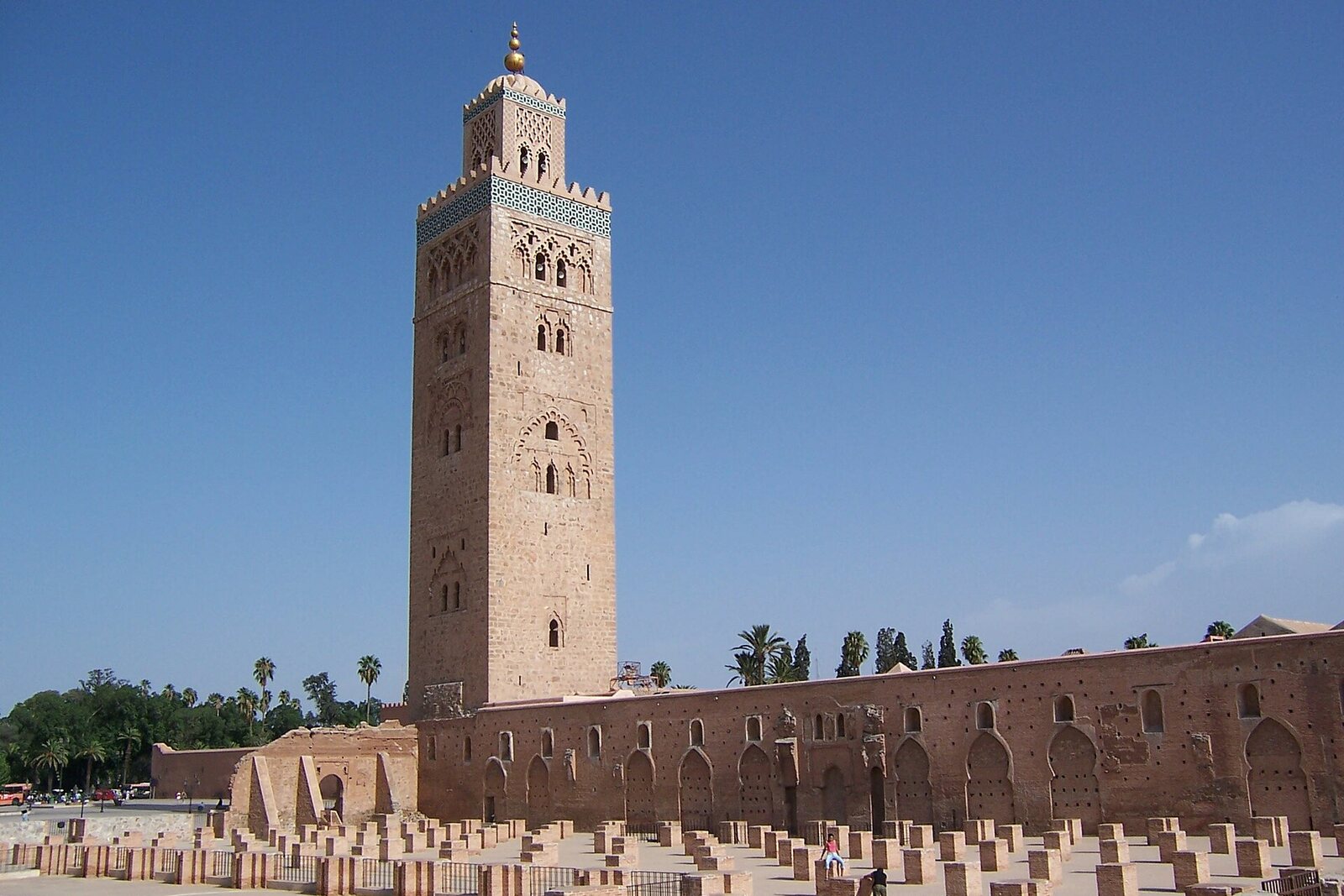
Look around first
What to notice
- Grid of low walls
- Column bases
- Filled-in arches
- Functioning mosque
The story of the place
A rectangular grid of low walls lies on the esplanade. The functioning Koutoubia Mosque stands beside it. For a long time, these foundations and the present mosque were considered two successive attempts: the first was supposedly demolished because of an error, and the second was built with more accurate alignment. The stones preserved a different story.
In eleven forty-seven, Abd al-Mu'min, leader of the Almohads, took Marrakech from the Almoravid dynasty. He declared the teachings of the former rulers erroneous, ordered their mosques closed or destroyed, and left the townspeople without their customary place for communal Friday prayer. Not everyone in his own army agreed with everything either: the new caliph was turning a religious movement into a hereditary dynasty and had already survived revolts by his companions.
Abd al-Mu'min built the new main mosque beside Qasr al-Hajar, the stone palace of the defeated rulers. The inhabitants of the conquered city, supporters of the former dynasty, and Almohads among whom the caliph still had opponents gathered here for the Friday sermon. That is why he entered from the palace by a covered passage, without showing himself to the crowd. Before he appeared, a wooden screen rose from slots in the floor. It separated the caliph from the worshippers and protected him.
On the other side of the prayer niche, they rolled out the minbar, the preacher’s stepped pulpit. Ali ibn Yusuf, the former Almoravid ruler of Marrakech, had commissioned it for the destroyed mosque. Abd al-Mu'min preserved the magnificent work of Cordoban craftsmen, but made it serve the victors: the minbar appeared before the people only when the new imam emerged. The pulpit itself survived and is now kept in El Badi Palace; the hidden passage and movable screen are no longer here.
The mosque quickly became too cramped. Before Abd al-Mu'min’s death in eleven sixty-three, builders broke ten wide arches through its prayer wall and added a second hall behind them, almost repeating the first. There were no doors in the arches: both halves formed one space. The new hall was turned only slightly, aligning it with the rising of Canopus, as the direction of prayer was then determined in the western Islamic world.
This is the source of doubt about the story of the erroneous first mosque. The second half is angled even farther south and, by modern calculation, is no more accurately directed toward Mecca. And the openings in the shared wall show that the old hall was intended for use together with the new one, not abandonment. For several centuries, worshippers passed through this wall, which now seems to be an outer wall.
The older half did not fall into decline until the second half of the seventeenth century. When craftsmen restored Koutoubia Mosque in the eighteenth century, they repaired the better-preserved hall, filled in the connecting arches, and left the ruined part without a roof. In nineteen twenty-three, the archaeologists Henri Basset, Henri Terrasse, and Jean Hainaut identified traces of the former openings in the blank wall and reconstructed the plan of the enormous double sanctuary. The low column bases on the esplanade mark the older half, while the hall beyond the filled-in arches continues to serve as a mosque.
The name remained from another group of people by its walls. “Koutoubia” comes from the word “kutubiyyin,” the name given to merchants in books and manuscripts. Their market stood beside the mosque. The stalls have disappeared, but the functioning hall and the open foundations of both its halves still bear the booksellers’ name.
Useful on site
Open city esplanade; the route reads the site from outside, without promising interior access to the mosque. The visibility of the brick traces depends on lighting and temporary barriers.
Checked: June 30, 2026. Check the official source before visiting.View the remains only from accessible paths, and do not go beyond barriers. The route does not promise interior access to the functioning mosque.