 Guide On Map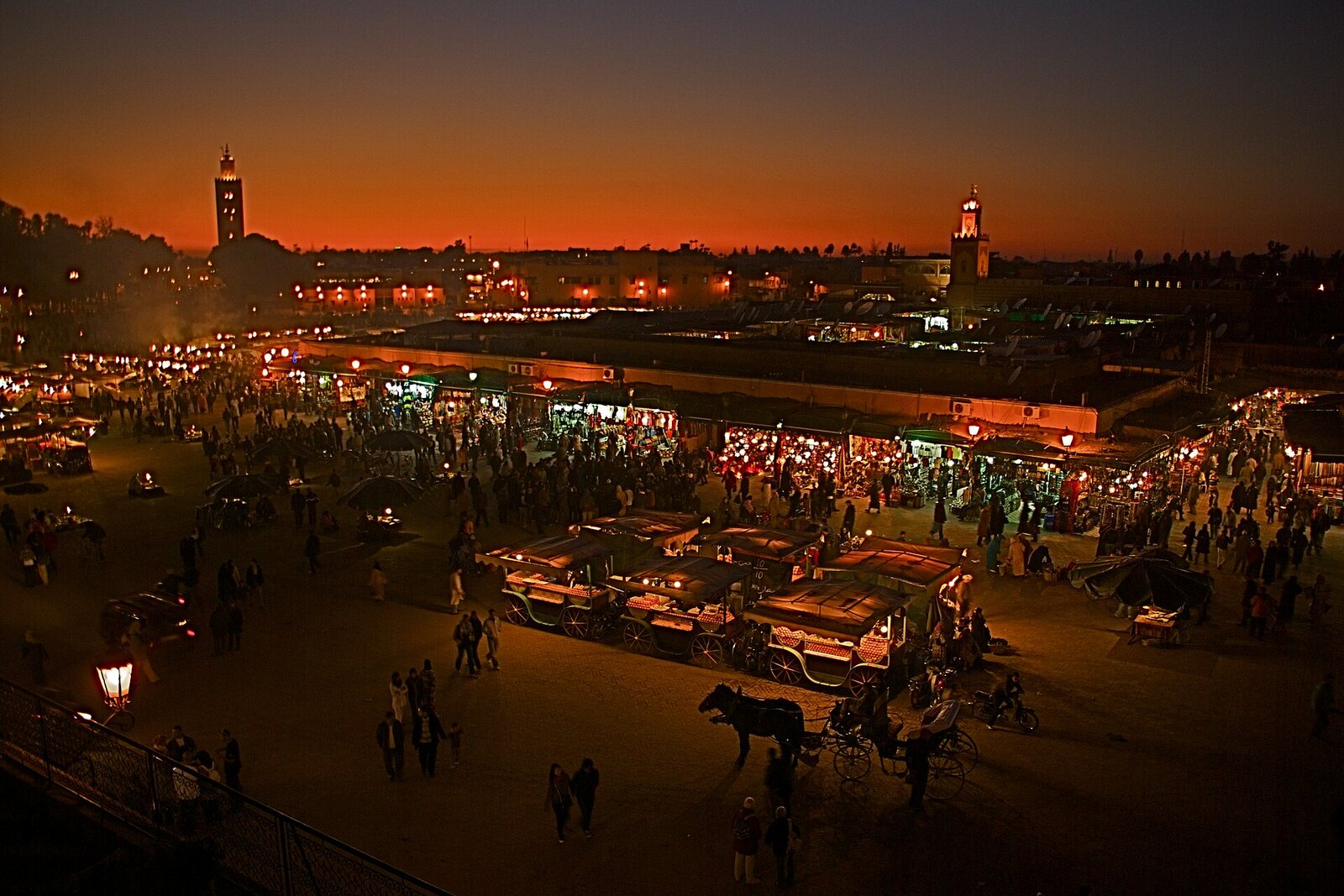
Look around first
What to notice
- Spectators’ circles
- Musicians
- Comedians
- Hats for collecting money
The story of the place
In the late nineteen sixties, ten-year-old schoolboy Mohammed Bariz wanted to tell stories on Jemaa el-Fnaa. To do so, he skipped classes and came to watch how the old masters held their listeners with gesture, voice, and pauses. His parents considered the halaiqi trade to be begging. Bariz’s father made cardboard bags and insisted that his son either study or bring earnings home.
At eleven, Mohammed ran away from home. He made it to Beni Mellal and spent more than a year and a half telling stories in the markets of nearby towns. The listeners’ coins were his only money. When the boy returned to Marrakech, his father allowed him to stay on one condition: every evening, his son had to give the family two and a half dirhams.
That money explains the form of the northern circles. There is no permanent stage or admission ticket here. The halaiqi stops passersby, and spectators close in around him—a ring like this is called a halqa. An assistant keeps the crowd from splitting the circle, narrows it for a storyteller or widens it for an acrobat, and before the end walks around its circumference with a hat. If the performer loses people’s attention beforehand, there will be no one to collect from.
After a year and a half in other towns’ markets, Bariz returned here and created his own halqa. When he began, twenty-six storytellers worked on the square. He had to win listeners away from every neighboring circle, but now storytelling could feed his family. Over time, Bariz memorized one hundred sixty-eight stories and became one of Morocco’s best-known storytellers.
He even turned cinema into a Jemaa el-Fnaa performance. During the two thousand ten Marrakech Film Festival, Bariz watched one film a day, then retold it here to people who had not found a seat in the theater. The film returned to the halqa’s setup: one person in the center, spectators around, and payment into a hat.
Bariz later called that same year, two thousand ten, the year of his final departure from the square. Of the original twenty-six storytellers, eight remained then. By two thousand twenty-two, he considered himself one of the last two traditional storytellers in Marrakech and performed only occasionally—in schools and cultural centers. None of Bariz’s five children continued the trade: their father did not want them to earn a living he himself called beggarly. The northern circles still close around musicians and comedians, but Bariz’s halqa of one hundred sixty-eight stories is no longer among them.
Useful on site
The public square is accessible all day; evening crowds are usually denser, but the exact arrangement of circles, rows, and lighting after recent work needs to be checked on site.
Checked: June 30, 2026. Check the official source before visiting.Do not push your way into the front row or block the view of those already listening. Ask permission before filming up close; it is customary to leave a reward for watching a full performance.